
Few buildings have been painted as often, or as lovingly, as the great cathedrals of Europe. For centuries they were the tallest things most people ever saw, and artists returned to them again and again: to their towers seen across a river, to their west fronts crowded with carving, and to the strange, cool light of their naves. A cathedral painting does something few other pictures can. It brings a sense of scale and stillness into an ordinary room. This guide looks at some of the best cathedral paintings in the FrameAnyPhoto collection, what makes each one special, and how to choose and frame one for your home.
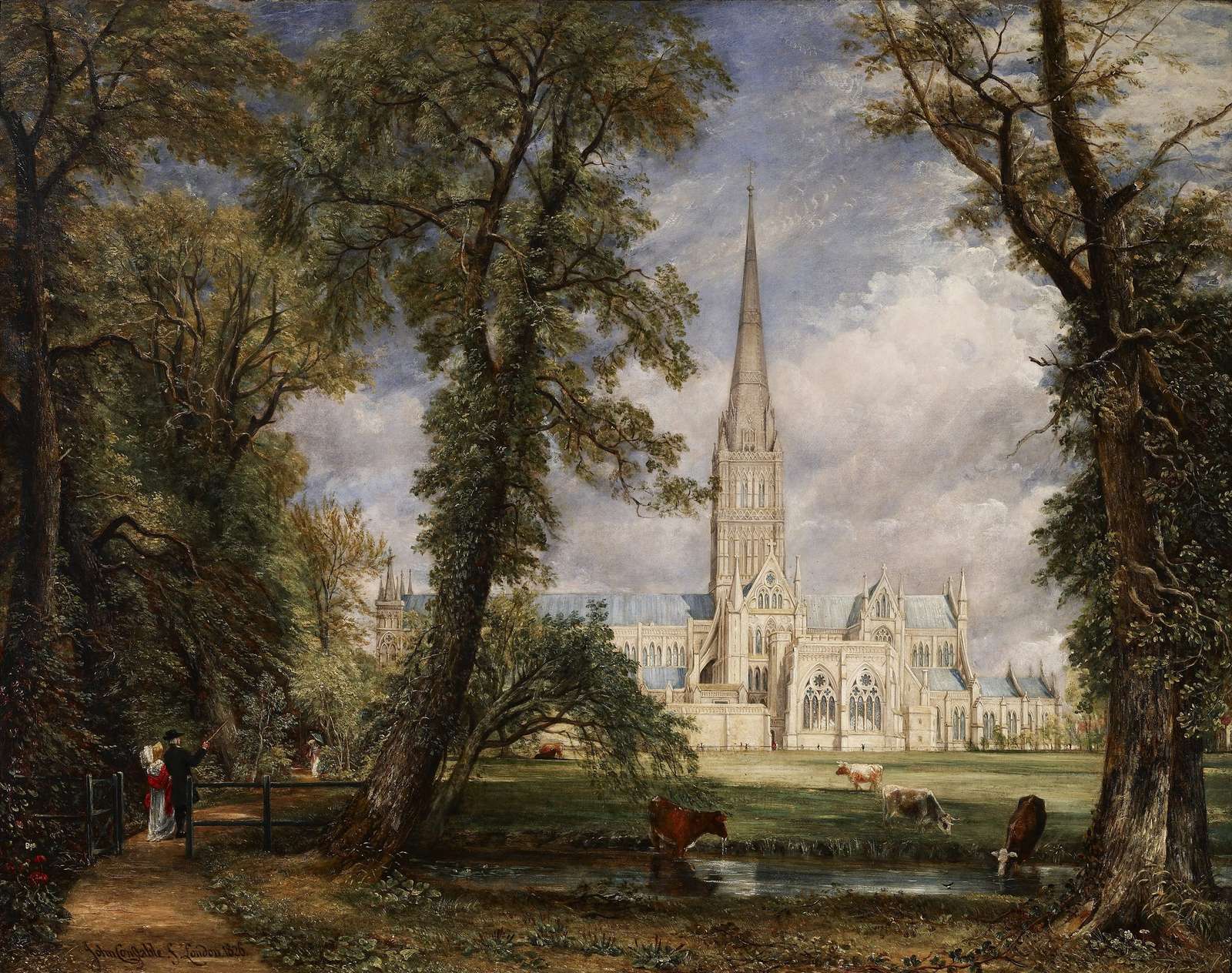
Constable’s Salisbury: a cathedral framed by trees
John Constable is best known for the farms and rivers of Suffolk, but Salisbury Cathedral became one of his signature subjects. His friend John Fisher was the nephew of the Bishop of Salisbury, and the bishop commissioned a view of the cathedral from the grounds of his own palace. Constable exhibited the first version at the Royal Academy in 1823 and painted further versions afterward. The bishop is reported to have disliked the dark clouds in the first picture, and the later versions open the sky.
Salisbury Cathedral from the Bishop’s Garden, the version in the Frick Collection, shows why the composition was so popular. Tall trees arch over the scene like the vaulting of a nave, cattle drink in the foreground, and the pale spire rises in the middle distance. It is a church painting that feels like a landscape, which makes it unusually easy to live with. It sits comfortably in a living room or study, with no sense of solemnity.
The cathedral as a dream: Cologne before it was finished
Cologne Cathedral was begun in 1248, but work stopped in the sixteenth century and the building stood unfinished for roughly three hundred years, a medieval crane famously left on its south tower. In the early nineteenth century, as Romantic enthusiasm for the Gothic grew, German painters began to imagine what the finished church would look like. Construction resumed in 1842 and was completed in 1880.
Carl Hasenpflug’s Ideal View of Cologne Cathedral (c. 1834–1836) belongs to that moment of anticipation. He painted the cathedral complete, its twin spires rising above the city, years before anyone had seen them. It is architecture as hope, and it makes a striking vertical picture for a stairwell, hallway or any narrow stretch of wall that needs height.
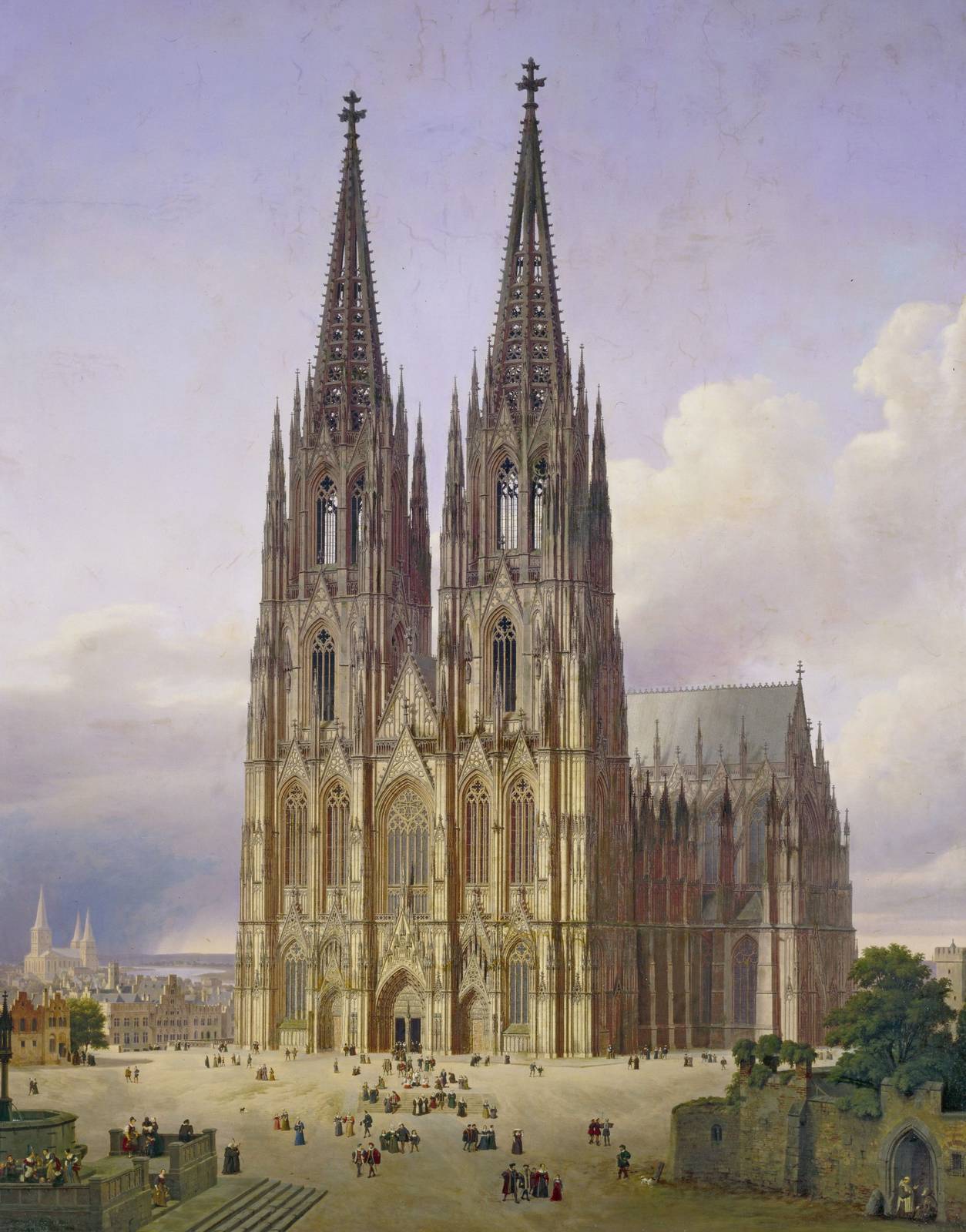
A cathedral painting brings a sense of scale and stillness into an ordinary room.
Inside the nave: light, stone and silence
Painters of church interiors faced a particular challenge: how to convey enormous height and depth on a flat canvas. In seventeenth-century Holland, Pieter Jansz. Saenredam made this his life’s work. He painted the whitewashed churches of the Dutch Republic, above all St Bavo’s in his home city of Haarlem, and he based his paintings on careful measured drawings made on site. The result, seen in Interior of St Bavo’s Church, Haarlem, is a calm, almost abstract space of pale columns and soft light. Saenredam’s interiors suit modern rooms surprisingly well; their restraint reads as minimal rather than old-fashioned.
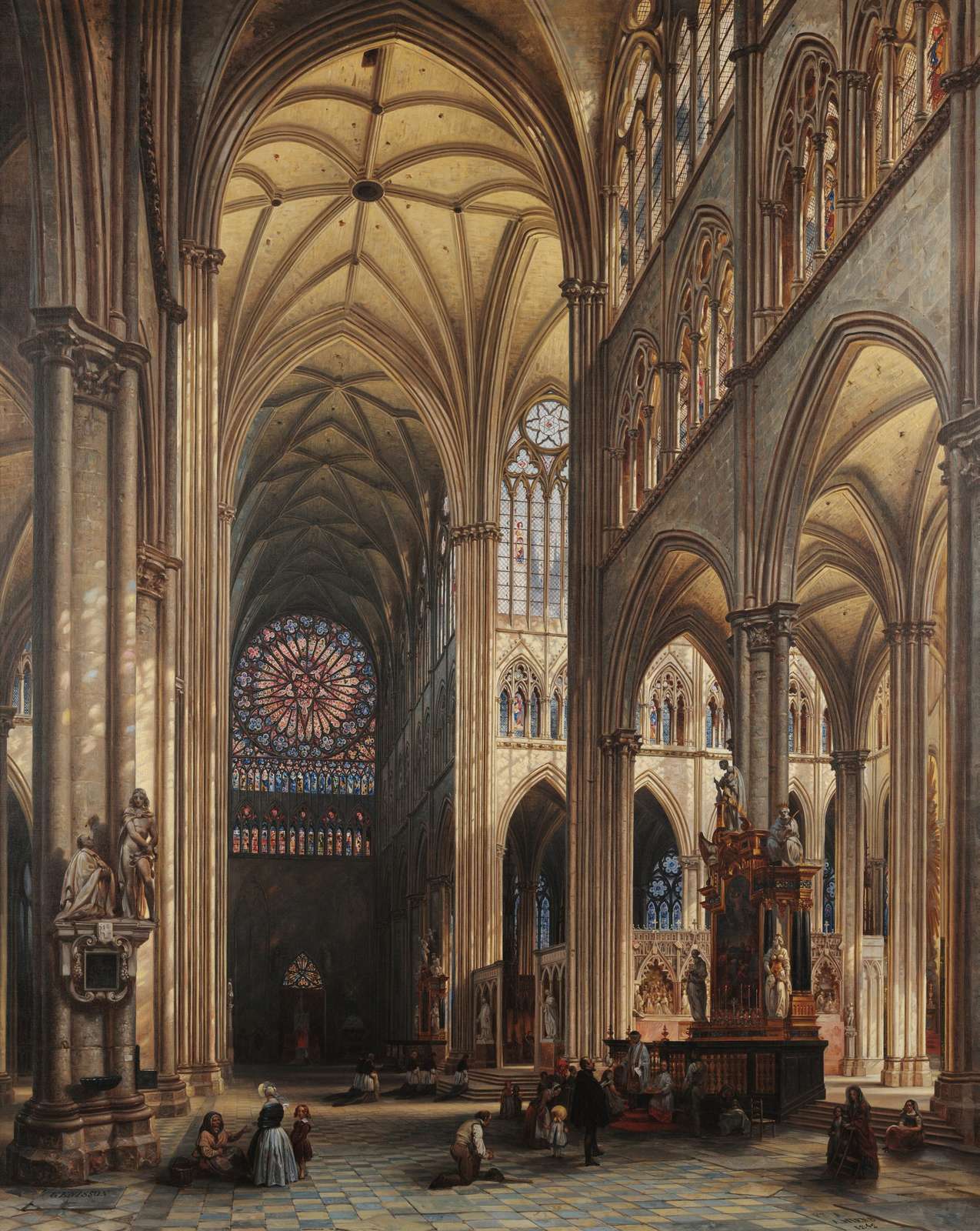
Two centuries later the Belgian painter Jules Victor Génisson took the opposite approach. His Interior of Amiens Cathedral (1842) is all soaring height and warm, golden light falling through a forest of piers. Amiens is one of the largest Gothic cathedrals in France, and Génisson makes you feel it. If you love the drama of a great church rather than its quiet, this is the picture to look at.
Cathedral fronts and city skylines
Some of the most satisfying cathedral pictures are really city views, with the church as anchor. Canaletto spent roughly a decade in England from 1746, painting London for English patrons, and his St. Paul’s Cathedral (c. 1754), now at the Yale Center for British Art, shows Wren’s dome with the crisp clarity he brought to Venice. It is an elegant choice for anyone with a London connection.
The Scottish painter David Roberts, later famous for his views of Egypt and the Holy Land, painted the West Façade of Reims Cathedral (c. 1825–1830), the church where French kings were traditionally crowned. Its tall format and dense carving make it a natural portrait-orientation piece. Benjamin Williams Leader, who was born in Worcester, painted his hometown’s Worcester Cathedral (1894), a wide, peaceful landscape now at the Chazen Museum of Art. And for something moodier, Arkhip Kuindzhi, the Russian painter later celebrated for his moonlit landscapes, painted Saint Isaac’s Cathedral by Moonlight (c. 1869), its great dome glowing in the night over St Petersburg.
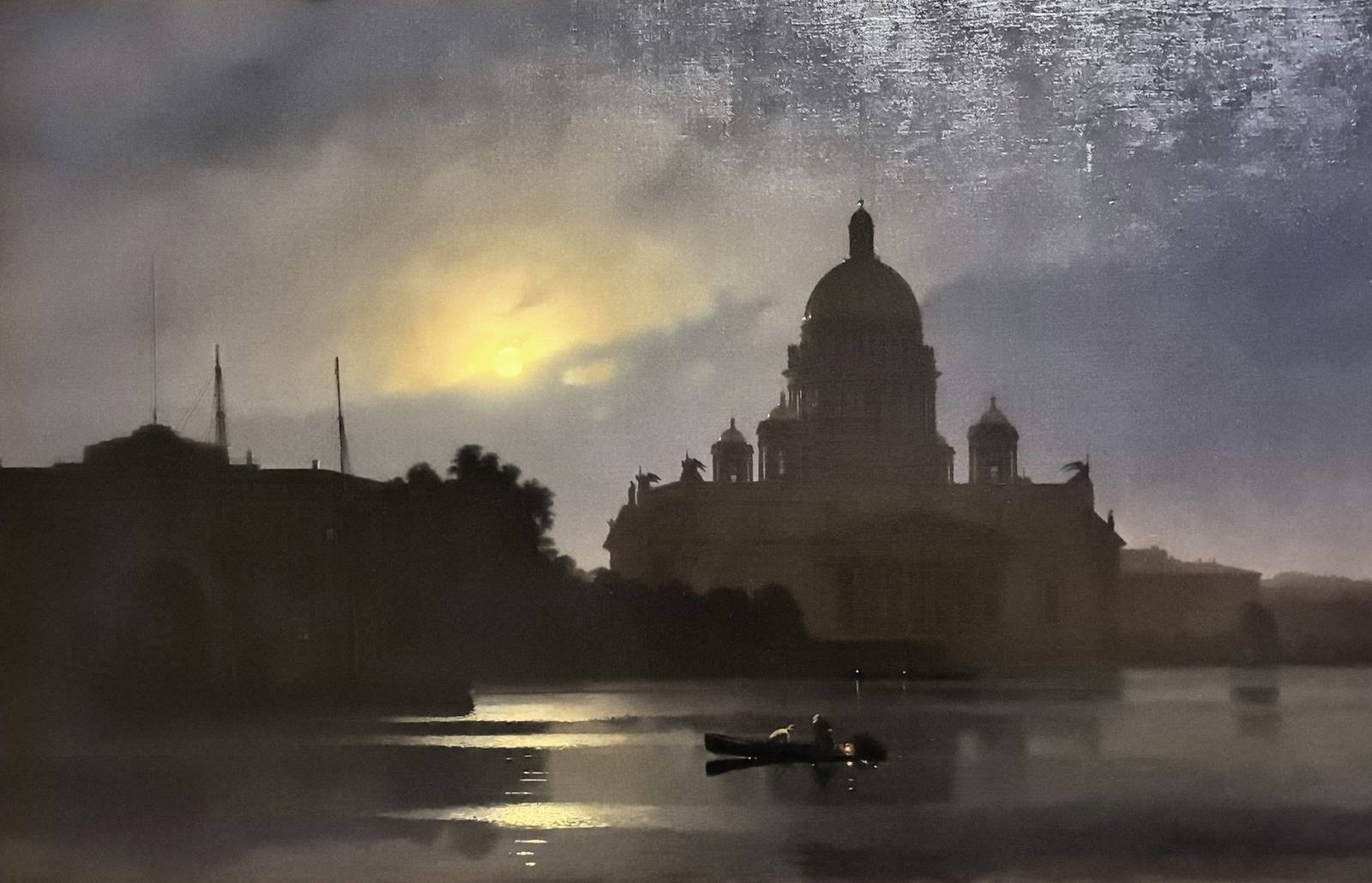
The best cathedral pictures are often city views, with the church as their anchor.
Choosing a cathedral print for your room
Start with shape. Cathedral façades and interiors are usually tall, which suits stairwells, hallways, the space between two windows or a narrow wall beside a bookcase. Riverside and skyline views, like Leader’s Worcester or Kuindzhi’s moonlit St Isaac’s, are wide and work above a sofa, bed or sideboard.
Then think about mood. Constable and Leader feel pastoral and relaxed; Saenredam is quiet and contemplative, a good fit for a study or reading corner; Génisson and Hasenpflug are grand and romantic, and they reward a wall where they can be seen from across the room. Kuindzhi’s night scene is wonderful in a dining room or anywhere lit in the evening.
Size and frame
Every FrameAnyPhoto print comes framed and ready to hang, in three sizes at $195, $295 and $395, with free shipping in the US. The exact dimensions follow the proportions of each painting, so a tall façade and a wide river view will differ; each work page shows the measurements for every size. For detailed architecture, the larger sizes let you read the tracery and carving from across the room, while a small print works well in a pair or a group.
The gilded Wood Ornament frame suits most of these paintings beautifully, echoing the gold of an old museum frame, and it is especially at home with Constable, Canaletto and the candlelit interiors. The Black Metallic frame gives the same pictures a cleaner, more architectural look that fits modern rooms, and at the largest size it is often the only option. Each work page shows which frames are available at each size.
You can browse the full collection of cathedral paintings and prints, from Venice and Vienna to Canterbury and Milan, and find the church, and the city, that means the most to you.