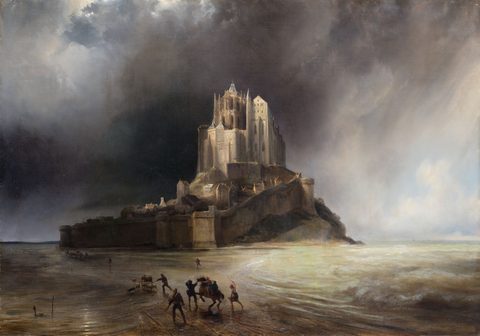
Mont Saint-Michel in a Storm
Théodore Gudin, 1830
A shaft of light strikes the abbey-fortress of Mont Saint-Michel as storm clouds roll in over the bay.
About this work
A shaft of light breaks through dark storm clouds to strike the abbey and fortified village of Mont-Saint-Michel, while waves churn across the bay around the rock, in Le Mont Saint-Michel sous l'orage by Théodore Gudin, dated 1830. The image comes from the heritage collections of Montpellier. Mont-Saint-Michel is a tidal island about a kilometre off the coast of Normandy at the mouth of the Couesnon River. A monastery was founded there in the eighth century, and the Benedictine abbey that crowns the rock was built and rebuilt over the following centuries, its walls withstanding English sieges during the Hundred Years' War. After the French Revolution it served as a prison until 1863. The famous tides of the bay, among the strongest in Europe, can rise and fall by more than 14 metres, and the rock is a UNESCO World Heritage Site. Gudin, born in Paris in 1802, studied with Anne-Louis Girodet and became the leading French marine painter of his generation. In 1830 he was named, with Louis-Philippe Crépin, one of the first two official Painters of the Navy, and he later served as court painter to Louis-Philippe and Napoleon III. He died in 1880.
Sources: Wikimedia Commons · Wikipedia: Mont-Saint-Michel · Wikipedia: Théodore Gudin
FAQ
Where can I buy a framed print of Mont Saint-Michel in a Storm?
Here. Mont Saint-Michel in a Storm is available as a framed print in three sizes: Small (20 × 14 in) for $195, Medium (24 × 17 in) for $295 and Large (36 × 25 in) for $395. Prices include the frame and US shipping; delivery takes 14–21 days, with 30-day returns.
What size works best for Mont Saint-Michel in a Storm?
The file is 5,600 × 3,920 px, so every size is sharp: even Large (36 × 25 in) prints at 156 ppi. Choose Large (36 × 25 in) for a large wall; Small (20 × 14 in) suits a narrower space.
Is it legal to print Mont Saint-Michel in a Storm?
Yes. This painting is in the public domain: Théodore Gudin died in 1880, so its copyright expired long ago. In the United States a faithful photograph of a public-domain painting does not create a new copyright (Bridgeman v. Corel, 1999), so the image can be printed and sold freely.

















