
No city has been painted more lovingly, or more often, than Venice. Built on islands in a shallow lagoon, threaded with canals instead of streets, and crowded with domes, bell towers and palaces that seem to float on their own reflections, it was a ready-made picture long before anyone set up an easel on a gondola. By the eighteenth century, painting the city had become a profession of its own, and the works those painters left behind are still the way most of us imagine Venice before we ever see it.
This guide walks through the great Venetian views in our Venice paintings collection, from Canaletto’s crisp, sunlit records of the 1730s to the moonlit and golden views of the nineteenth century, with notes on what to look for and how to hang them at home.
Venice was a ready-made picture long before anyone set up an easel on a gondola.
The view painters: what a veduta is
Italians call a detailed, largely faithful painting of a city a veduta, a “view,” and the painters who specialized in them vedutisti. Venice became the capital of the genre in the eighteenth century for a simple commercial reason: the Grand Tour. Young British aristocrats and other wealthy travelers ended their years of European travel in Venice, and they wanted to bring the city home. A large, precise painting of the Grand Canal was the souvenir of a lifetime, and the best painters could hardly keep up with demand.
Canaletto: the city in perfect daylight
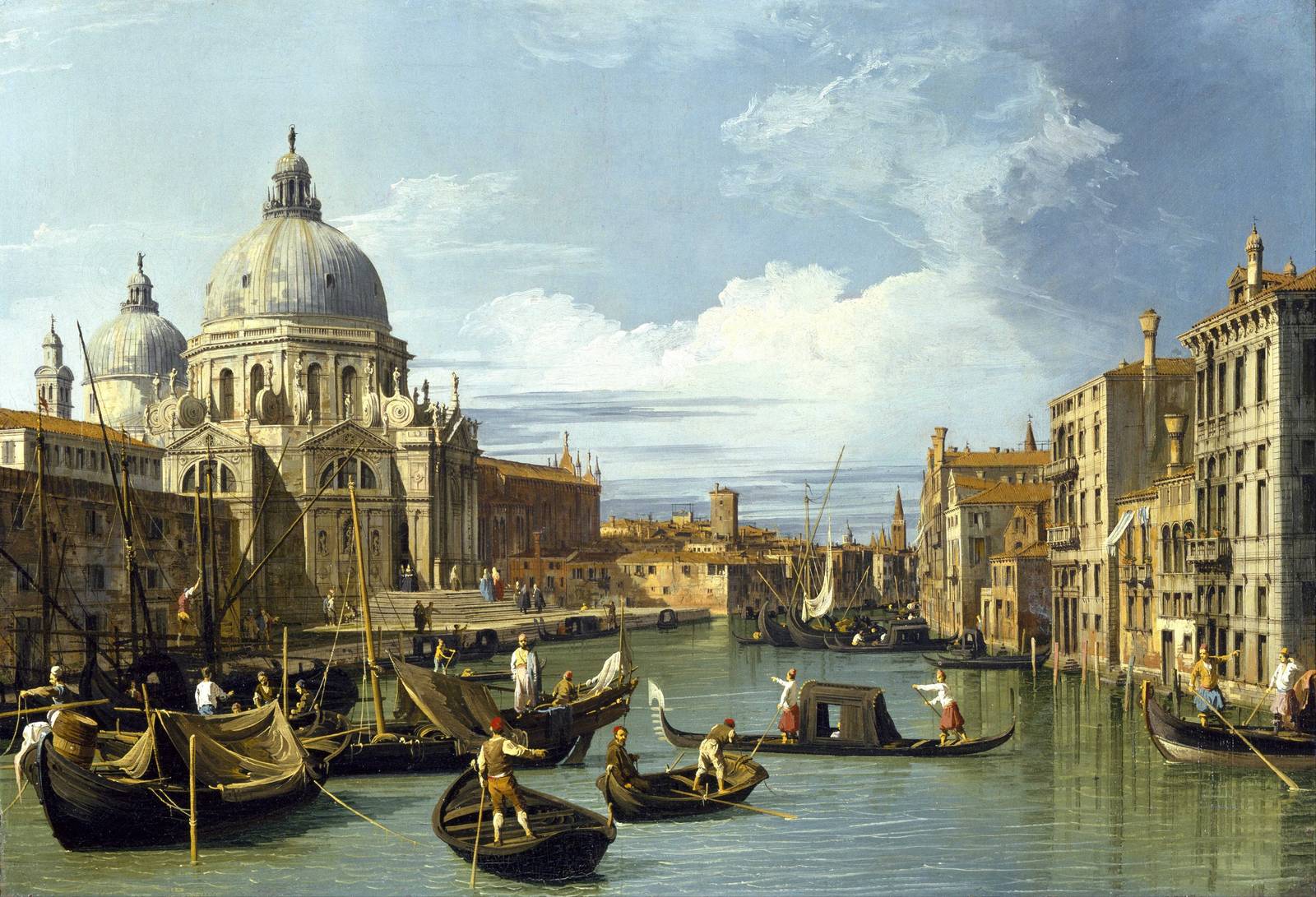
Giovanni Antonio Canal, known as Canaletto (1697–1768), is the name most closely tied to Venetian views. The son of a theater-scenery painter, he brought a stage designer’s command of space to the city’s canals and squares, and he became the favorite painter of British collectors, many of whom bought through Joseph Smith, the English merchant and later consul who lived in Venice. When the War of the Austrian Succession cut off much of that tourist trade, Canaletto followed his customers to England in 1746 and spent most of the next decade painting London and English country houses.
His Entrance to the Grand Canal, from about 1730, shows the moment the canal opens into the broad basin of San Marco, with the great domed church of Santa Maria della Salute on the right. The light is clear and even, the water a calm blue-green, and every cornice and mooring post is drawn with care. Scholars have long debated how much Canaletto relied on optical aids such as the camera obscura, but his views were never simple tracings: he freely adjusted angles, widened spaces and combined viewpoints to make a scene read better than the real place could from any single spot.
A large, precise painting of the Grand Canal was the souvenir of a lifetime.
Bernardo Bellotto: the nephew who took the view north
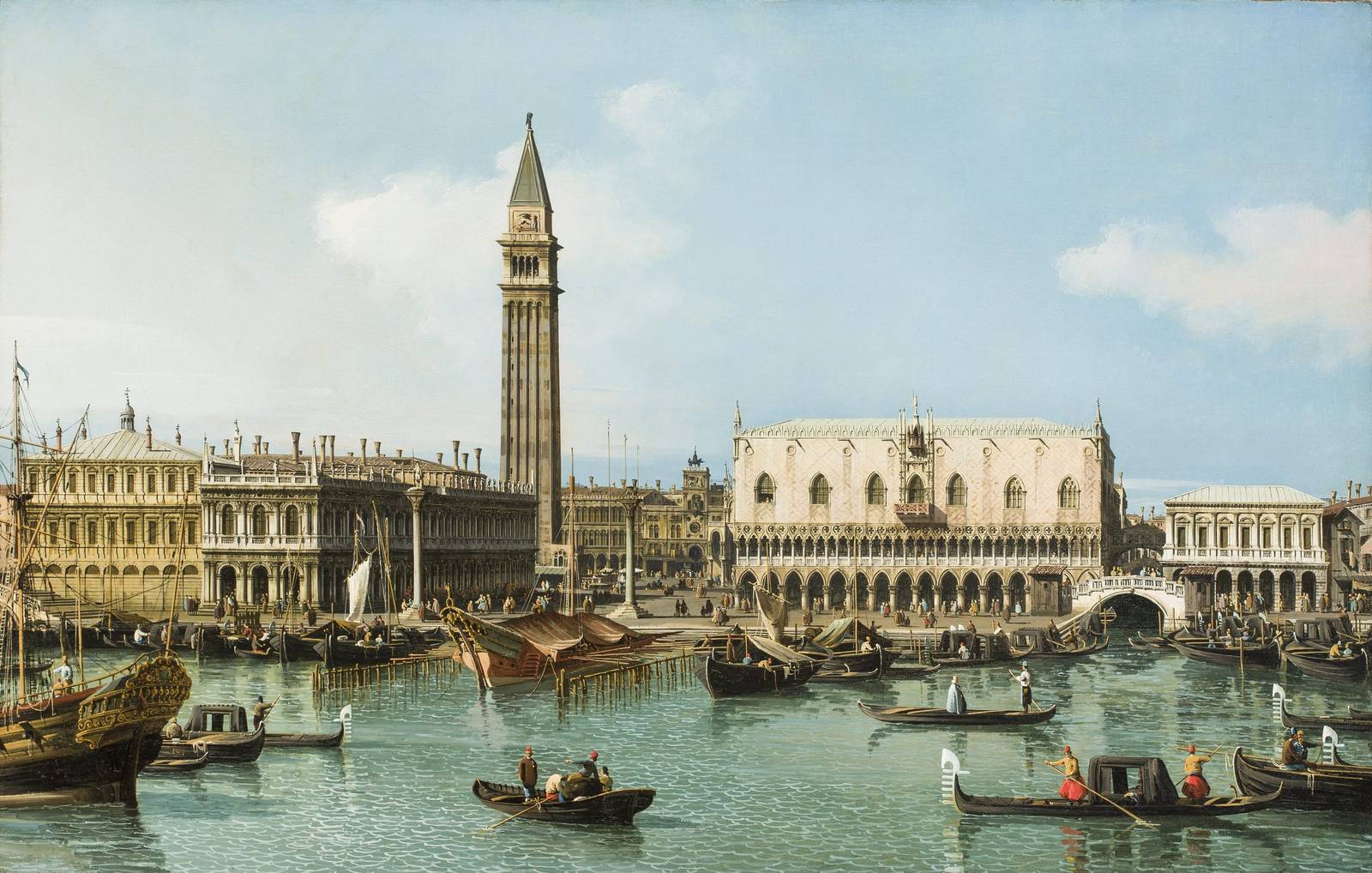
Bernardo Bellotto (1722–1780) was Canaletto’s nephew and trained in his uncle’s studio, and his early Venetian work can be hard to tell apart from Canaletto’s. Look closer, though, and Bellotto’s pictures tend to be cooler in color, with deeper shadows and a slightly heavier, more sculptural sense of light. In The Molo from the Basin of San Marco, painted around 1740, we look from the water toward the waterfront of the Doge’s Palace, the political heart of the Venetian Republic, with ships and gondolas crowding the foreground.
Two more of his Venetian canvases show his range. The Grand Canal with the Salute and the Dogana, about 1743, takes in the same famous corner of the city Canaletto loved, while Rio dei Mendicanti and the Scuola Grande di San Marco, around 1740, turns away from the tourist postcard to a quieter canal in the north of the city, beside the marble façade of one of Venice’s great confraternity buildings. Bellotto left Italy in 1747 and spent the rest of his career as a court painter in Central Europe, chiefly in Dresden and later in Warsaw. His view of Pirna, a small town on the Elbe near Dresden, shows how he carried the Venetian view-painting method to an entirely different landscape.
Francesco Guardi: Venice in a shimmer
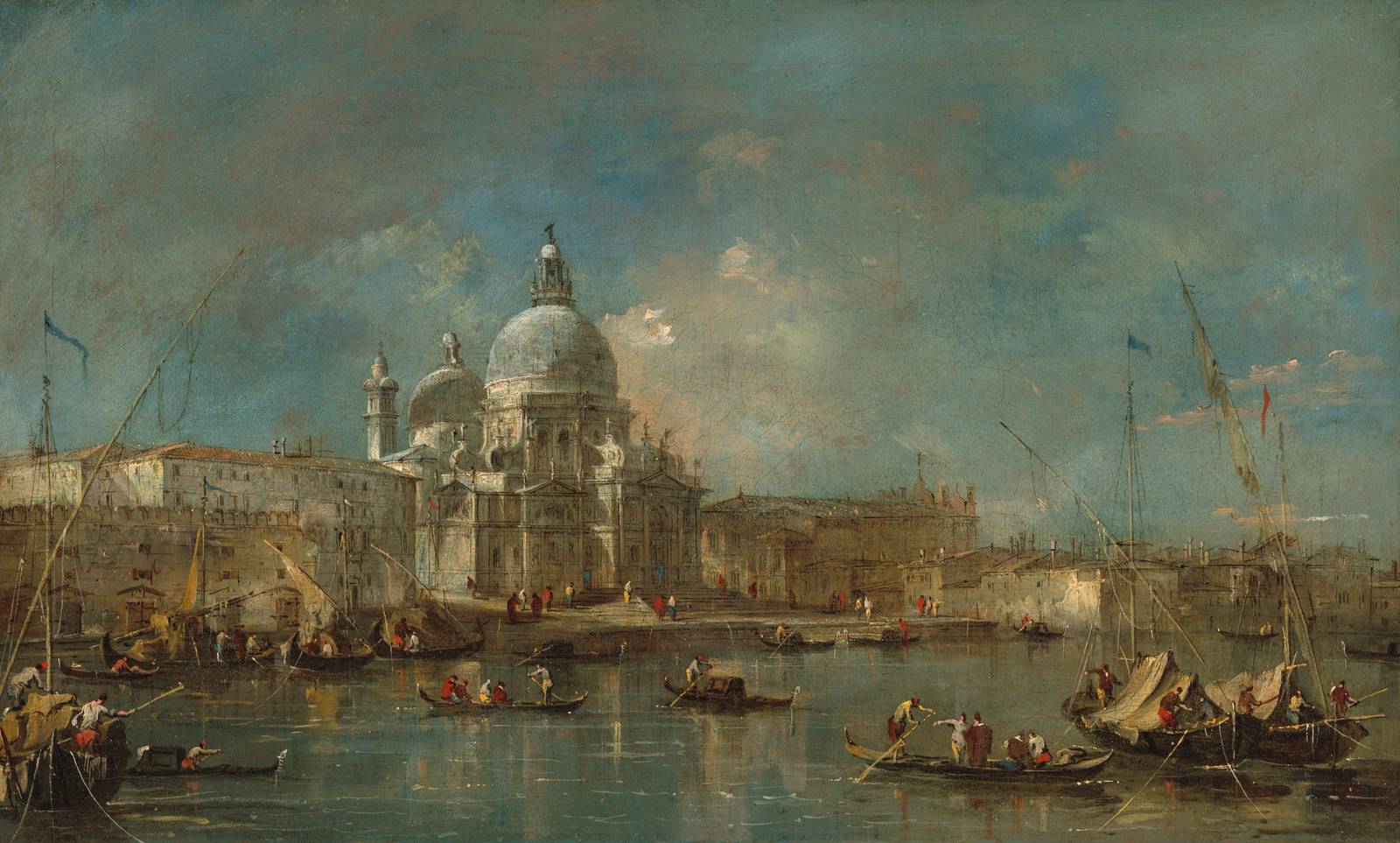
If Canaletto painted Venice as a well-ordered stage, Francesco Guardi (1712–1793) painted it as a mood. Working a generation later, when the Venetian Republic was in its final decades, Guardi used quick, flickering touches of paint for figures and boats, letting buildings dissolve into hazy light and silvery water. Collectors at the time often preferred Canaletto’s clarity, and Guardi’s reputation rose much later, when nineteenth-century viewers came to value atmosphere over precision.
His Santa Maria della Salute, from about 1770, shows the church that appears in nearly every painting in this guide. The Salute was begun in 1631 as a thanksgiving for the end of a devastating plague, designed by the architect Baldassare Longhena, and its great white dome and scroll-like buttresses still mark the entrance to the Grand Canal. Beside it, at the tip of the island, stands the old customs house, the Dogana da Mar, crowned by a golden globe. Once you know these two landmarks, you will spot them again and again.
The nineteenth century: golden light and moonlight
The Republic fell to Napoleon in 1797, but Venice never lost its hold on painters. In the nineteenth century, arriving now by steamship and, from the 1840s, by the railway causeway across the lagoon, artists from all over Europe came to paint it, and many favored warmer, more romantic effects than their predecessors.
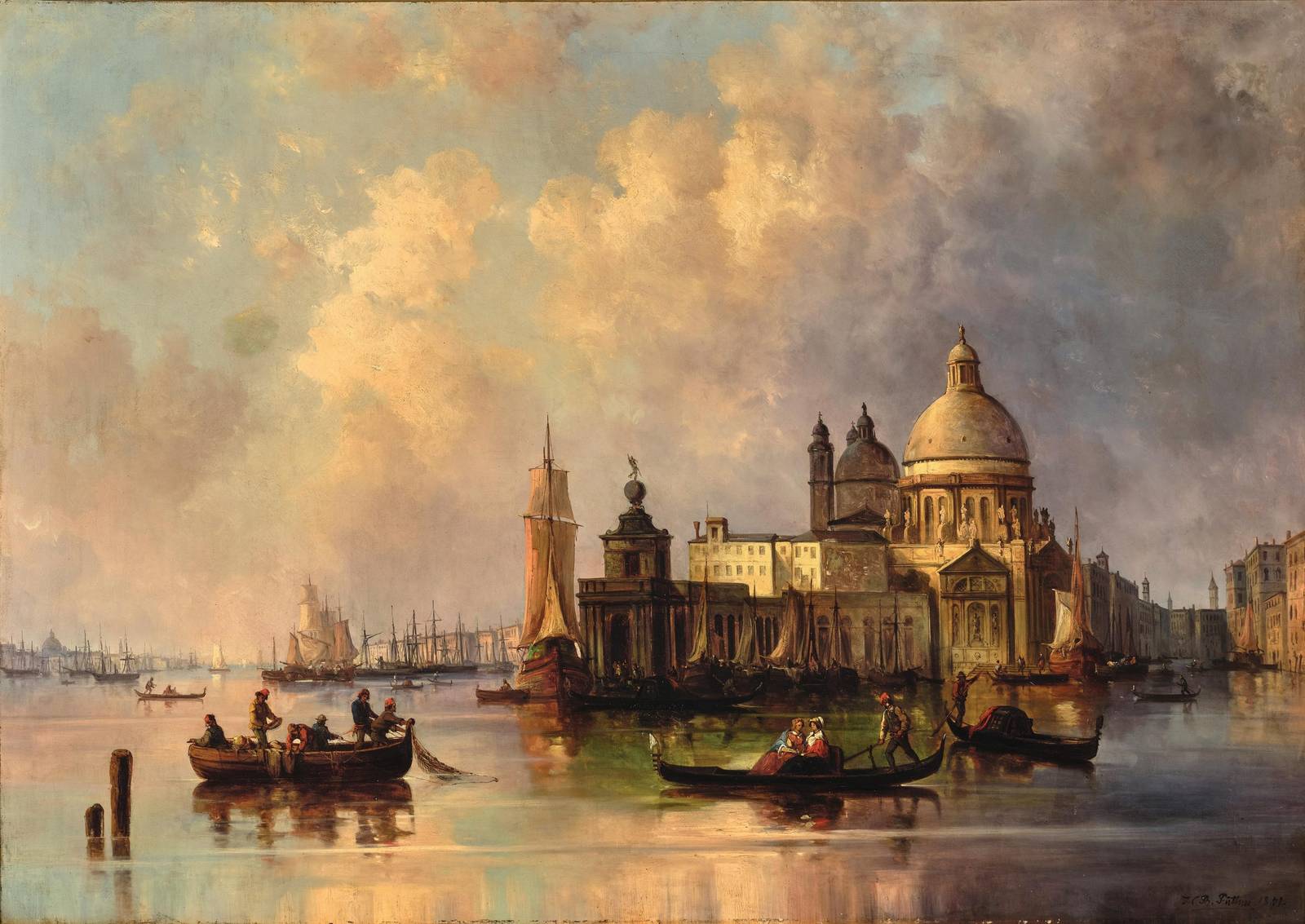
The Austrian painter Josef Püttner’s Venice, View of Santa Maria della Salute of 1871 sets the Salute and the Dogana beneath towering golden clouds, with gondolas in the foreground. Giovanni Grubacs’s Grand Canal from the Ponte dell’Accademia takes one of the city’s classic viewpoints, looking down the canal past palazzi toward the Salute dome. San Simeone Piccolo, from the circle of the Austrian painter Karl Kaufmann, shows the green-domed church that now faces the railway station, and Francesco Zanin’s Island of San Giorgio Maggiore looks across the lagoon to Andrea Palladio’s white church and its campanile.
For a different hour entirely, the English painter Henry Pether, a specialist in moonlit scenes, gives us San Giorgio Maggiore in Moonlight, the same island silhouetted against a pale night sky. If night scenes appeal to you, our guide to moonlight paintings has more.
Once you know the Salute and the Dogana, you will spot them again and again.
How to choose and hang a Venice painting
- Pick your Venice. Canaletto and Bellotto give you crisp detail that rewards close looking, which suits a hallway, study or dining room where people stand near the wall. Guardi and the nineteenth-century painters read more as atmosphere and work well across a living room.
- Mind the shape. Most Venetian views are wide. Hang one horizontal view above a sofa, sideboard or bed, where its width echoes the furniture beneath it.
- Make a pair. Two views of the same landmark make an elegant pair: try Canaletto’s and Püttner’s takes on the Salute, painted almost 150 years apart, or Zanin’s daytime San Giorgio beside Pether’s moonlit one.
- Choose the frame by light. Gold frames pick up the warm stone and sunlight in Canaletto and Püttner; a black or dark wood frame suits Pether’s night scene and Bellotto’s cooler palette.
- Size it. Every work comes framed and ready to hang in up to three sizes, Small at $195, Medium at $295 and Large at $395. We print each painting at its true proportions without cropping, so exact dimensions are listed on each work page.
A Venice painting also makes a lovely gift for someone who has been there, or who has always wanted to go. For more city views, browse our Italy paintings and harbor paintings, or explore the full Canaletto page.