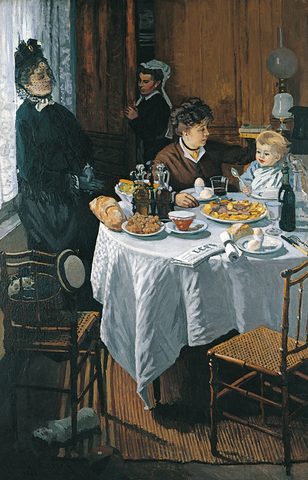
The Luncheon
Claude Monet, 1868
A table set outdoors. Shade and appetite.
About this work
The Luncheon (Le Déjeuner) is a large oil on canvas, 231.5 by 151.5 centimetres, painted by Claude Monet in 1868. It belongs to the Städel Museum in Frankfurt (inventory SG 170). The picture shows a family meal laid on a white tablecloth: Monet's companion Camille Doncieux and their young son Jean sit at the table, with a visitor by the window and a maid at the door, and the morning light falls across the bread, eggs and fruit. Monet painted it in Étretat on the Normandy coast, where the family spent the winter of 1868 to 1869. He submitted it to the Paris Salon of 1870, and the jury rejected it. Oscar-Claude Monet was born in Paris in 1840 and raised in Le Havre. He became the founder of Impressionism and its most consistent practitioner, painting nature as he perceived it and working outdoors whenever he could. The movement took its name from his Impression, Sunrise, shown in 1874 at the first Impressionist exhibition, which he and like-minded artists organised as an alternative to the Salon. The Luncheon belongs to the years just before that break, when Monet was still trying to win acceptance with large figure paintings of modern life.
Sources: Wikimedia Commons · Wikidata: The Luncheon · Wikipedia: Claude Monet
FAQ
Where can I buy a framed print of The Luncheon?
Here. The Luncheon is available as a framed print in three sizes: Small (13 × 20 in) for $195, Medium (15 × 24 in) for $295 and Large (23 × 36 in) for $395. Prices include the frame and US shipping; delivery takes 14–21 days, with 30-day returns.
What size works best for The Luncheon?
The file is 2,501 × 3,893 px. Medium (15 × 24 in) is the largest size that prints at 150 ppi or more (162 ppi), the sharpest choice for close viewing; Large (23 × 36 in) prints at 108 ppi, fine from a few feet away but softer up close.
Is it legal to print The Luncheon?
Yes. The Luncheon is in the public domain: its copyright, if it ever had one, expired long ago. In the United States a faithful photograph of a public-domain painting does not create a new copyright (Bridgeman v. Corel, 1999), so the image can be printed and sold freely.

















