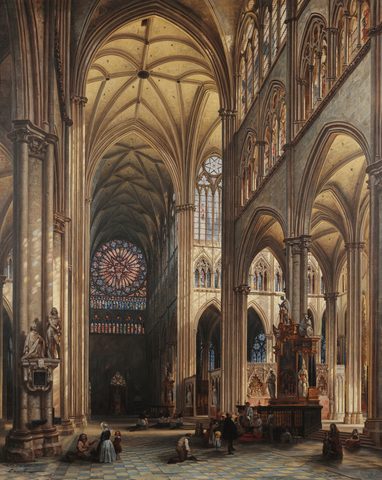
Interior of Amiens Cathedral
Jules Victor Génisson, 1842
Amiens opens like a canyon of stone. Daylight rides the nave. No crypt, no martyrdom—just height and clear air.
About this work
The Belgian painter Jules Victor Génisson painted this Interior of Amiens Cathedral in 1842. The oil on canvas belongs to the Pinacoteca do Estado de São Paulo in Brazil. The tall canvas looks down the vaulted nave toward a rose window, conveying the height of one of the great Gothic interiors. Génisson lived from 1805 to 1860. Amiens Cathedral stands on a slight ridge above the River Somme in Picardy, about 120 kilometres north of Paris. It was built almost entirely between 1220 and about 1270, a remarkably short time for a Gothic cathedral, which gives it an unusual unity of style. It is an early example of High Gothic and of the Rayonnant style, which appeared in its triforium and clerestory, begun in 1236, and in the enlarged high windows of the choir added in the 1250s. Its builders aimed to make the interior as large and as full of light as possible; by volume, about 200,000 cubic metres, it is the largest cathedral in France, more than double Notre-Dame in Paris. It has been a UNESCO World Heritage Site since 1981.
Sources: Wikimedia Commons · Wikipedia: Amiens Cathedral
FAQ
Where can I buy a framed print of Interior of Amiens Cathedral?
Here. Interior of Amiens Cathedral is available as a framed print in three sizes: Small (16 × 20 in) for $195, Medium (19 × 24 in) for $295 and Large (29 × 36 in) for $395. Prices include the frame and US shipping; delivery takes 14–21 days, with 30-day returns.
What size works best for Interior of Amiens Cathedral?
The file is 8,932 × 11,218 px, so every size is sharp: even Large (29 × 36 in) prints at 308 ppi. Choose Large (29 × 36 in) for a large wall; Small (16 × 20 in) suits a narrower space.
Is it legal to print Interior of Amiens Cathedral?
Yes. Interior of Amiens Cathedral is in the public domain: its copyright, if it ever had one, expired long ago. In the United States a faithful photograph of a public-domain painting does not create a new copyright (Bridgeman v. Corel, 1999), so the image can be printed and sold freely.

















