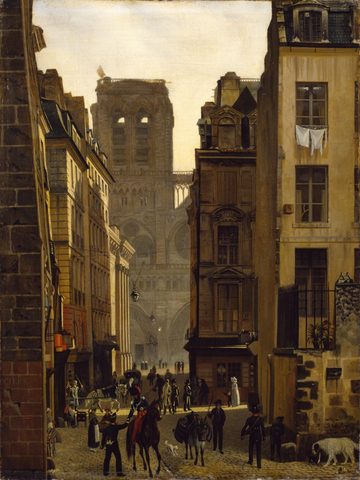
Rue Neuve-Notre-Dame in Paris
Eduard Gaertner, 1826
Notre-Dame closes the street like a cliff of stone. Gaertner packs daylight into every façade.
About this work
A narrow Paris street lined with tall houses leads straight to the towers of Notre-Dame Cathedral in this 1826 painting by the German artist Eduard Gaertner. The cathedral's west front fills the end of the street, pale against the sky, while the street below is busy with people, carts and horses. Sunlight catches some of the façades, and others fall into shadow.
Gaertner (1801–1877) was a German painter who specialized in pictures of urban architecture, and he became one of the leading painters of Berlin's streets and buildings. He painted this view during a stay in Paris early in his career. The image comes from the Brandenburg Museum's digital collection.
The tall, narrow format emphasizes the height of the houses and the cathedral, and the detailed street life rewards close looking. The image is 5706 × 7614 pixels in portrait format, ideal for large prints. It suits a hallway, a living room or a study, and is a lovely gift for anyone who loves Paris and Notre-Dame.
Sources: Wikimedia Commons · Wikipedia: Eduard Gaertner
FAQ
Where can I buy a framed print of Rue Neuve-Notre-Dame in Paris?
Here. Rue Neuve-Notre-Dame in Paris is available as a framed print in three sizes: Small (15 × 20 in) for $195, Medium (18 × 24 in) for $295 and Large (27 × 36 in) for $395. Prices include the frame and US shipping; delivery takes 14–21 days, with 30-day returns.
What size works best for Rue Neuve-Notre-Dame in Paris?
The file is 5,706 × 7,614 px, so every size is sharp: even Large (27 × 36 in) prints at 211 ppi. Choose Large (27 × 36 in) for a large wall; Small (15 × 20 in) suits a narrower space.
Is it legal to print Rue Neuve-Notre-Dame in Paris?
Yes. Rue Neuve-Notre-Dame in Paris is in the public domain: its copyright, if it ever had one, expired long ago. In the United States a faithful photograph of a public-domain painting does not create a new copyright (Bridgeman v. Corel, 1999), so the image can be printed and sold freely.

















