Liberation of Paris
U.S. Army Signal Corps, 1944
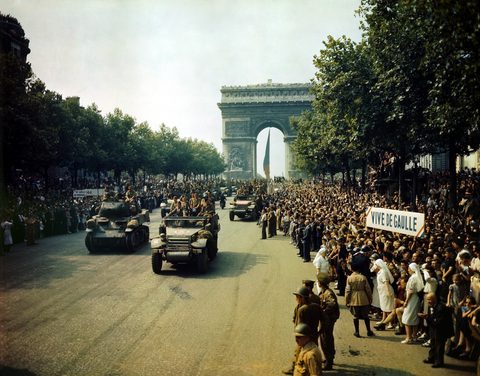
Crowds line the Champs-Élysées to watch Free French tanks and half-tracks after the liberation of Paris, 29 August 1944. U.S. Army Signal Corps photograph.
About this work
Crowds of Parisians line the Champs-Élysées to watch tanks and half-tracks of General Leclerc's Free French 2nd Armored Division pass the Arc de Triomphe in August 1944, just after the liberation of Paris. The photograph was taken by Jack Downey for the U.S. Office of War Information and is held by the Library of Congress (fsac.1a55001). Paris had been occupied by German forces since June 1940. On 19 August 1944 the French Resistance rose against the garrison, and the Allied command, which had planned to bypass the city, sent Leclerc's division and the U.S. 4th Infantry Division to its aid. The German commander, General Dietrich von Choltitz, surrendered on 25 August, having ignored Hitler's order to leave the city in ruins. The next day General Charles de Gaulle led a victory procession down the Champs-Élysées, and on 29 August the U.S. 28th Infantry Division paraded along the same avenue on its way to the front. The Champs-Élysées runs 1.9 kilometres from the Place de la Concorde to the Arc de Triomphe and is 70 metres wide.
Sources: Wikimedia Commons · Wikipedia: Liberation of Paris · Wikipedia: Champs-Élysées
FAQ
Where can I buy a framed print of Liberation of Paris?
Here. Liberation of Paris is available as a framed print in three sizes: Small (20 × 16 in) for $195, Medium (24 × 19 in) for $295 and Large (36 × 28 in) for $395. Prices include the frame and US shipping; delivery takes 14–21 days, with 30-day returns.
What size works best for Liberation of Paris?
The file is 7,282 × 5,704 px, so every size is sharp: even Large (36 × 28 in) prints at 202 ppi. Choose Large (36 × 28 in) for a large wall; Small (20 × 16 in) suits a narrower space.
Is it legal to print Liberation of Paris?
Yes. This photograph was made for the U.S. Office of War Information, a federal agency, and works of the U.S. federal government are in the public domain, so it can be printed and sold. The print is made from the Library of Congress file.

















