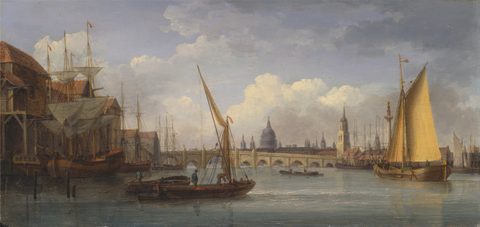
London Bridge, with St. Paul's Cathedral in the Distance
William Anderson, c. 1815
St. Paul's crowns the river traffic. Anderson gives London its cathedral skyline at full breath.
About this work
Sailing barges and ships crowd the Thames in this wide view by William Anderson, painted around 1815. On the left, large ships moor beside timber wharves, and in the foreground two barges with tan sails glide across the calm water. The many arches of old London Bridge span the river in the middle distance, and beyond them the dome of St. Paul's Cathedral rises over the city, with church spires along the skyline.
Anderson (1757–1837) was a Scottish-born marine painter who worked in London, known for calm river and harbor scenes painted with clear light and careful detail. The painting's image comes from Google Arts & Culture.
The long, panoramic format and the soft clouds make this a calm and spacious picture of London's working river. The image is 6842 × 3241 pixels, ideal for a long frame above a sofa or a sideboard. It is a lovely gift for anyone who loves London.
Sources: Wikimedia Commons
FAQ
Where can I buy a framed print of London Bridge, with St. Paul's Cathedral in the Distance?
Here. London Bridge, with St. Paul's Cathedral in the Distance is available as a framed print in three sizes: Small (20 × 9 in) for $195, Medium (24 × 11 in) for $295 and Large (36 × 17 in) for $395. Prices include the frame and US shipping; delivery takes 14–21 days, with 30-day returns.
What size works best for London Bridge, with St. Paul's Cathedral in the Distance?
The file is 6,842 × 3,241 px, so every size is sharp: even Large (36 × 17 in) prints at 190 ppi. Choose Large (36 × 17 in) for a large wall; Small (20 × 9 in) suits a narrower space.
Is it legal to print London Bridge, with St. Paul's Cathedral in the Distance?
Yes. London Bridge, with St. Paul's Cathedral in the Distance is in the public domain: its copyright, if it ever had one, expired long ago. In the United States a faithful photograph of a public-domain painting does not create a new copyright (Bridgeman v. Corel, 1999), so the image can be printed and sold freely.

















