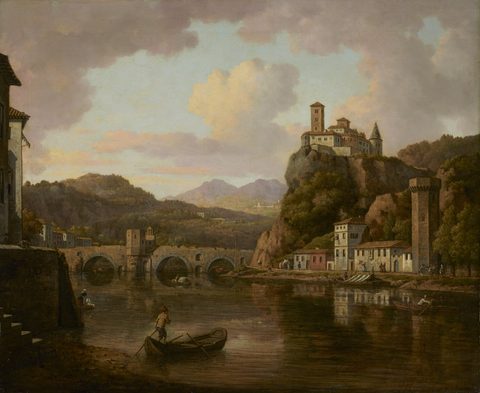
Castle on the Rhône River, France
William Marlow, c. 1765–1770
A castle and old town climb the rocks above a bridge on the Rhône, bright in the southern sun.
About this work
A castle and a small town climb a rocky hill above a stone bridge in this view of the Rhône River in France by the English painter William Marlow. The castle stands at the top of the rock, the houses and towers of the town step down toward the water, and a many-arched bridge crosses the river. In the foreground a man rows a small boat on the calm water, and soft clouds drift across the sky.
Marlow (1740–1813) was an English landscape and marine painter and etcher who traveled through France and Italy in the 1760s, and many of his paintings record what he saw there. This canvas is one of a pair, and its source lists it with the Minneapolis Institute of Art. It is dated between about 1765 and 1780.
The golden light and the balanced composition make this a classic Grand Tour landscape. The image is 8963 × 7347 pixels, enough for very large prints. It suits a living room or a dining room, and is a lovely gift for anyone who loves France.
Sources: Wikimedia Commons · Wikipedia: William Marlow
FAQ
Where can I buy a framed print of Castle on the Rhône River, France?
Here. Castle on the Rhône River, France is available as a framed print in three sizes: Small (20 × 16 in) for $195, Medium (24 × 20 in) for $295 and Large (36 × 30 in) for $395. Prices include the frame and US shipping; delivery takes 14–21 days, with 30-day returns.
What size works best for Castle on the Rhône River, France?
The file is 8,963 × 7,347 px, so every size is sharp: even Large (36 × 30 in) prints at 245 ppi. Choose Large (36 × 30 in) for a large wall; Small (20 × 16 in) suits a narrower space.
Is it legal to print Castle on the Rhône River, France?
Yes. Castle on the Rhône River, France is in the public domain: its copyright, if it ever had one, expired long ago. In the United States a faithful photograph of a public-domain painting does not create a new copyright (Bridgeman v. Corel, 1999), so the image can be printed and sold freely.

















