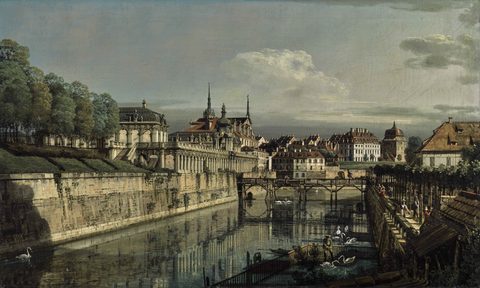
Dresden: The Moat of the Zwinger
Bernardo Bellotto, 1751–1752
The Zwinger's ramparts and pavilions above the moat in Augustus the Strong's Dresden.
About this work
Bernardo Bellotto painted the moat of the Zwinger in Dresden in 1751 to 1752, with the Baroque pavilions and galleries of Augustus the Strong's festival complex rising above the ramparts and the still water, and townspeople walking along the banks. This painting was one of two Bellotto views that belonged to the Hamburg retail magnate Max Emden, who sold them under duress after fleeing Nazi persecution. Germany restituted them to his heirs in 2019, and they were auctioned at Sotheby's in London in July 2020. The Zwinger was designed by the architect Matthäus Daniel Pöppelmann, with sculpture by Balthasar Permoser, and built from 1710 to 1728 as an orangery, exhibition gallery and setting for court festivals. Its name comes from the medieval word for the space between a fortress's outer and inner walls, which is where it was built. Badly damaged in the bombing of Dresden in February 1945, it was restored after the war and now houses the Old Masters Picture Gallery. Bellotto, born in Venice around 1721 and trained by his uncle Canaletto, was court painter in Dresden from 1748 and later worked in Vienna and Warsaw, where he died in 1780.
Sources: Wikimedia Commons · The Art Newspaper · Wikipedia: Zwinger (Dresden)
FAQ
Where can I buy a framed print of Dresden: The Moat of the Zwinger?
Here. Dresden: The Moat of the Zwinger is available as a framed print in three sizes: Small (20 × 12 in) for $195, Medium (24 × 14 in) for $295 and Large (36 × 22 in) for $395. Prices include the frame and US shipping; delivery takes 14–21 days, with 30-day returns.
What size works best for Dresden: The Moat of the Zwinger?
The file is 8,587 × 5,149 px, so every size is sharp: even Large (36 × 22 in) prints at 234 ppi. Choose Large (36 × 22 in) for a large wall; Small (20 × 12 in) suits a narrower space.
Is it legal to print Dresden: The Moat of the Zwinger?
Yes. This painting is in the public domain: Bernardo Bellotto died in 1780, so its copyright, if it ever had one, expired long ago. In the United States a faithful photograph of a public-domain painting does not create a new copyright (Bridgeman v. Corel, 1999), so the image can be printed and sold freely.

















