
Moonlight is hard to paint. It is dim, it changes quickly, and it drains color from everything except the sky. For centuries painters made night scenes in the studio from memory and imagination, then tried to persuade the viewer that a few cool tones and a single bright disc added up to a real night. The best of them succeeded so well that their moons have become some of the most loved images in Western art. Moonlight is the one light that makes every painter a little bit of a poet.
These pictures are also, quietly, some of the most livable art you can hang. In the long evenings between November and March, a moonlit painting looks right at the hour you are most likely to be home to see it. This guide looks at four of the great night scenes in our moonlight paintings collection, from German Romanticism to Van Gogh, with a few notes on where they look best.
Moonlight is the one light that makes every painter a little bit of a poet.
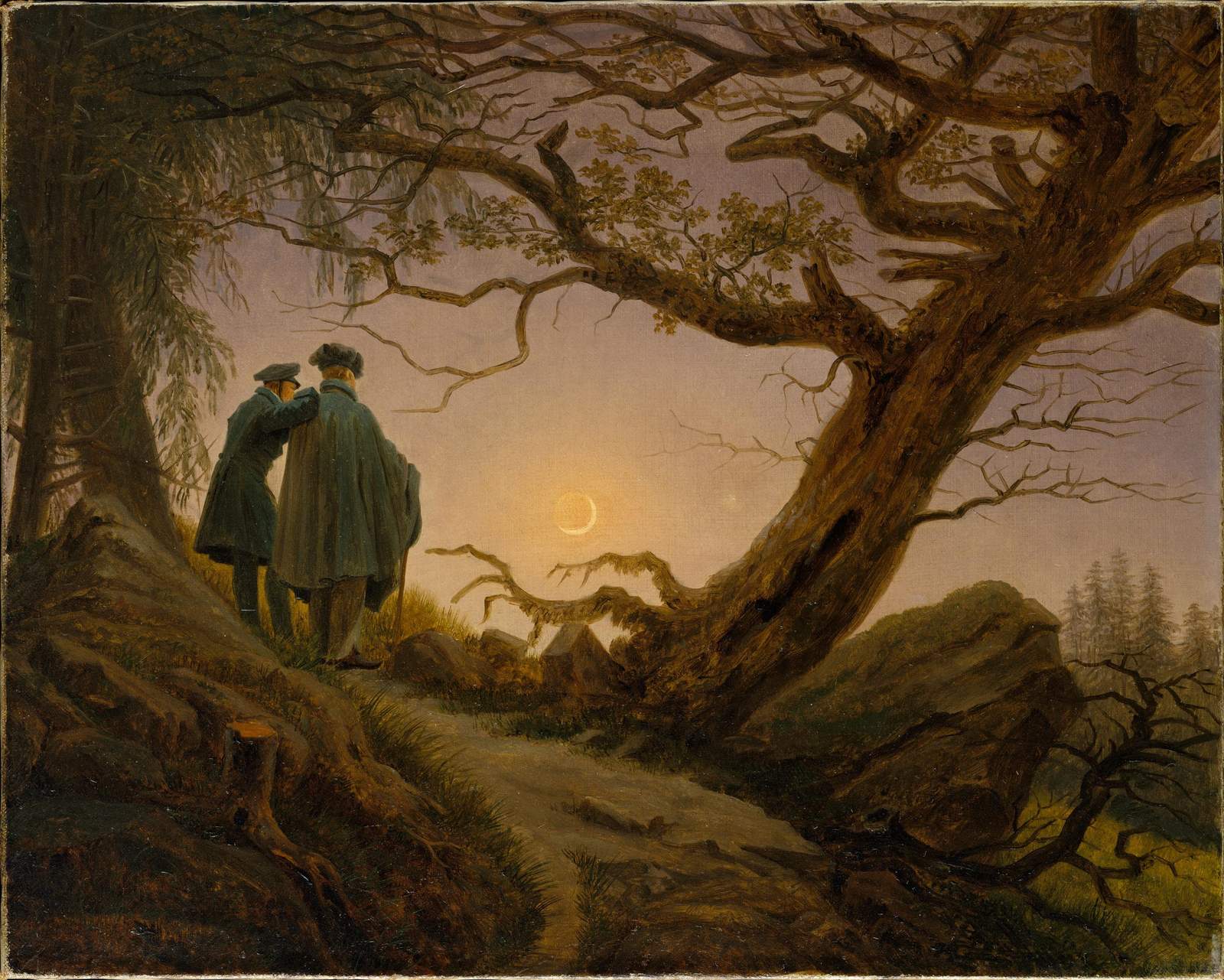
Caspar David Friedrich: the moon as a shared silence
No painter is more closely tied to moonlight than Caspar David Friedrich, the great German Romantic who worked in Dresden. In Two Men Contemplating the Moon, two figures stand on a rocky path at dusk beside an uprooted oak and a dead tree, their backs to us, looking at a thin crescent moon and the evening star. Friedrich painted the subject more than once. The earliest version, from 1819–20, is in Dresden; the Metropolitan Museum’s canvas is a later variant from about 1825–30, and Friedrich also painted a related composition with a man and a woman.
Because we see the figures from behind, we are invited to stand with them, and the painting becomes less a view than a shared moment of attention. It is one of the reasons Friedrich still feels modern. His Moonrise over the Sea of 1822, in Berlin’s Alte Nationalgalerie, works the same way: three figures sit on a boulder at the shore as the moon comes up and two sailing ships approach. For more on his habit of painting people from behind, read our essay on Friedrich’s figures seen from behind.
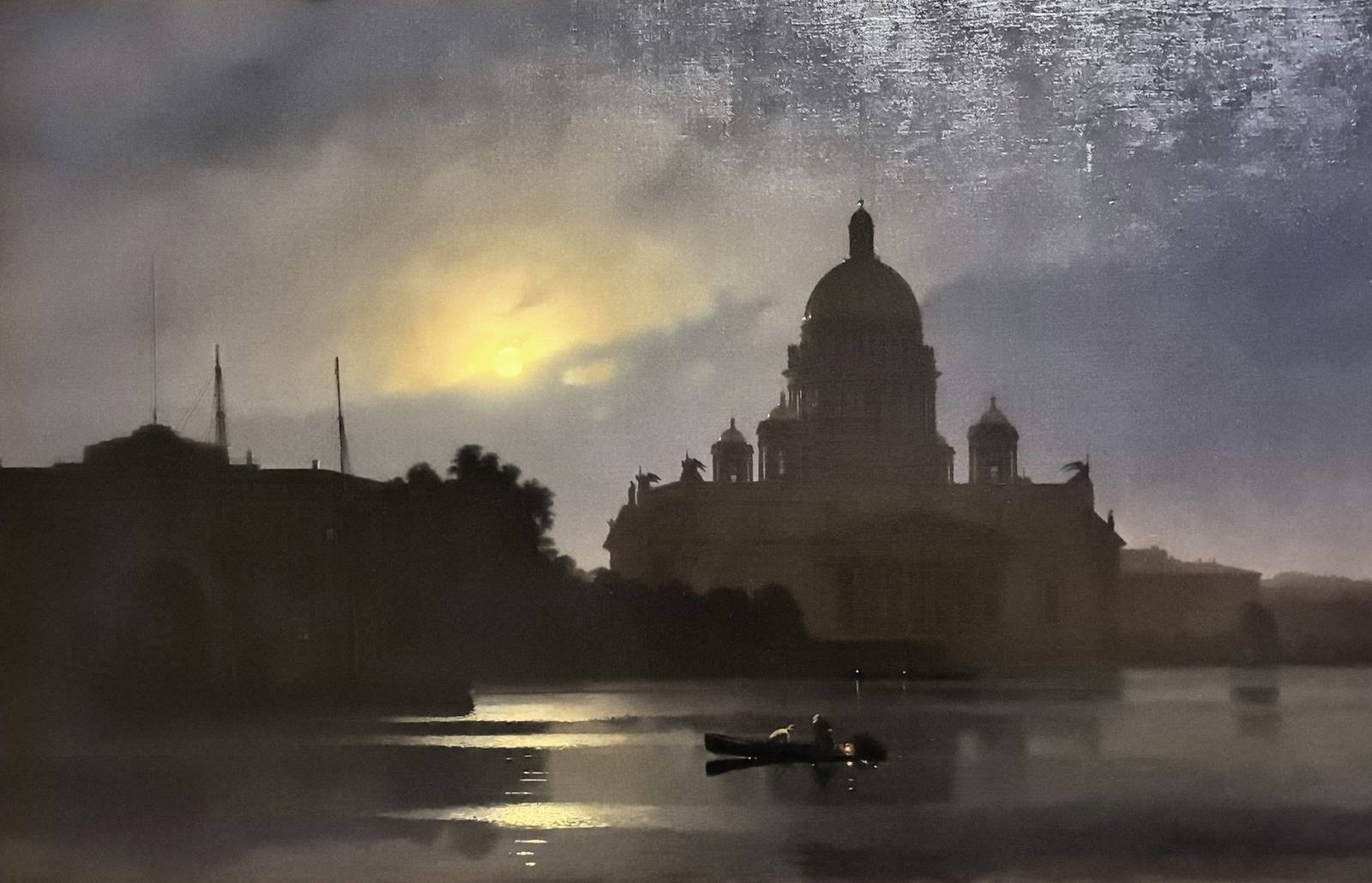
Arkhip Kuindzhi: the painter of luminous nights
Arkhip Kuindzhi, born in Mariupol and trained largely on his own before working in St. Petersburg, became famous in Russia for moonlight so intense that some viewers suspected a trick. When he showed Moonlit Night on the Dnieper in 1880, he exhibited it alone in a darkened room lit so that the painting seemed to glow, and people lined up to see it. His secret was not a hidden lamp but careful control of contrast and color, setting a few luminous tones against a deep, dark surround.
Saint Isaac’s Cathedral by Moonlight is an earlier work, painted around 1869, and already shows the direction he would take. The great domed cathedral of St. Petersburg, completed in 1858, stands in dark silhouette against a cloudy sky, while the moon breaks through the clouds and lays a path of light across the water, where a small boat drifts in the foreground. It is a wonderful picture for anyone who loves architecture or has traveled in Russia, and its wide shape suits the space above a console table or a sideboard.
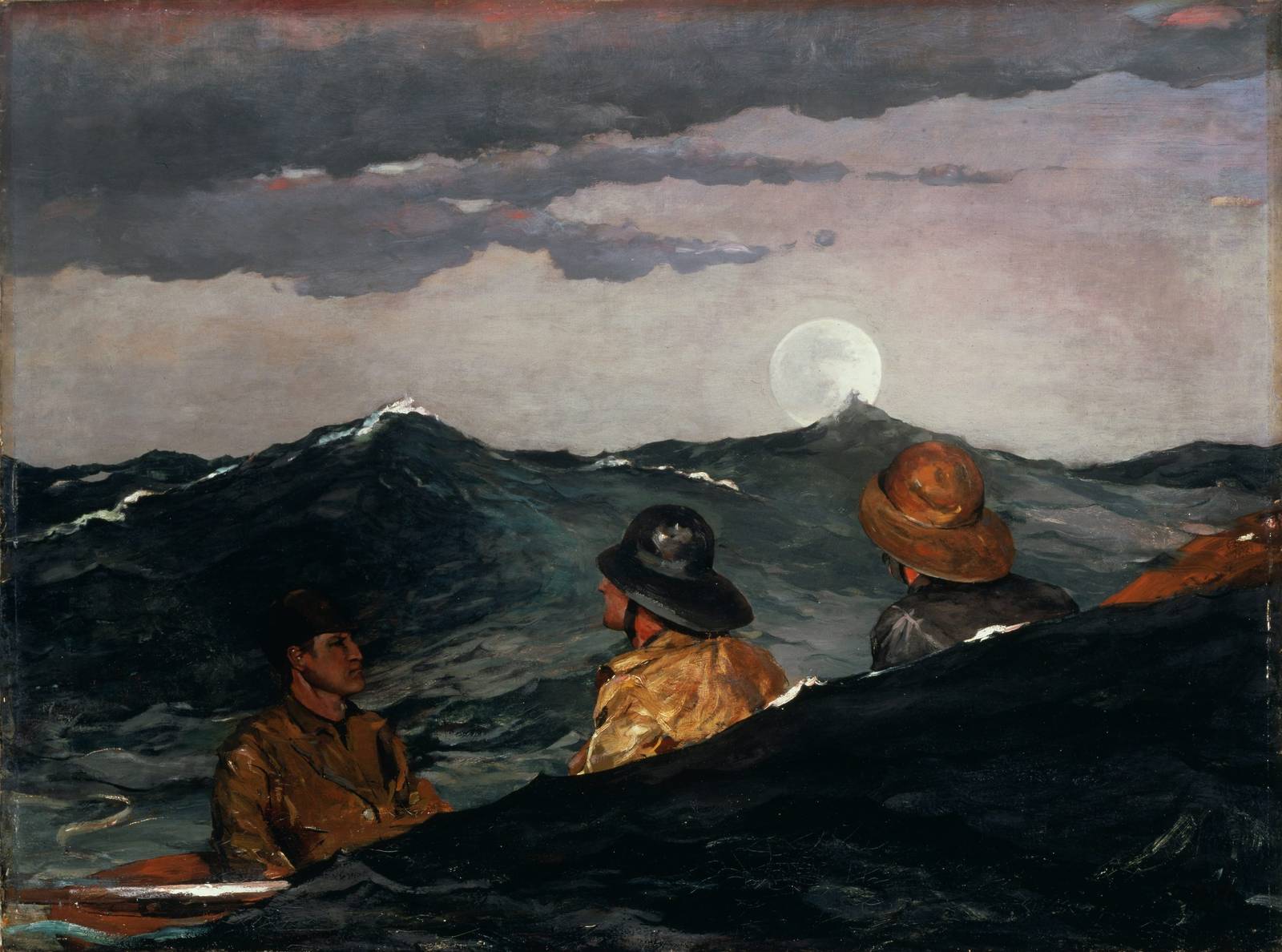
Winslow Homer: the moon at sea level
Winslow Homer spent the last decades of his life at Prouts Neck on the Maine coast, painting the Atlantic in all weathers. Kissing the Moon, painted in 1904, is one of his last major oils and one of his most surprising. Three men sit in a small dory, almost hidden between swells, and a wave crest rises just high enough to touch the full moon on the horizon. The title is Homer’s little joke, and the picture is both humorous and slightly unnerving, since we are down in the trough with the boat, unable to see what comes next.
The painting is now in the Addison Gallery of American Art in Andover, Massachusetts. Its cool greens and grays make it a natural fit for a coastal home, a den or a study, and it hangs well alongside the brighter pictures in our guide to Winslow Homer’s sea paintings.
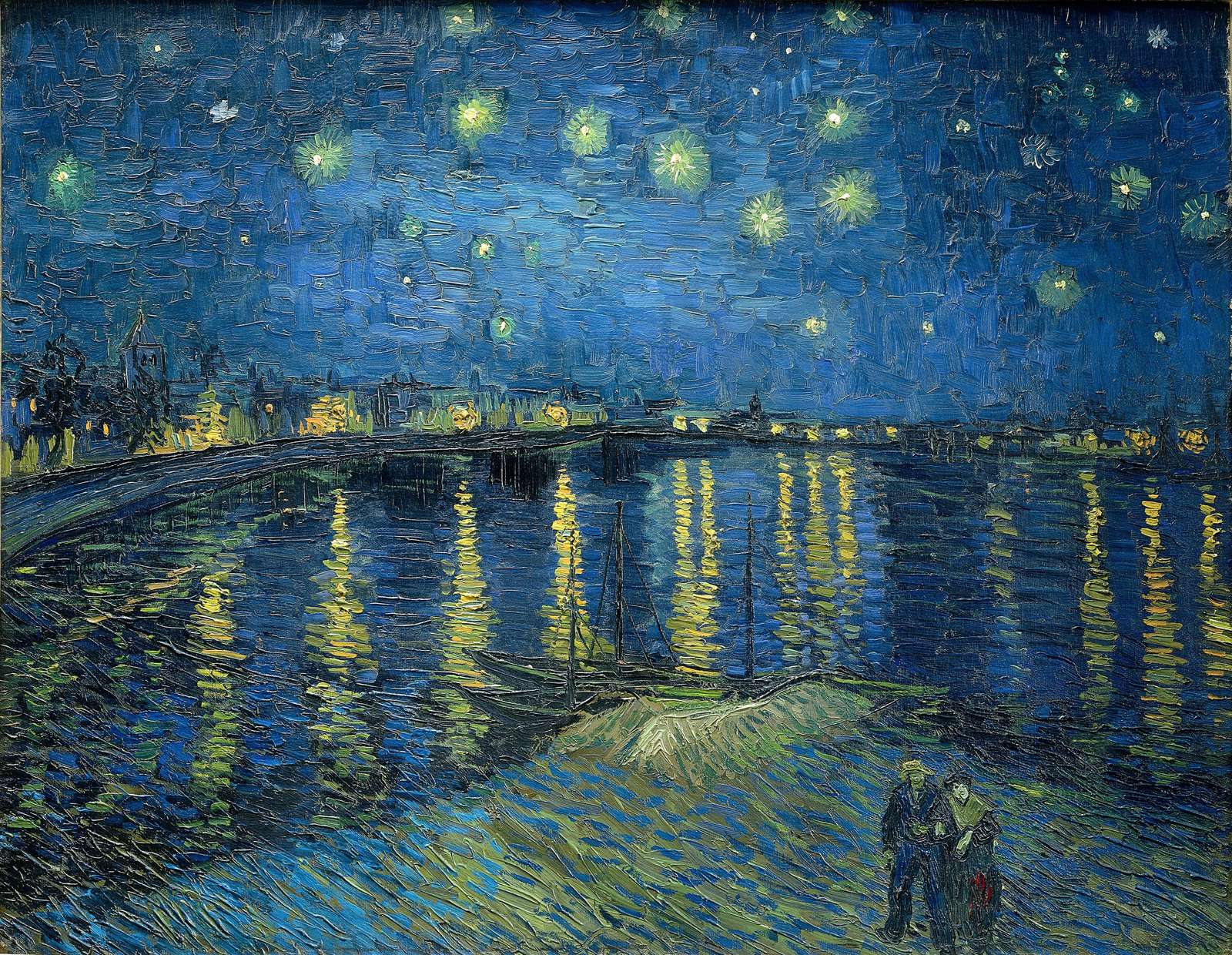
Van Gogh: starlight and gaslight
Vincent van Gogh had no moon in Starry Night Over the Rhône, painted in Arles in September 1888, but it belongs in any collection of great night scenes. The stars of the Big Dipper glitter over the river, the new gas lamps of the town send gold reflections across the water, and a couple walks along the bank in the foreground. Van Gogh painted it outdoors at night, part of his effort that year to paint darkness in color rather than in black. It is now in the Musée d’Orsay in Paris.
The more famous Starry Night, painted the following June at the asylum in Saint-Rémy and now at the Museum of Modern Art in New York, does include a crescent moon, blazing in the upper right corner. The two make a fine pair, the calm river scene and the turbulent sky, and our guide to Van Gogh’s paintings places them in the story of his life.
Living with night paintings
Night scenes are dark by nature, and a few practical choices help them look their best at home. A moonlit painting asks the room to slow down to its pace. Give it that chance:
- Light them well. Place a moonlit picture where a lamp or a picture light falls on it in the evening. Dark paintings disappear on a dim wall, and they reflect a window placed directly opposite.
- Use them where you unwind. Bedrooms, reading corners and dens are natural homes for night pictures. The Friedrich and the Homer are calm enough to fall asleep to.
- Choose the frame by temperature. A gold frame warms Van Gogh’s and Kuindzhi’s glowing lights; a black frame sharpens the cool blues and greens of Friedrich and Homer.
- Size for the room. Every print comes in up to three sizes, Small at $195, Medium at $295 and Large at $395, framed and ready to hang, and we never crop, so exact dimensions are on each work page.
Moonlight paintings also make thoughtful holiday gifts, especially for someone who loves the quiet of winter evenings. If you are building a seasonal wall, our guide to winter landscape paintings is a good companion, and the full moonlight collection has more night scenes, from Venice to the Alps.