
Snow changes everything a painter thought he knew about color. A field that was green in July becomes a sheet of reflected sky; shadows turn blue and violet; a single red scarf suddenly carries the whole picture. For two centuries artists have gone out into the cold, or stood at a hotel window above a frozen boulevard, to catch that strange, quiet light. Winter landscape paintings make some of the most rewarding pictures to live with, especially now, as the days shorten and the holidays arrive. This guide walks through the best winter paintings in the FrameAnyPhoto collection, from German Romanticism to the Impressionists in Paris, and offers some practical advice on choosing and framing one, or giving one as a gift.
Friedrich: winter as a place of hope
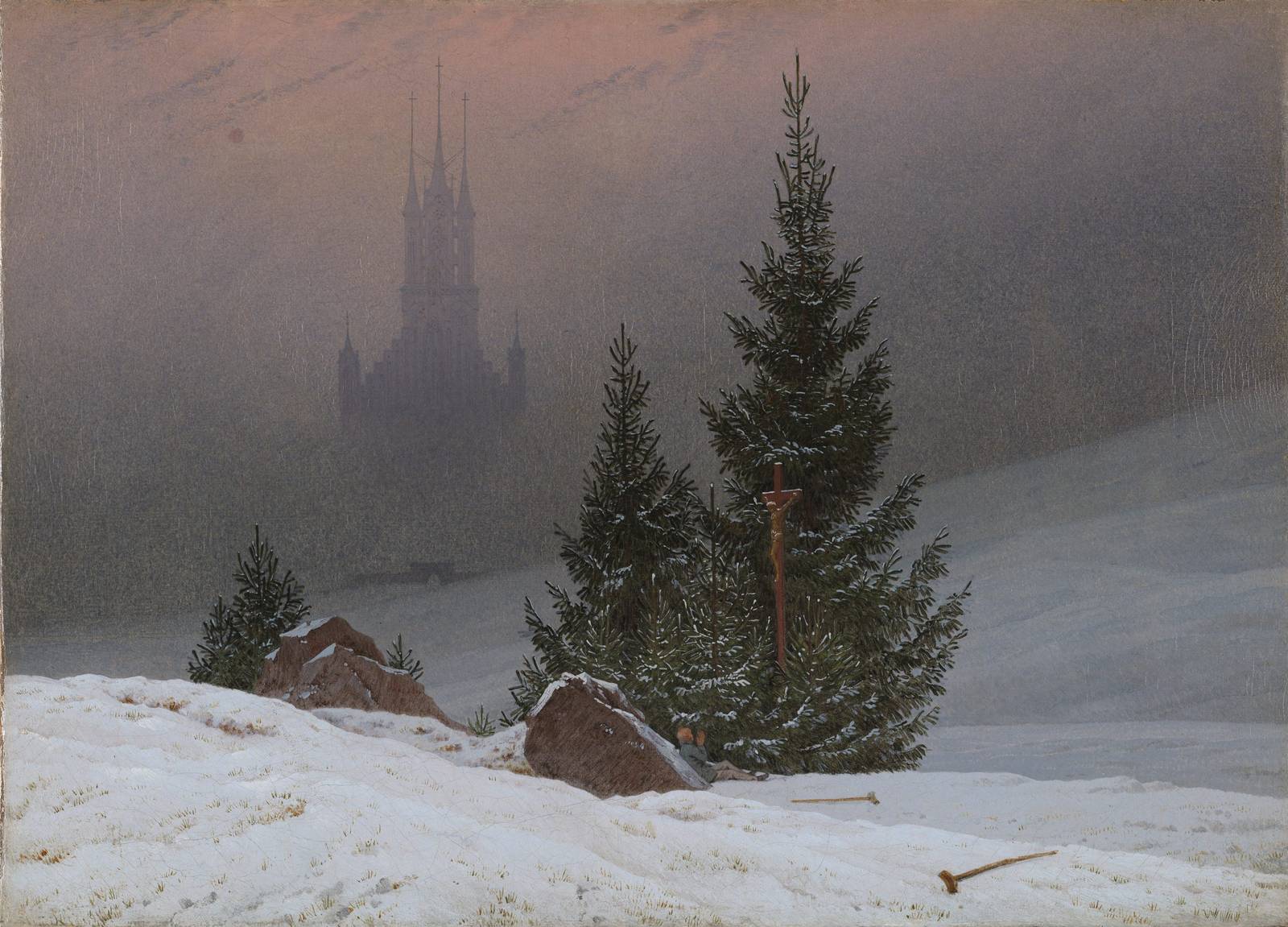
Caspar David Friedrich painted winter more seriously than almost anyone before him. In his Winter Landscape of about 1811, a man has cast aside his crutches and leans against a rock in the snow, turned toward a crucifix set among young fir trees. Behind him, the pale towers of a Gothic church rise out of the mist like a vision. For Friedrich, the evergreen firs and the half-seen church were signs of faith surviving the cold, and the picture reads as a winter of the soul giving way to something brighter.
What makes it so good on a wall is its restraint. The palette is almost entirely grey, white and soft brown, so it sits calmly in a room rather than shouting. It suits a study, a reading corner or a bedroom, anywhere you want a picture that rewards a second look. If you love Friedrich, our guide to his figures seen from behind goes deeper into his work.
Friedrich was not alone in finding romance in the frozen north. Johann Philipp Ulbricht’s Winter Landscape with a Gothic Castle, from around 1820, sets a castle on its height above a snowy road, with small figures making their way through the cold daylight. It has the storybook quality that people often want at this time of year, and it pairs naturally with the Friedrich in a hallway or above a mantel.
Snow turns a painting into a study of light itself: every shadow becomes a color.
The Impressionists go out in the snow
Half a century later, the French Impressionists made snow one of their great experiments. Painting outdoors, they discovered that snow is almost never simply white. It takes on the warm cream of low sun, the blue of open sky and the lilac of late afternoon, and they set those colors down side by side.
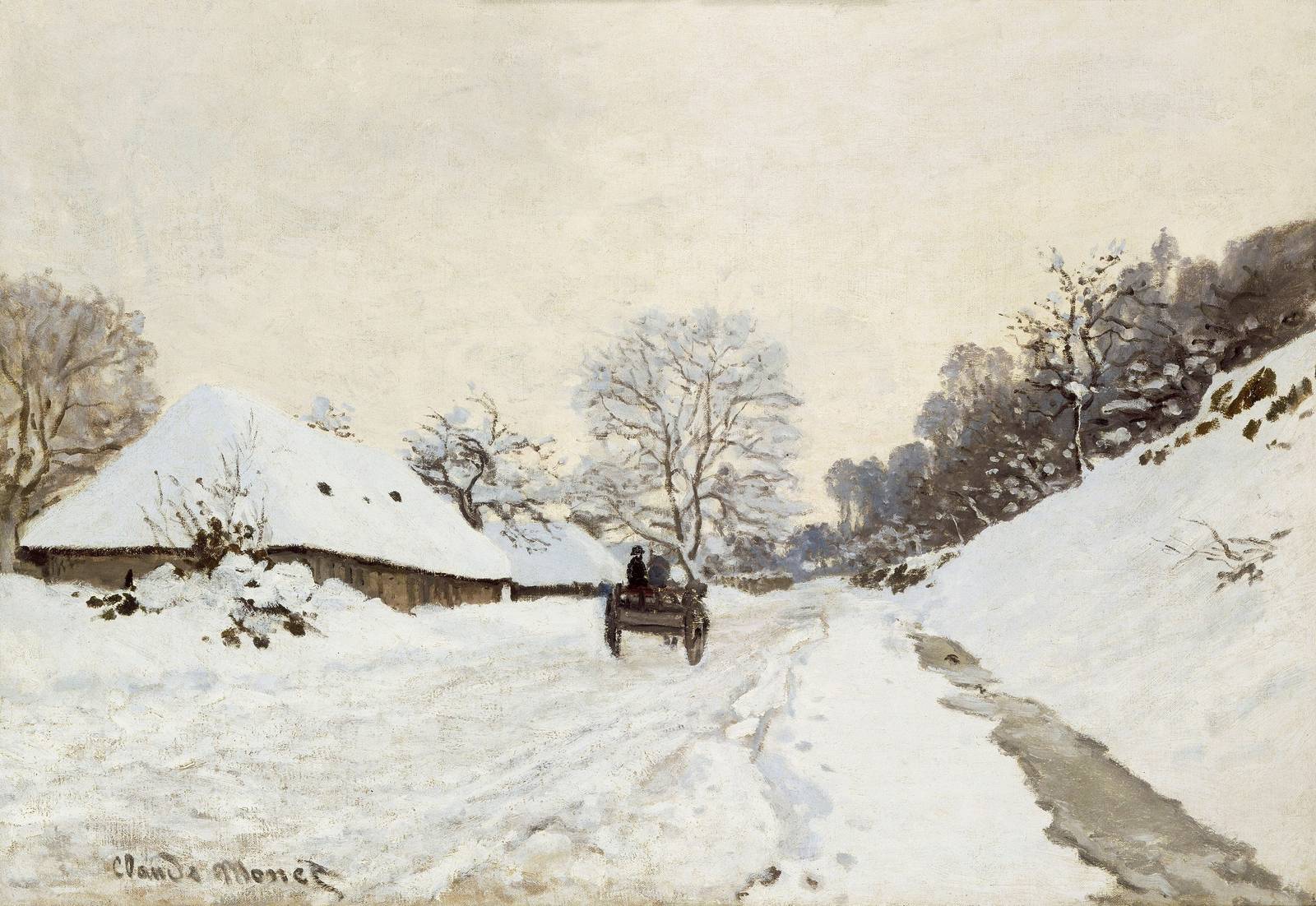
Claude Monet was one of the first. A Cart on the Snowy Road at Honfleur, painted in the 1860s near the Normandy port across the estuary from Le Havre, where he grew up, shows a lone cart on a country road between farm buildings, the sky heavy with more snow to come. It is an early picture, painted before Impressionism had a name, but you can already see Monet watching how the light falls across the snow rather than simply describing a road.
A few years later he painted The Red Kerchief, now in the Cleveland Museum of Art. Monet’s wife, Camille, passes outside a window in a snowy garden, wrapped in a red hood. She is glimpsed for just a moment, and that flash of red against the white and grey is the whole point. It is one of the most tender winter pictures of the century, and a lovely choice for a bedroom or an entry where you want warmth rather than drama.
Monet’s friend Alfred Sisley lived in the village of Marly-le-Roi, west of Paris, in the mid-1870s and painted it again and again, in flood, in summer and under snow. La Place du Chenil à Marly, effet de neige shows a small village square muffled in white, with soft walls and bare trees. Nothing much happens in it, and that is exactly its charm.
Paris under snow: Pissarro and Caillebotte
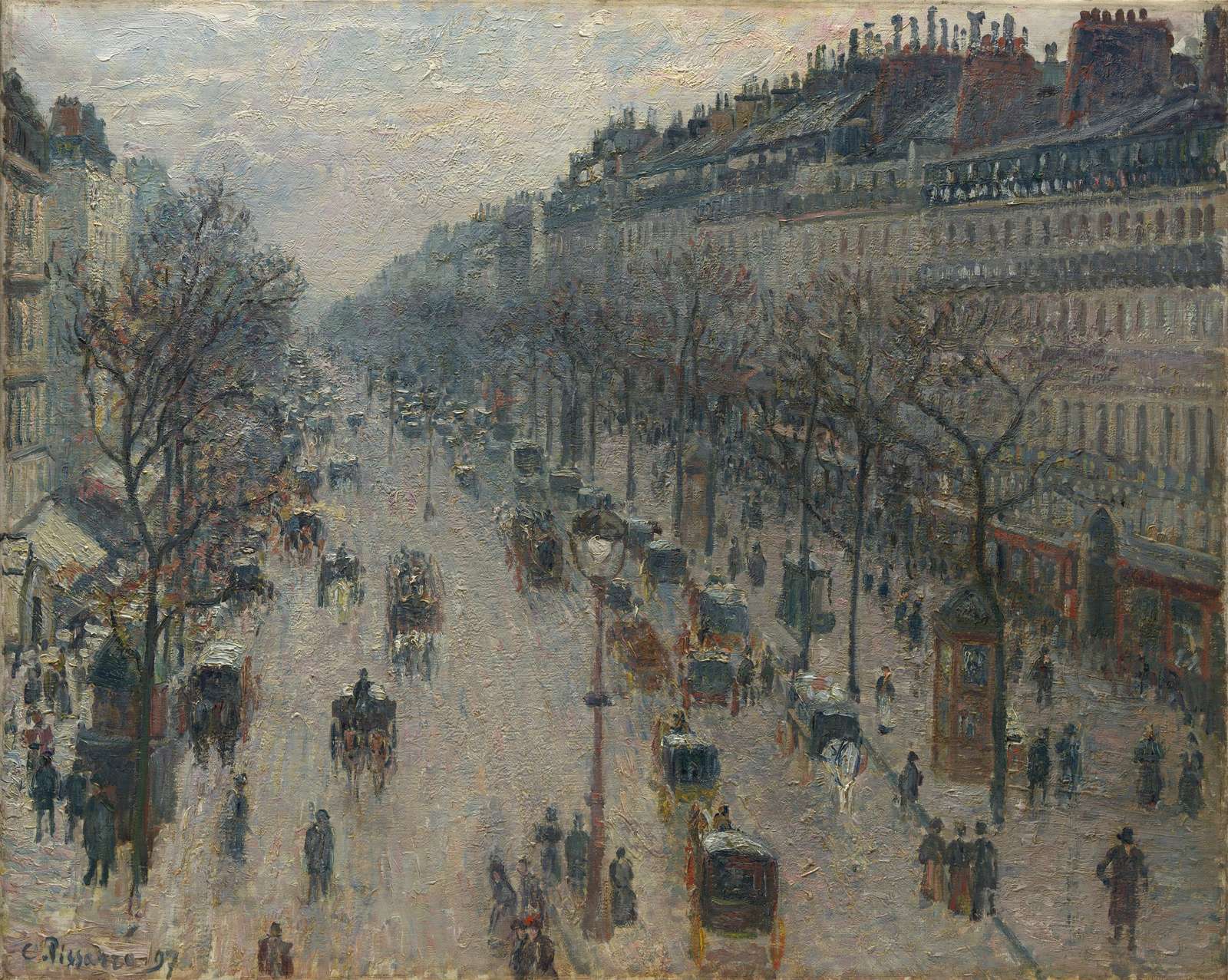
In early 1897, Camille Pissarro took a room in a hotel overlooking the Boulevard Montmartre and painted the street below at different times of day and in different weather. The Boulevard Montmartre on a Winter Morning, now at the Metropolitan Museum of Art, is one of the finest of the series. The boulevard runs away from us in a long diagonal, carriages and pedestrians reduced to quick flecks of paint, the trees bare and the light thin and silvery. It is a city picture and a winter picture at once.
The following year Pissarro worked from a window above the Avenue de l’Opéra, and Avenue de l’Opéra, Morning Snow catches the grand street just after a snowfall, the paving turned to slush and the buildings softened by cold air. Hung together, the two make a natural pair for anyone who loves Paris; you can find more in our Camille Pissarro collection.
Gustave Caillebotte took a different view, quite literally. His View of Rooftops (Snow Effect), now in the Musée d’Orsay, looks out across a jumble of snowy Paris roofs, chimneys and zinc under a heavy grey sky. There are no people at all. It is an unusually modern-looking picture for its time, almost abstract in its blocks of white and grey, and it looks especially good in a contemporary room.
American winters: Bierstadt and Inness
American painters found their own kind of winter. Albert Bierstadt, best known for his vast Western panoramas, spent the early 1870s in California and painted the Sierra Nevada. Lake Tahoe in Winter sets snow-covered peaks around the lake in clear, crisp light, the kind of view that brings mountain air into a living room. It suits a cabin, a ski house or anyone who simply loves the high country.
George Inness was a very different painter, more interested in mood than in grand scenery. A Winter Sky, in the Cleveland Museum of Art, is built almost entirely from soft, glowing tones, a low landscape under a cold sky. It is the kind of picture that changes with the light in your room through the day, and it works well in a quiet space such as a bedroom or study.
A winter painting is the rare gift that suits the season and still looks right in July.
Choosing and framing a winter painting
Winter paintings tend to share a palette of whites, greys, blues and soft browns, which makes them unusually easy to place. They sit comfortably with neutral walls, natural wood and linen, and they cool down a warm room without making it feel cold. A good rule is to think about what the painting is doing: the Friedrich and the Inness are contemplative, the Pissarros are lively and urban, and the Bierstadt is all scale and fresh air.
Every FrameAnyPhoto print comes framed and ready to hang, in three sizes at $195, $295 and $395, with free shipping in the US. Each work is printed at its own proportions, so nothing is cropped, and every work page shows the exact dimensions for each size. The gilded Wood Ornament frame gives winter scenes a lovely contrast, a little warmth around all that cool light, and it suits the Friedrich, the Monets and the Sisley especially well. The Black Metallic frame brings out the graphic quality of the Caillebotte rooftops and the Pissarro boulevards, and at the largest size it is often the only option. If you are unsure about size, our guide to choosing the right size and frame has some simple rules of thumb.
Winter landscapes also make thoughtful holiday gifts. They feel seasonal without being tied to a single holiday, so they will look right long after the decorations come down. If you are buying for someone else, choose a picture that connects to a place they love, Paris, the mountains or the countryside, and keep it simple. For more ideas, see our holiday gift guide to framed art prints, or browse the full collection of winter landscape paintings.