
Winslow Homer is often called the greatest American painter of the sea, and it is hard to argue. Few artists have made water feel so heavy, so cold and so alive. Yet he came to the ocean fairly late, after careers as an illustrator and a painter of country life, and the seas he is famous for were mostly painted from a single rocky point on the coast of Maine. This guide follows that path, from Boston print shop to Prouts Neck, and offers some practical advice on choosing and framing a Homer for your own walls.
From illustrator to painter
Homer was born in Boston in 1836. He had little formal art training; as a young man he was apprenticed to a Boston lithography firm, and he soon struck out as a freelance illustrator. His drawings appeared in Harper’s Weekly, and during the Civil War the magazine sent him to the front, where he recorded camp life far more often than battle. That habit of watching ordinary people closely, and of telling a story in a single image, stayed with him for the rest of his life.
He began painting in oils during the war years, and his canvas Prisoners from the Front (1866) established his reputation. After a stay in France in 1867 he returned to American subjects: schoolchildren, farm girls, croquet players and summer visitors on the beach. Eagle Head, Manchester, Massachusetts (High Tide) (1870), now at The Metropolitan Museum of Art, belongs to this moment. Three young women come out of the surf, a dog at their heels. The sea is already there, but it is still a backdrop for a bright seaside day.
Gloucester and the turn to watercolor
In the summer of 1873 Homer worked in Gloucester, Massachusetts, and began to take watercolor seriously. The medium suited him perfectly: quick, transparent and alive to light. A Basket of Clams (1873), a small scene of two boys carrying a basket of clams along the shore, shows how quickly he found his touch. He would go on to make hundreds of watercolors, and many critics rank them among the finest ever painted in America.
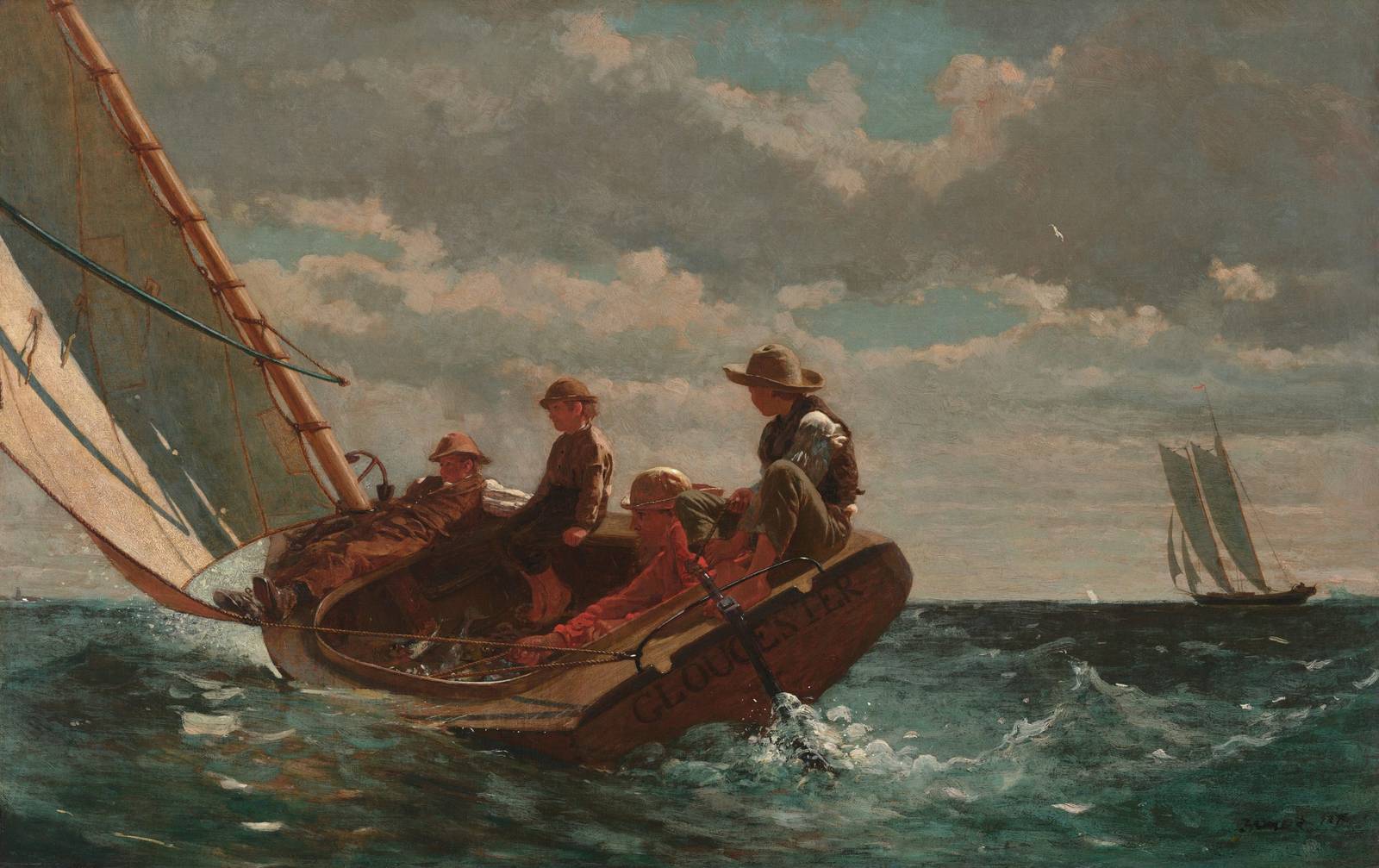
Gloucester also gave him one of his best-loved oils. Breezing Up (A Fair Wind) (1873–76), in the National Gallery of Art in Washington, shows a man and three boys in a small catboat heeling over in a fresh wind, with a schooner on the horizon. It is pure optimism: sunlight, spray and a boat moving fast. If you want a Homer that feels happy rather than heroic, this is the one.
He came to the ocean fairly late, and the seas he is famous for were mostly painted from a single rocky point in Maine.
The North Sea and a change of tone
In 1881 Homer crossed the Atlantic again and spent the better part of two years in Cullercoats, a fishing village on the North Sea coast of England. There he painted the wives and daughters of fishermen waiting on the shore, and the hard, dangerous work of the sea. When he came home, his art had changed. The sunny summer scenes gave way to something graver and more monumental, with people pitted against weather and water.
Prouts Neck and the great sea paintings
In 1883 Homer settled at Prouts Neck, on the coast of Maine near Portland, where his family owned property. He turned a carriage house into a studio overlooking the ocean, and he lived and worked there for the rest of his life. The paintings he made in the years that followed are the ones most people picture when they hear his name.
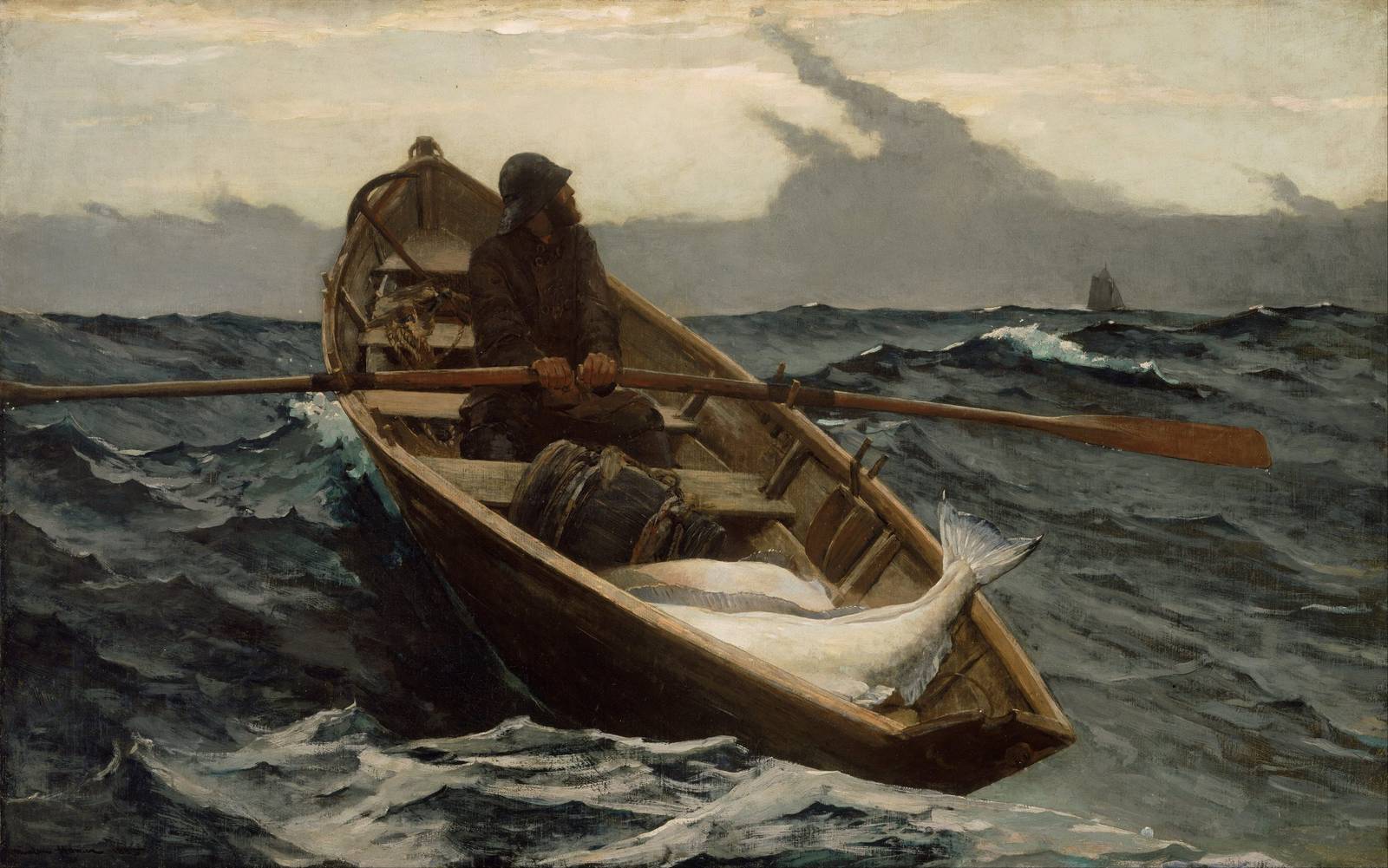
Two of them form a natural pair. The Fog Warning (1885), at the Museum of Fine Arts, Boston, shows a lone fisherman in a dory, his catch in the boat, looking over his shoulder at the distant schooner as a bank of fog builds on the horizon. The Herring Net (1885), at the Art Institute of Chicago, puts two fishermen in a pitching dory, hauling a net heavy with silver fish. Neither picture shows a disaster. What they show is the moment just before one might happen, and the quiet competence of the men who face it.
Undertow (1886), at the Clark Art Institute, brings the drama onto the beach: two rescuers drag two half-drowned women out of the surf. It is one of his most powerful figure paintings and a striking choice for anyone who loves the sea in its unforgiving mood.
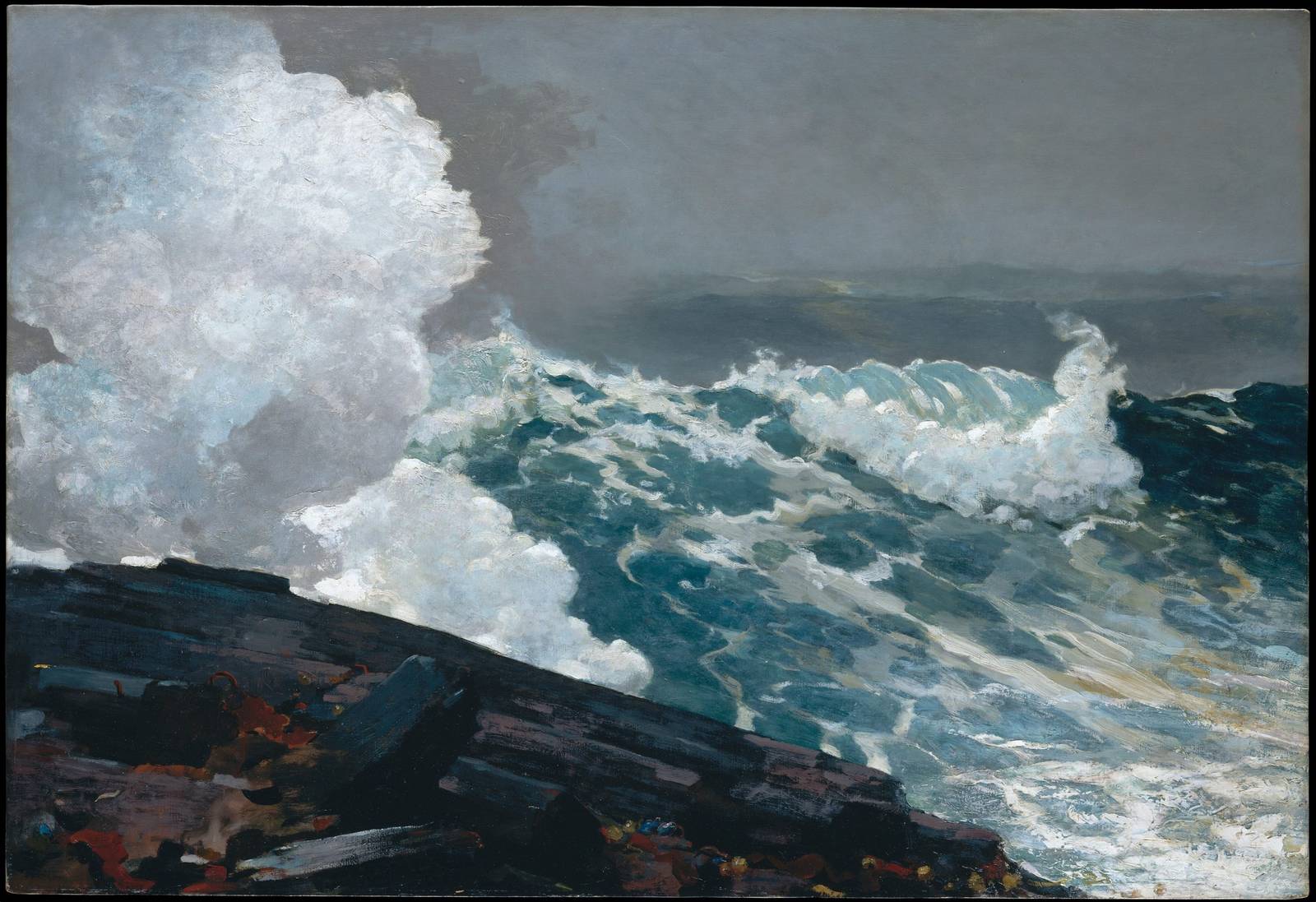
Later still, Homer often left people out entirely. Northeaster (1895), at The Metropolitan Museum of Art, is simply a wave exploding against the rocks of Prouts Neck, painted with broad, physical strokes. Early Morning After a Storm at Sea (1900–1903), at the Cleveland Museum of Art, is calmer but no less grand, with long green swells rolling in under a gray dawn. These are paintings about the ocean itself, and they hold a wall the way a window would.
Warm water and winter escapes
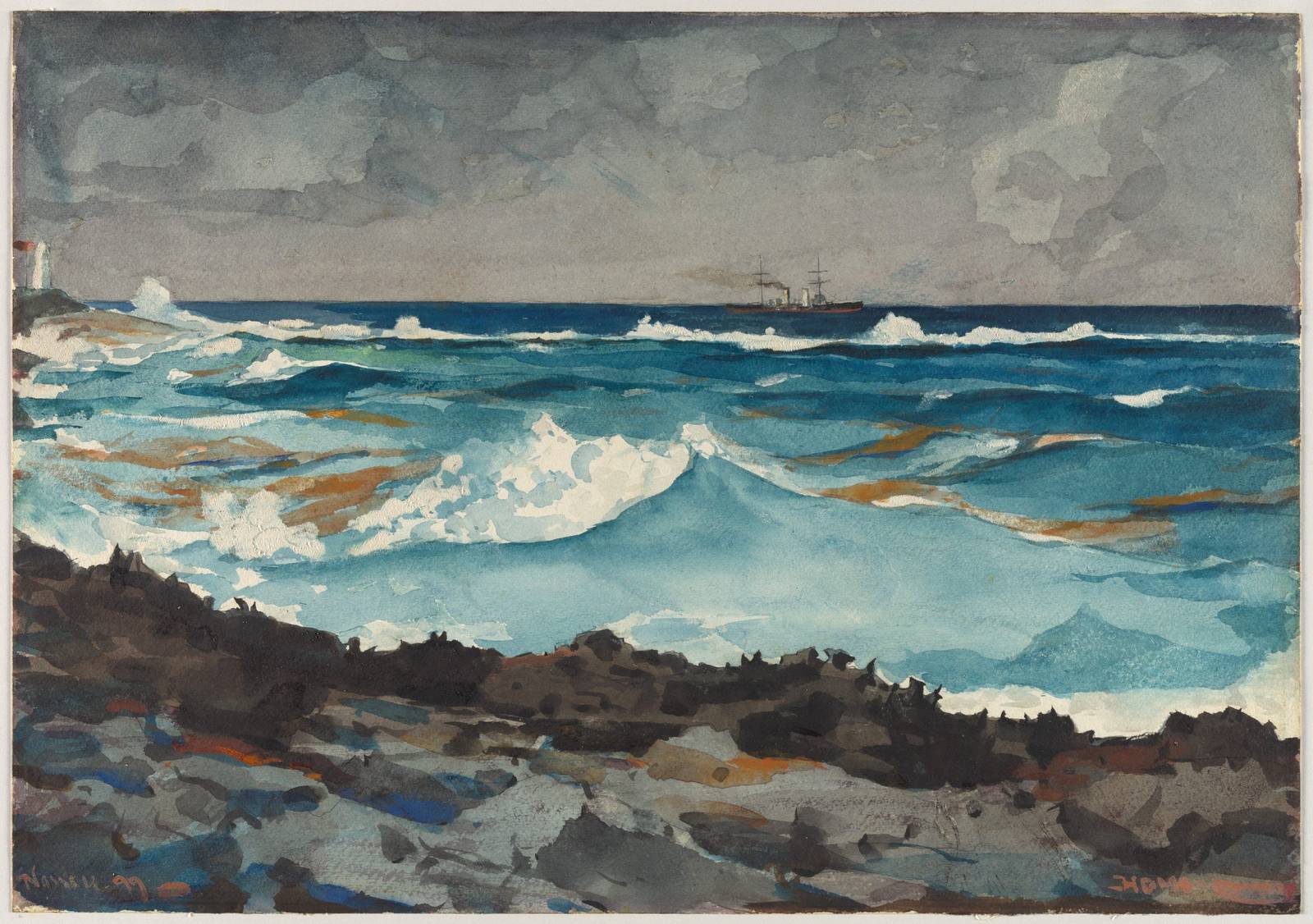
Homer did not spend every winter in Maine. He traveled to the Bahamas, Florida and Bermuda, and those trips produced some of his most luminous watercolors. Shore and Surf, Nassau (1899), at the Met, trades North Atlantic gray for turquoise and white, with a breaking wave and a blaze of tropical light. It is a fine choice for a beach house or any room that wants color. Late in life he also painted Kissing the Moon (1904), in which the heads of three men in a boat barely clear an enormous swell, the moon just touching its crest. Homer died at Prouts Neck in 1910.
These are paintings about the ocean itself, and they hold a wall the way a window would.
Choosing a Homer for your room
- Living room: Breezing Up or The Fog Warning gives a strong, horizontal focal point above a sofa, with a story people will ask about.
- Study or office: The Herring Net and Northeaster suit dark wood, leather and deep navy or green walls.
- Coastal home: Shore and Surf, Nassau or Eagle Head brings the beach indoors without feeling like a generic seascape.
- Kitchen or breakfast nook: A Basket of Clams is small in spirit and warm in tone, perfect for a more casual space.
Sizes and frames
Every FrameAnyPhoto print is made at the original’s proportions, with nothing cropped, so dimensions vary a little from work to work. Most Homer works come in three sizes: Small at $195, Medium at $295 and Large at $395. The Fog Warning, for example, runs from about 20 × 13 inches up to 36 × 23 inches. Homer’s wide, low compositions read best at Medium or Large, where the horizon has room to breathe.
The black metallic frame gives a clean, modern edge that keeps attention on the water, and it pairs well with Homer’s strong darks. The ornate wood frame leans toward the nineteenth-century gallery look and suits traditional rooms. Over furniture, aim for art roughly half to two-thirds the width of the piece below it. A pair, such as The Fog Warning and The Herring Net, makes a natural set for a hallway or either side of a window.
Browse every work on our Winslow Homer artist page, and find more drama on the water in stormy sea paintings and beach paintings.