
Most paintings ask us to look at someone. Caspar David Friedrich often asks us to look with someone. His figures stand with their backs to us, at the edge of a cliff, on a beach at moonrise, at the bow of a ship, and we find ourselves sharing their view instead of studying their faces. Art historians call this device the Rückenfigur, the figure seen from behind. It is the quiet engine of Friedrich’s best-known pictures, and it is the main reason his paintings feel less like windows onto Germany two centuries ago than like invitations to stand somewhere and think.
From the Baltic to Dresden
Friedrich was born in 1774 in Greifswald, a port town on the Baltic coast of Pomerania that was then under Swedish rule. He trained at the Academy in Copenhagen in the 1790s and settled in Dresden in 1798, where he lived and worked until his death in 1840. The geography of his life runs straight through the paintings: the chalk and shingle of the Baltic shore, the island of Rügen, the ruined abbey near his hometown, the hills and mountains he walked and sketched from Saxony and Bohemia. He drew outdoors with great care and then composed in the studio, combining studies into scenes that are convincing in detail and invented as wholes.
That method matters when you choose one of his pictures for a wall. A Friedrich landscape is rarely a portrait of a single, findable view. It is a built arrangement of sky, ground and figure designed to hold a mood steady. This is why his work suits rooms meant for reflection — a study, a reading corner, a bedroom — better than places that need constant energy.
The wanderer and the fog
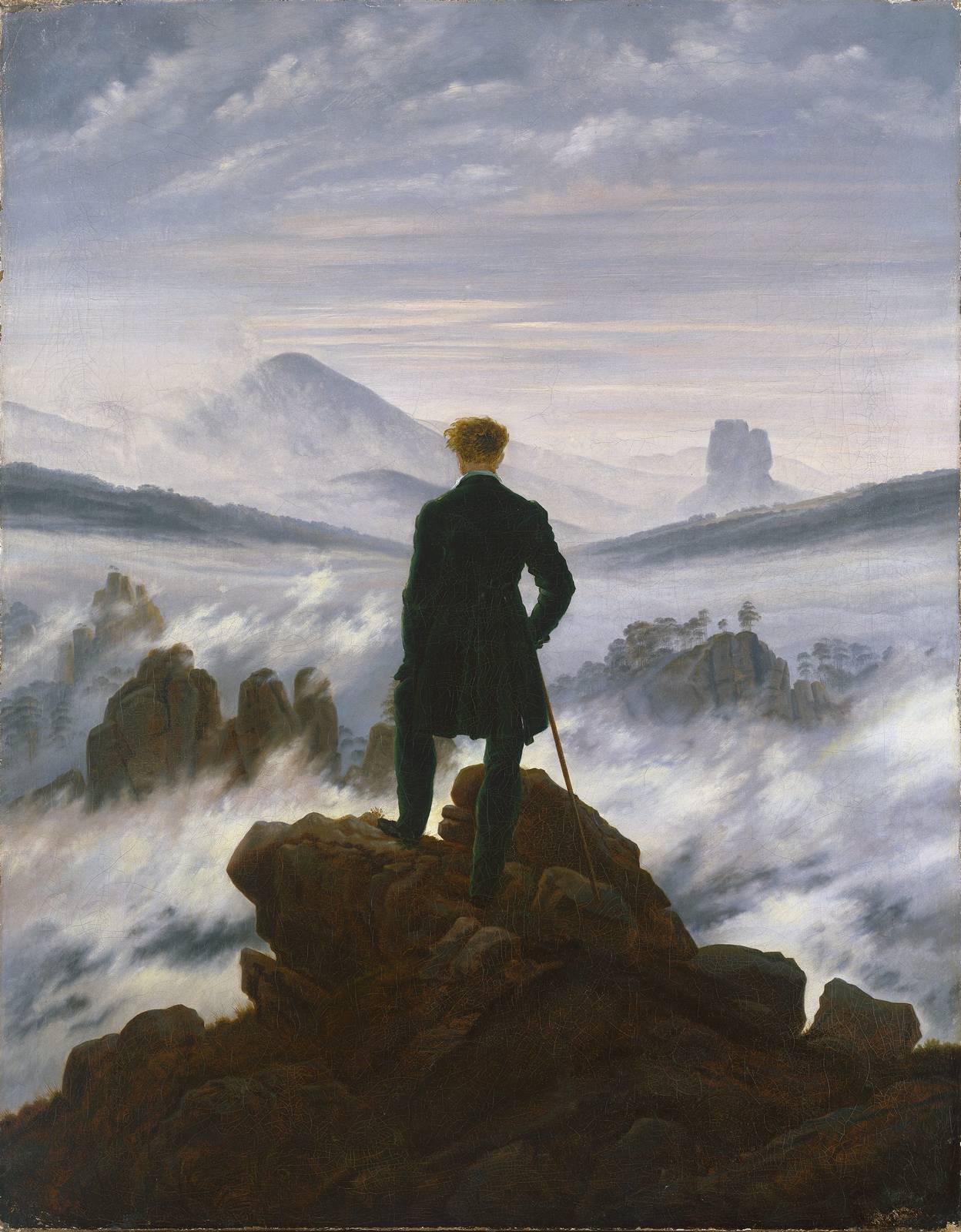
Wanderer above the Sea of Fog, in the Hamburger Kunsthalle and dated around 1818, has become one of the most reproduced images of European Romanticism. A man in a dark green coat stands on a rocky outcrop, cane in hand, above a landscape dissolved into mist. Peaks rise from the fog in the distance. We do not see his expression, and Friedrich gives us no caption that tells us what he feels. The picture leaves that work to the viewer, which is part of why it has been claimed for so many meanings: confidence, solitude, mastery, unease.
It is worth noticing how the composition builds that openness. The figure stands almost at the center, dark against pale, so the eye returns to him again and again. Yet the lines of the rocks and the receding ridges keep pulling attention outward. You are always moving between the person and the view, never resting on either for long.
You are always moving between the person and the view, never resting on either for long.
Company under the moon
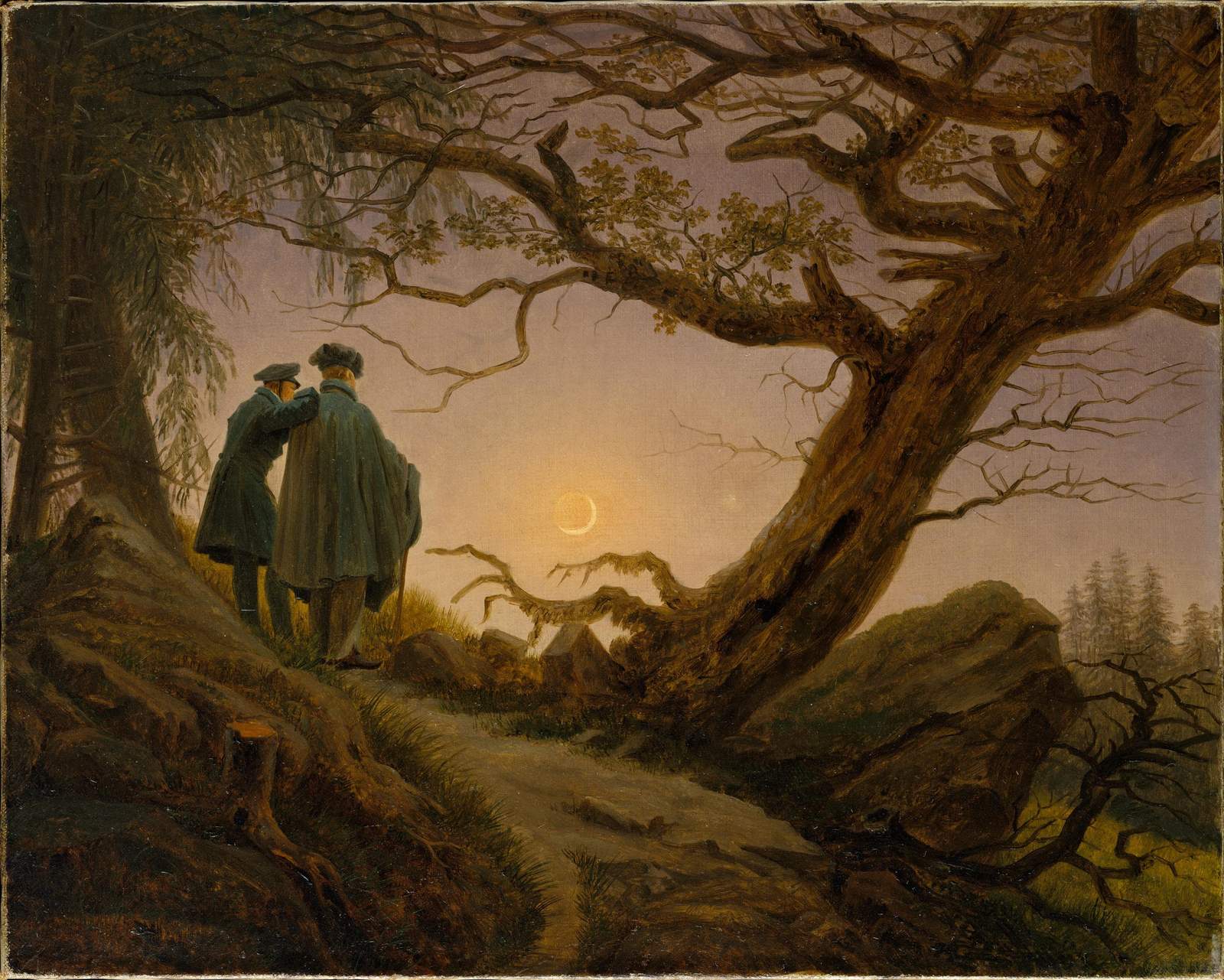
Friedrich’s figures are not always alone. In Two Men Contemplating the Moon, two companions pause on a forest path beside an uprooted tree and a gnarled oak to watch a crescent moon rise. The Metropolitan Museum of Art dates its canvas to about 1825–30; an earlier version painted in 1819 is in Dresden. The scene is small in incident and large in feeling. One man rests a hand on the other’s shoulder, and the shared act of looking becomes a kind of friendship made visible.
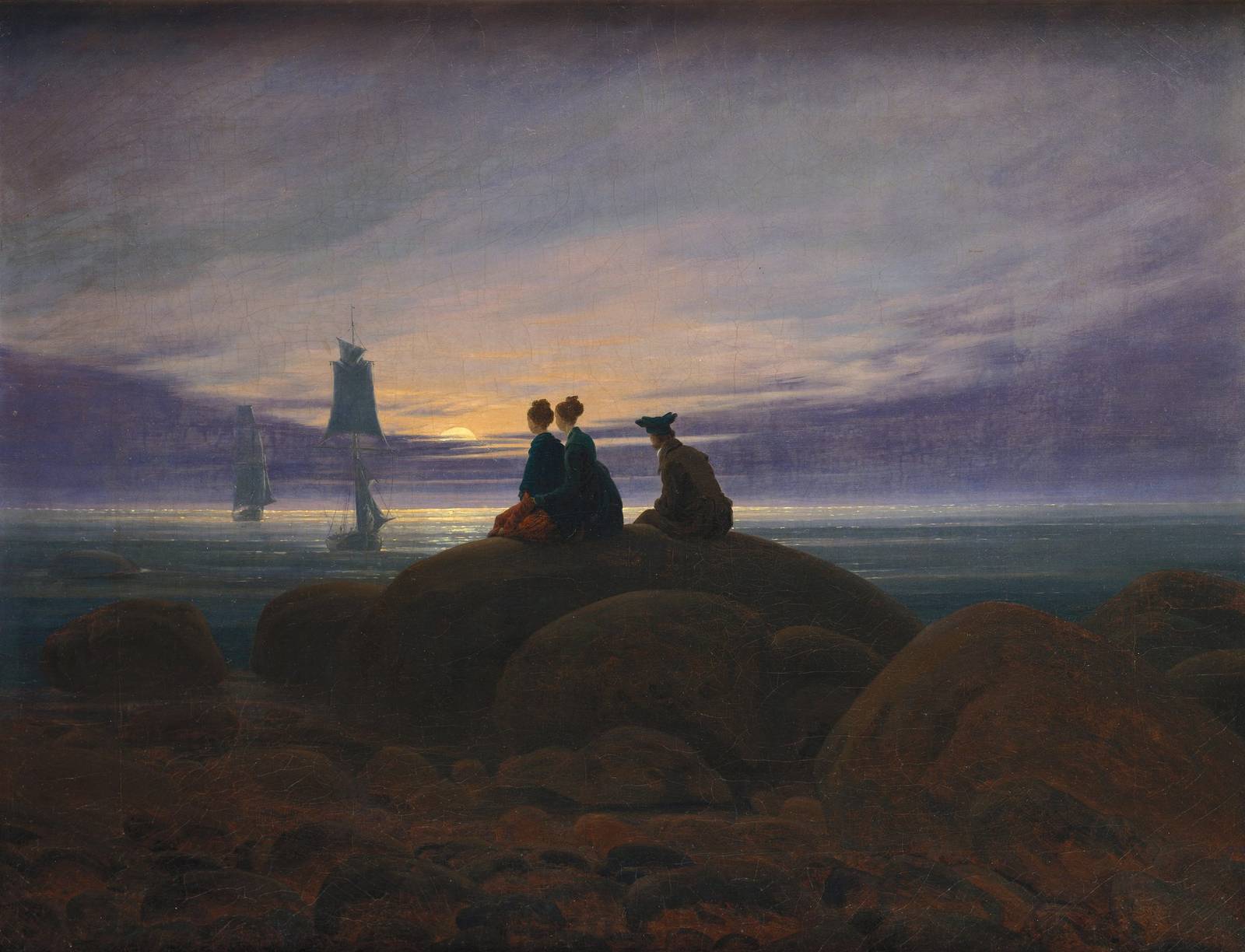
Moonrise over the Sea, painted in 1822 and now in the Alte Nationalgalerie in Berlin, extends the idea to the coast. Figures sit on a boulder at the water’s edge as ships approach under a rising moon. The sky carries most of the color, and the figures are again turned toward it. For a living room or dining room, these moonlit pictures are among the most companionable Friedrichs: quiet, but not lonely.
Ships, family and time
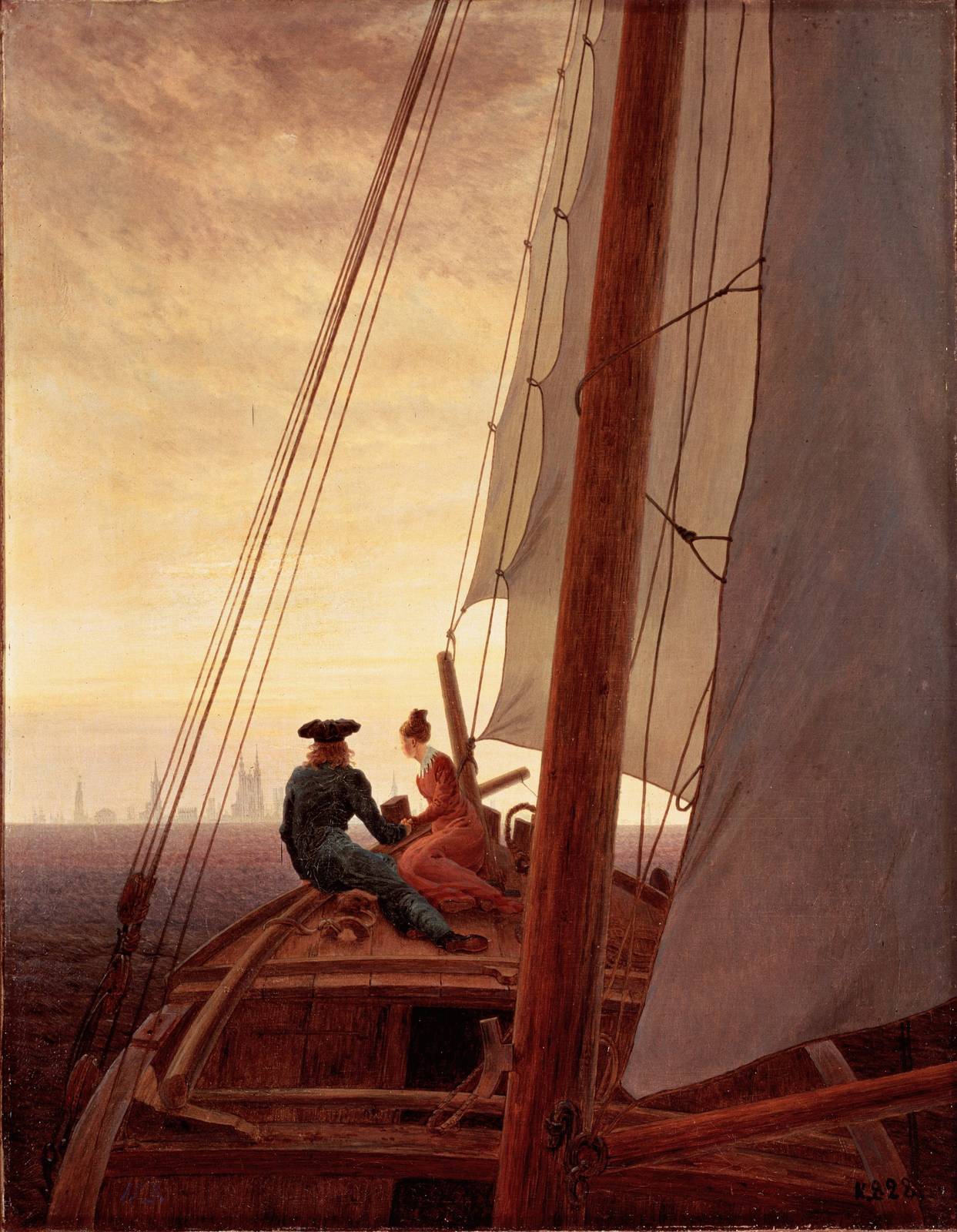
Friedrich married Caroline Bommer in 1818, and On a Sailing Ship, in the State Hermitage Museum, belongs to that year. A man and a woman sit at the bow, hands joined, looking toward a distant town. It is often connected with the couple’s journey to the Baltic coast after their marriage. Whatever biography we read into it, the image is unusually tender for Friedrich: a voyage seen not as danger but as a shared beginning.
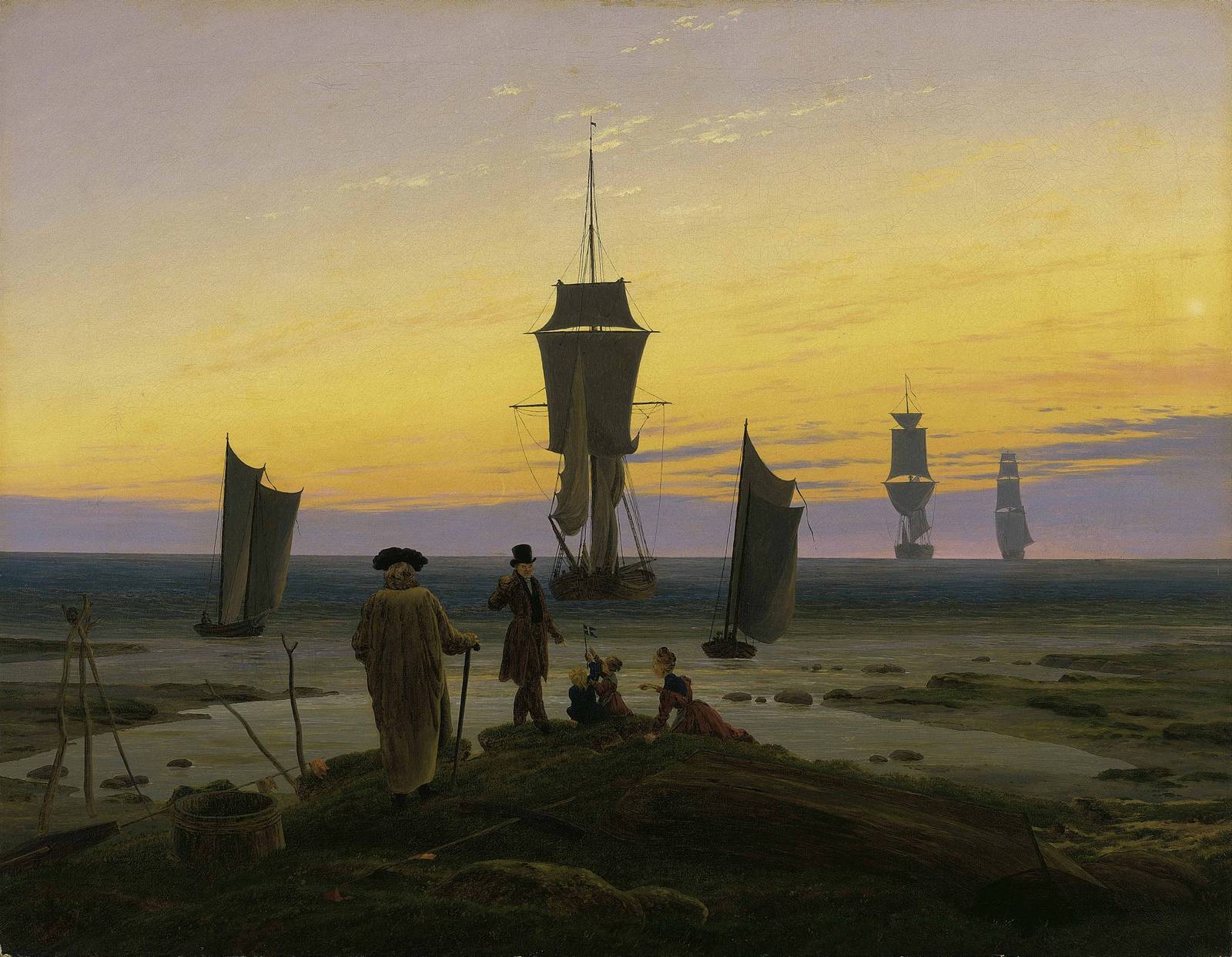
Late in his career, around 1835, he painted The Stages of Life, now in the Museum der bildenden Künste in Leipzig. Five figures gather on a shore at dusk while five ships sit at different distances on the water. The picture is widely read as a meditation on age and family, with the older man in the foreground often taken as the artist himself, though Friedrich left no explanation. The pairing of people and vessels — some near, some far — gives the theme of passing time a form you can grasp at a glance, which is exactly what makes it rewarding to see every day.
Winter and faith
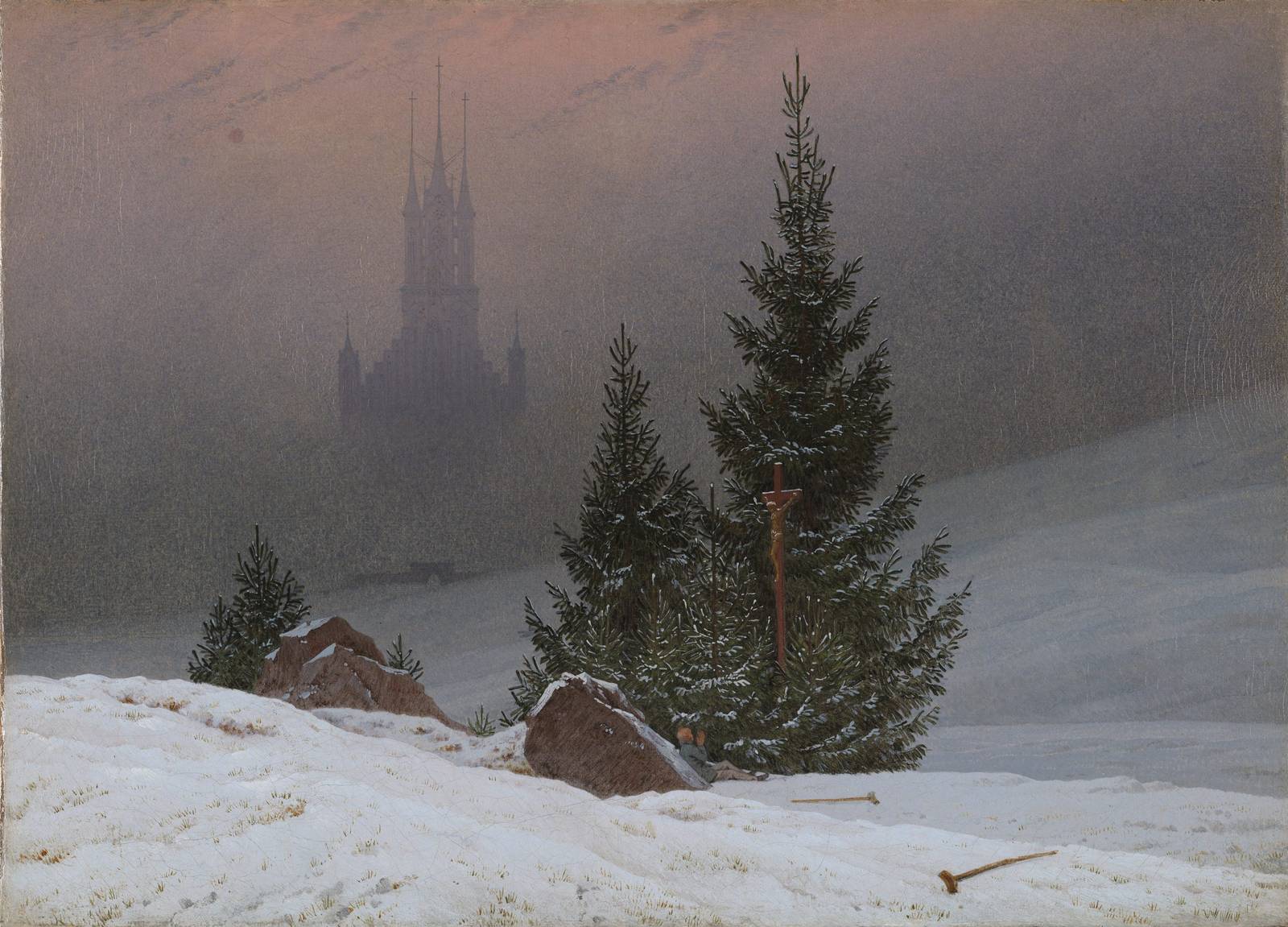
Friedrich’s religious feeling runs through his landscapes rather than sitting on top of them. In Winter Landscape, about 1811, now in the National Gallery in London, a man who has set aside his crutches leans against a rock in the snow, facing a crucifix among young fir trees, while the outline of a Gothic church rises out of the mist behind. The picture is usually read as an image of hope found through faith. It is one of the most beautiful snow scenes of the period, and its palette of grey, white and dark green makes it an unusually adaptable print for a winter wall.
For more snowbound pictures in a similar key, browse our winter landscape paintings.
Forgotten, then everywhere
Friedrich was admired early in his career, but by the time of his death his reputation had faded, and for decades he was largely overlooked. A turning point came with a major exhibition of German art in Berlin in 1906, which helped bring his paintings back into view. In 2024, the 250th anniversary of his birth was marked by large exhibitions in Hamburg, Berlin and Dresden. Today the back-turned wanderer appears on book covers, album sleeves and posters around the world — a fate that would surely have surprised a painter once known chiefly in Dresden.
Choosing a Friedrich for your home
Start with the mood of the room. The moonlit pictures, Two Men Contemplating the Moon and Moonrise over the Sea, bring warmth and companionship. Wanderer above the Sea of Fog and Winter Landscape are cooler and more solitary, good above a desk or in a hallway where a single strong image can anchor the space. On a Sailing Ship is a thoughtful wedding or anniversary gift. The Stages of Life suits a family room, where its subject meets daily life.
Each of these works is printed from a museum scan and framed at its true shape, with nothing cropped. You can see every Friedrich we offer on our Caspar David Friedrich artist page.