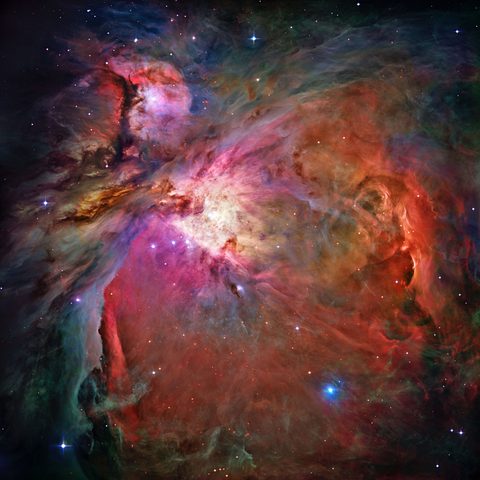
Orion Nebula
NASA / ESA / M. Robberto, 2006
Close enough to see the gas glow. Dust, young stars, a cavity blown clear. Our own sun once looked like this from somewhere else. Some of those lights will outlive us. Some already died.
About this work
In January 2006 NASA and ESA released this Hubble Space Telescope mosaic of the Orion Nebula, one of the most detailed astronomical images made up to then. The survey took 105 Hubble orbits, with all of the telescope's imaging instruments working at once, and the Advanced Camera for Surveys mosaic covers an area of sky about the size of the full Moon. The Orion Nebula, also called Messier 42, is the middle "star" in the sword of Orion, south of Orion's Belt. It is bright enough to see with the naked eye and lies about 1,300 light-years away, which makes it the closest region of massive star formation to Earth. It is about 25 light-years across. At its heart is a very young cluster called the Trapezium, after its four brightest stars, whose radiation lights up the surrounding gas. Hubble first observed the nebula in 1993, and its images have since revealed protoplanetary disks around most of the newly formed stars there. The image is credited to NASA, ESA, M. Robberto (STScI/ESA) and the Hubble Space Telescope Orion Treasury Project Team.
Sources: HubbleSite news release 2006-01 · Wikipedia: Orion Nebula
Print facts
- Native resolution
- 9,000 × 9,000 px
- Sharp at 150 ppi up to
- 60 × 60 in
- Sizes
- Small (20 × 20 in) · $100 · 450 ppi
Medium (24 × 24 in) · $150 · 375 ppi
Large (36 × 36 in) · $300 · 250 ppi - Price includes
- Frame and US shipping · 14–21 days · 30-day returns
FAQ
Where can I buy a framed print of Orion Nebula?
Here. Orion Nebula is available as a framed print in three sizes: Small (20 × 20 in) for $100, Medium (24 × 24 in) for $150 and Large (36 × 36 in) for $300. Prices include the frame and US shipping; delivery takes 14–21 days, with 30-day returns.
What size works best for Orion Nebula?
The file is 9,000 × 9,000 px, so every size is sharp: even Large (36 × 36 in) prints at 250 ppi. Choose Large (36 × 36 in) for a large wall; Small (20 × 20 in) suits a narrower space.
Is it legal to print Orion Nebula?
Yes. The image was released by NASA, ESA and the Space Telescope Science Institute. NASA and STScI material is not protected by copyright in the United States unless noted, and ESA publishes its copy under a Creative Commons Attribution 4.0 licence, so it can be printed with credit to NASA, ESA, M. Robberto (STScI/ESA) and the Hubble Space Telescope Orion Treasury Project Team. A print does not imply endorsement by NASA or ESA.