
The beach is a surprisingly young subject for painting. For most of history the seashore was a place of work and danger, the domain of fishermen, smugglers and shipwrecks. Then, in the nineteenth century, railways and new ideas about sea air turned the coast into a place to spend a holiday, and painters followed the crowds down to the sand. What they made is some of the happiest art there is: wide skies, bright water, parasols, children, and the particular light you only get near the sea.
This guide follows the beach painting from the Normandy coast, where it was more or less invented, to Spain, New England and Cornwall, using works from our beach paintings collection. At the end are some tips for choosing a beach print for your own home.
Painters followed the crowds down to the sand, and made some of the happiest art there is.
Eugène Boudin and the fashionable shore
Eugène Boudin was born in Honfleur, on the Normandy coast, in 1824, and spent his life painting the sea and sky of the Channel. By the 1860s the beaches at Trouville and Deauville had become fashionable resorts for Parisians, now only a train ride away, and Boudin found a subject nobody else was painting: well-dressed holidaymakers sitting and strolling on the sand, small under an enormous sky.
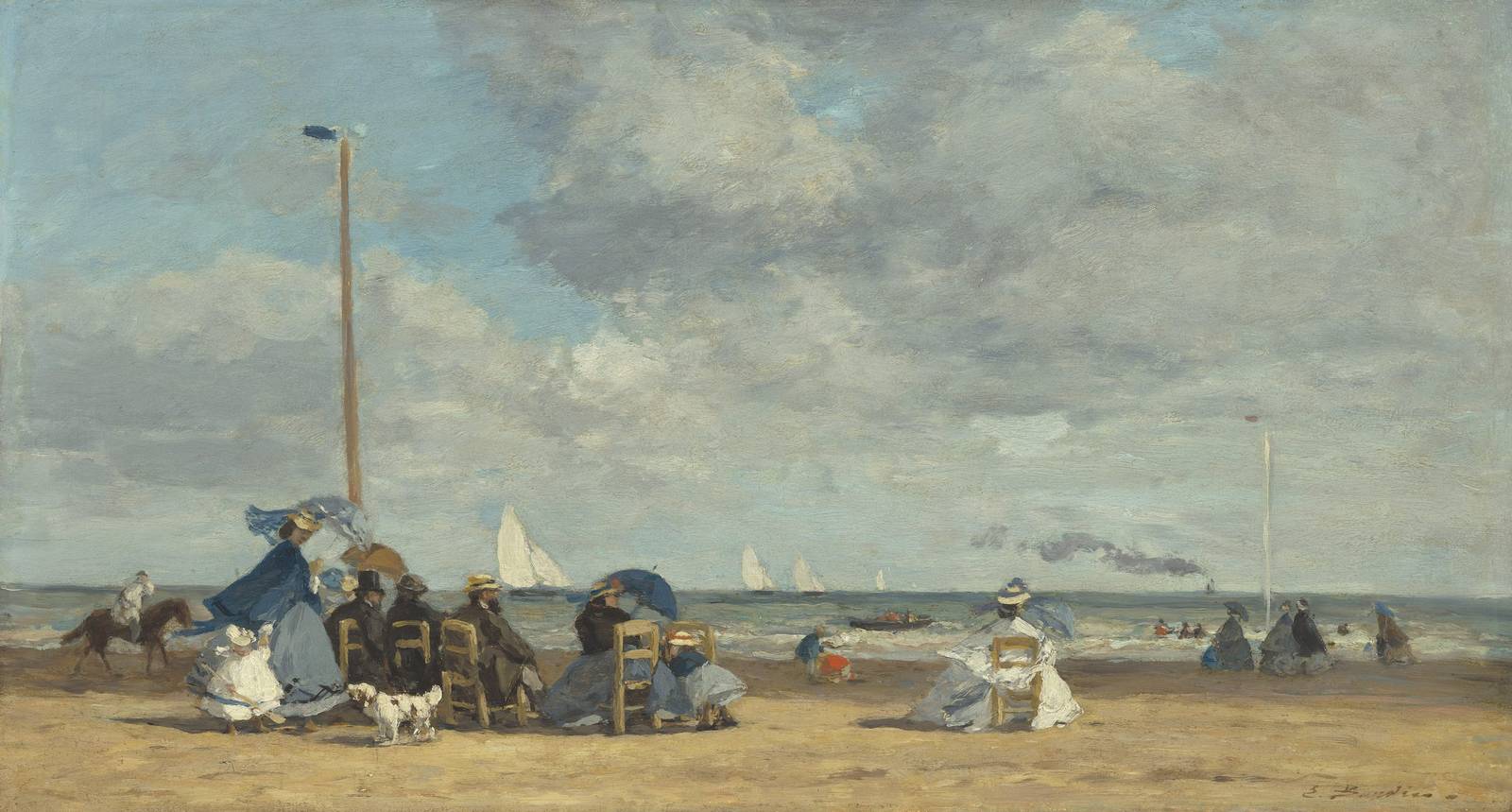
His Beach at Trouville (1864–65, National Gallery of Art) is a lovely example: a parasol, an empty chair and a small dog on the sand, with the sea and sky taking up most of the canvas. Another Beach at Trouville (1863) stretches into a long, pale panorama, and On the Beach, Dieppe (1864, Metropolitan Museum of Art) gathers its figures under a soft, cloudy sky. Boudin painted outdoors, and his skies, quick and luminous, are the real subject. These wide, low pictures look wonderful over a sofa or a bed.
Boudin matters for another reason too. In Le Havre in the late 1850s he met a teenage caricaturist named Claude Monet and encouraged him to paint outdoors, directly from nature. Monet later credited Boudin with opening his eyes.
Monet on the Normandy coast
Monet’s family lived in Le Havre, and he painted the beaches nearby throughout his life. The Beach at Sainte-Adresse (1867, Art Institute of Chicago) shows a resort just outside the town, with fishing boats drawn up on the shingle under a grey sky while a few visitors look on. Fifteen years later he spent months on the coast near Dieppe, and Low Tide at Pourville (1882, Cleveland Museum of Art) is all shimmering wet sand, cliffs and light.
The chalk cliffs and arches at Étretat drew him back again and again. Our Étretat (1883, North Carolina Museum of Art) shows the Falaise d’Aval, the cliff with its famous arch, and you can compare it with Gustave Courbet’s The Cliff at Étretat (about 1869), painted when Courbet spent a summer there. Courbet builds the cliff up heavily, almost like sculpture; Monet lets it dissolve into air. In 1886 Monet went further afield to Belle-Île off Brittany, and Rocks at Belle-Île, Port-Domois trades the holiday beach for dark rocks and churning Atlantic water. See more on our Claude Monet page.
Sorolla and the Mediterranean sun
If the French beach is soft and silvery, the Spanish beach is blinding. Joaquín Sorolla, born in Valencia in 1863, became famous for painting the brilliant light of the Mediterranean shore near his hometown.
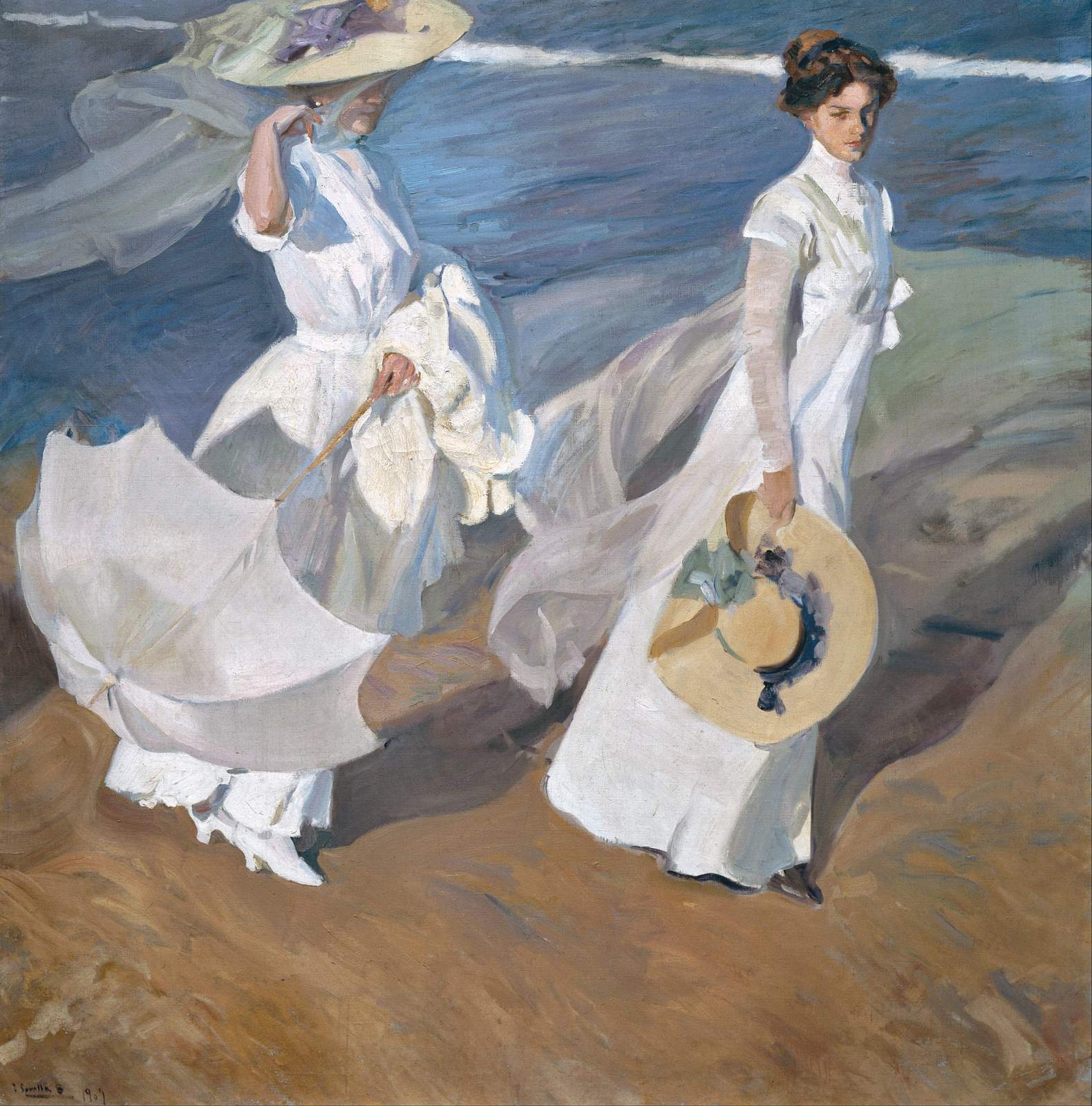
The Return from Fishing (about 1894) shows the working beach: oxen dragging a sailing boat out of the surf, the sail full of wind and light. It helped make his name in Paris, where a version of it was shown at the Salon and acquired by the French state. Strolling along the Seashore (1909, Museo Sorolla) is the leisure beach at its most elegant: two women in white dresses, one holding a parasol, walking along the sand with their veils lifting in the breeze. They are the painter’s wife, Clotilde, and their daughter María. Few paintings capture sunlight on white fabric so well, and it is one of the most popular works we sell for bright, airy rooms. Browse more on our Joaquín Sorolla page.
American beaches: from luminism to summer crowds
American painters came to the shore with a quieter eye. In the 1860s and 1870s painters later grouped as luminists painted calm, glowing coastal scenes. Alfred Thompson Bricher’s A Quiet Day near Manchester (1873) shows golden cliffs, a curving beach and a glassy sea on the Massachusetts coast. Martin Johnson Heade’s Point Judith, Rhode Island (about 1863) is the stormy counterpart, with dark water breaking on the New England shore.
By the early twentieth century the American beach had become a crowded, cheerful place, and Edward Henry Potthast, a Cincinnati-born painter who settled in New York, made it his specialty. His On the Beach, Ogunquit, Maine (1924) is pure summer: bathers, sun and sparkling water painted with loose, bright strokes that owe a clear debt to the French Impressionists. See more on our Edward Henry Potthast page.
Across the Atlantic, the English painter John Brett brought a sharp, almost scientific clarity to the Cornish coast. His Kynance (1888) shows the bright sea, rocks and sand of a cove on the Lizard peninsula in a long, panoramic format.
How to choose a beach print
- Pick your light. Boudin and early Monet are cool and silvery, perfect for soft grey or white rooms; Sorolla and Potthast are warm and sunny, made for bright spaces; Heade and Belle-Île bring drama.
- Use the wide ones wide. Boudin’s Trouville scenes and Brett’s Kynance are long and low, ideal above a sofa, bed or console.
- Bring summer indoors in winter. A beach painting in a dark season is a small daily holiday; it also makes a thoughtful gift for someone who misses the coast.
- Match the frame. White or natural wood keeps a coastal room light; gold flatters the warm Sorolla and Potthast pictures.
- Size it. Every work comes framed and ready to hang in up to three sizes, Small at $195, Medium at $295 and Large at $395, printed at the original’s true proportions without cropping. Exact dimensions are on each work page.
For more sea and shore, browse our Beach collection, stormy sea paintings and Impressionist paintings, or see every work by Eugène Boudin.