
No ancient city has held painters’ imaginations as long as Rome. For the artists of the eighteenth century, it was a place of ruins: broken arches, grass growing on the Colosseum, tourists sketching among the columns. For the painters of the nineteenth century, it was a stage to rebuild, with the stands full again, the sand of the arena raked smooth and the chariots wheeling around the Circus Maximus.
This guide walks through the paintings of ancient Rome in our collection in two parts, first the ruins as travelers saw them and then the spectacles as later painters imagined them, with notes on what each picture shows and where it might hang. You can see them all together in our Colosseum and Roman ruins collection and the wider Roman Empire category.
Eighteenth-century painters showed Rome as a city of ruins; nineteenth-century painters filled the stands again.
The Pantheon: Panini’s great interior
Giovanni Paolo Panini (1691–1765) made his career painting Rome for visitors on the Grand Tour, the long educational journey that wealthy young Europeans, many of them British, took through Italy. His Interior of the Pantheon (about 1734, National Gallery of Art, Washington) is one of the best-loved pictures of any Roman building.
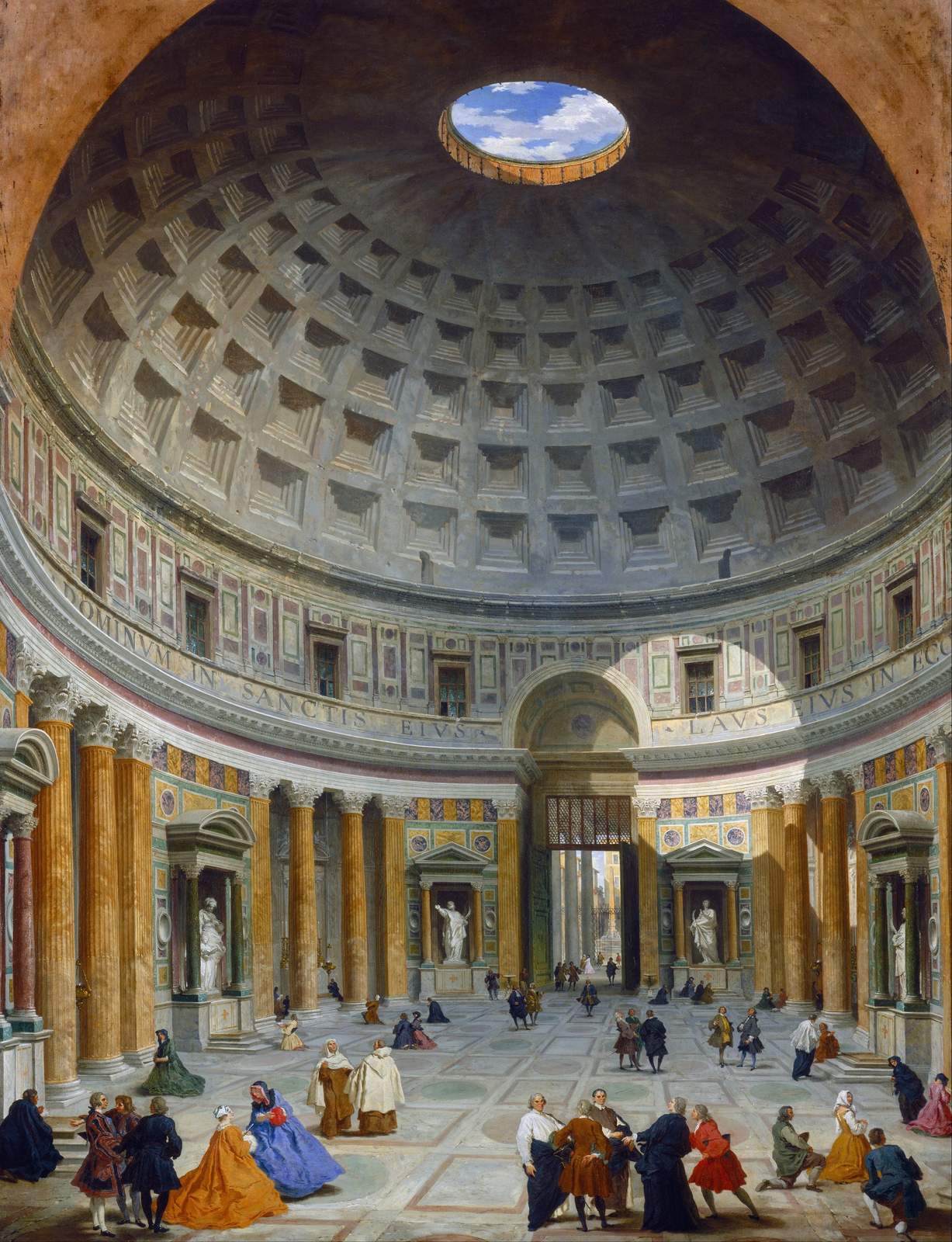
The Pantheon was rebuilt under the emperor Hadrian in the early second century AD, though the inscription on its porch still credits Marcus Agrippa, who built the earlier temple on the site. Its concrete dome is as wide as the building is tall, and the only light comes from the round opening at the top, the oculus. Panini catches exactly that: a disc of sunlight falling on the wall, and visitors of every kind, from priests to fashionable tourists, crossing the marble floor below. The building was consecrated as a church in 609, which is one reason it survived so well.
Because the painting is upright and full of quiet detail, it works beautifully in a study, a library or an entry hall, anywhere you want a sense of calm and order.
The Colosseum and the Arch of Constantine
The Venetian painter Canaletto is best known for Venice and London, but his View of the Arch of Constantine with the Colosseum (1742–45, J. Paul Getty Museum) shows two of Rome’s great monuments side by side. The Arch of Constantine was dedicated in AD 315 to celebrate the emperor’s victory at the Milvian Bridge three years earlier. Beyond it rises the curved wall of the Colosseum, the Flavian Amphitheatre, begun under Vespasian in the 70s AD and opened by his son Titus in AD 80.
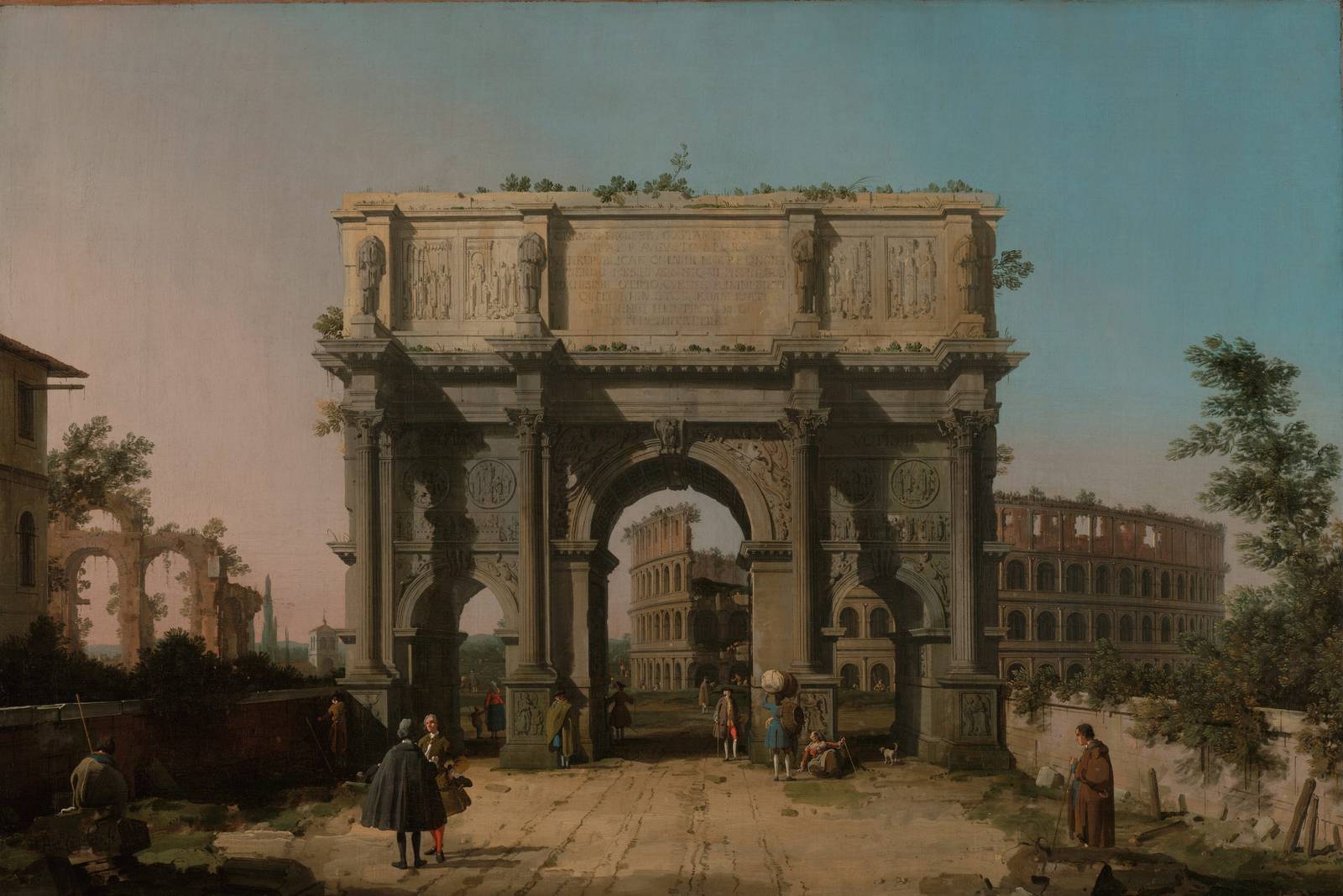
Canaletto paints the monuments in clear, even daylight, with a few small figures for scale. The arena itself is a ruin here, as it was in his time, its stone long quarried for other buildings. It is a crisp, architectural picture that suits an office or a dining room, and it pairs naturally with Panini’s Pantheon.
Gérôme: the arena brought back to life
A century later, the French painter Jean-Léon Gérôme (1824–1904) set out to show not the ruins but the games themselves. He researched armor, architecture and costume carefully, and his crowded, polished scenes shaped how many people still picture ancient Rome.
His Ave Caesar! Morituri te salutant (1859, Yale University Art Gallery) shows a line of gladiators raising their arms to the emperor’s box. The Latin means “Hail, Caesar! Those who are about to die salute you.” The phrase comes from the Roman historian Suetonius, who records it in his life of the emperor Claudius, at a staged naval battle on the Fucine Lake. It is not known to have been a regular custom in the arena, but Gérôme’s painting made it famous.
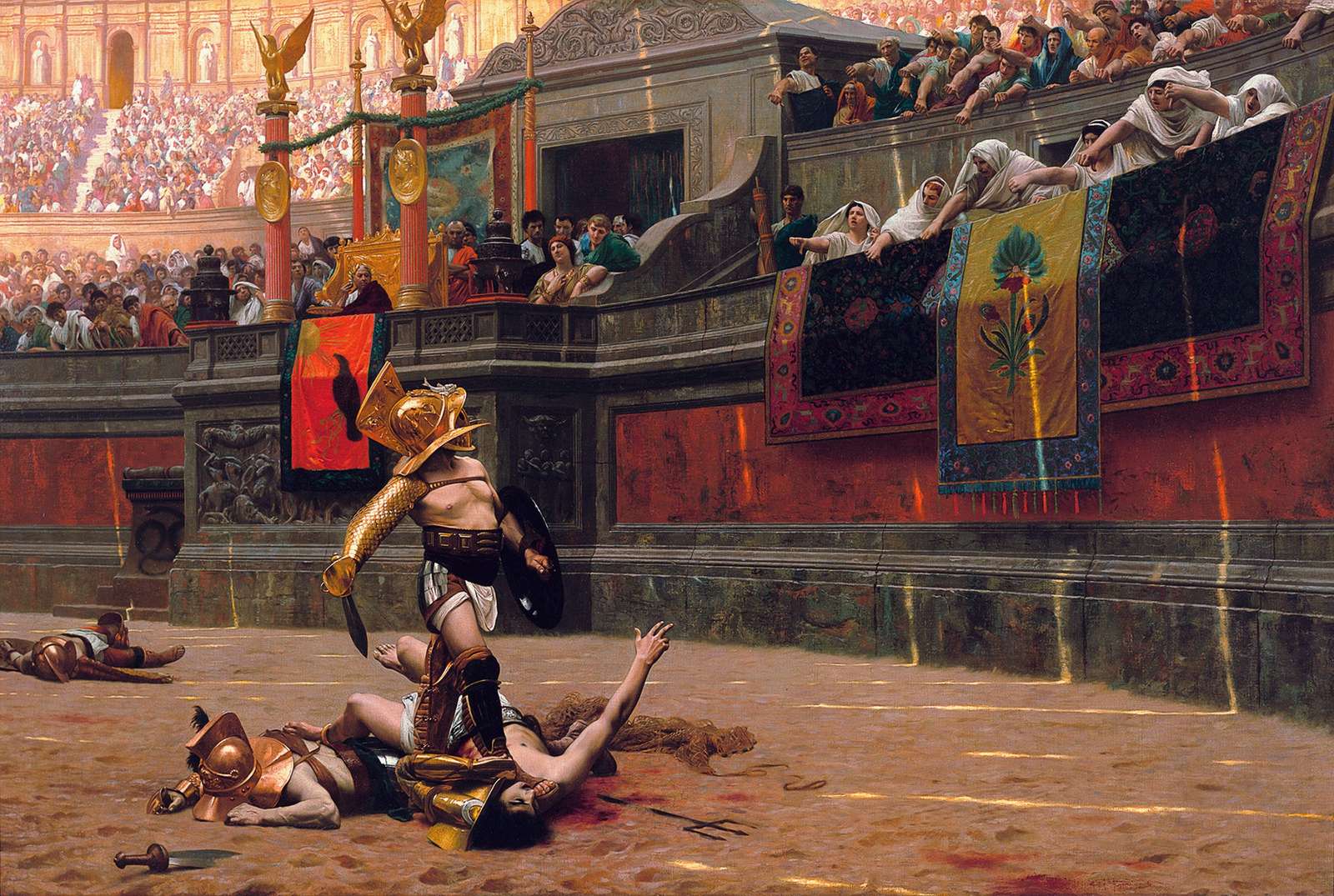
Gérôme’s best-known arena picture is Pollice Verso (1872, Phoenix Art Museum). The title means “with a turned thumb.” A victorious gladiator stands over his fallen opponent and looks up to the stands, where the crowd, and the white-robed Vestal Virgins in the front row, are signalling their verdict. Historians still debate exactly which thumb gesture meant death in ancient Rome; Gérôme’s thumbs-down version is the one that stuck. The painting is often said to have helped inspire Ridley Scott’s 2000 film Gladiator.
Historians still debate which thumb gesture meant death; Gérôme’s version is the one that stuck.
If the Vestals catch your eye, Louis Hector Leroux’s Vestal Virgins at the Colosseum (about 1890) turns the camera around, so to speak, and shows the priestesses themselves in their seats of honor above the arena.
The Circus Maximus and the chariot races
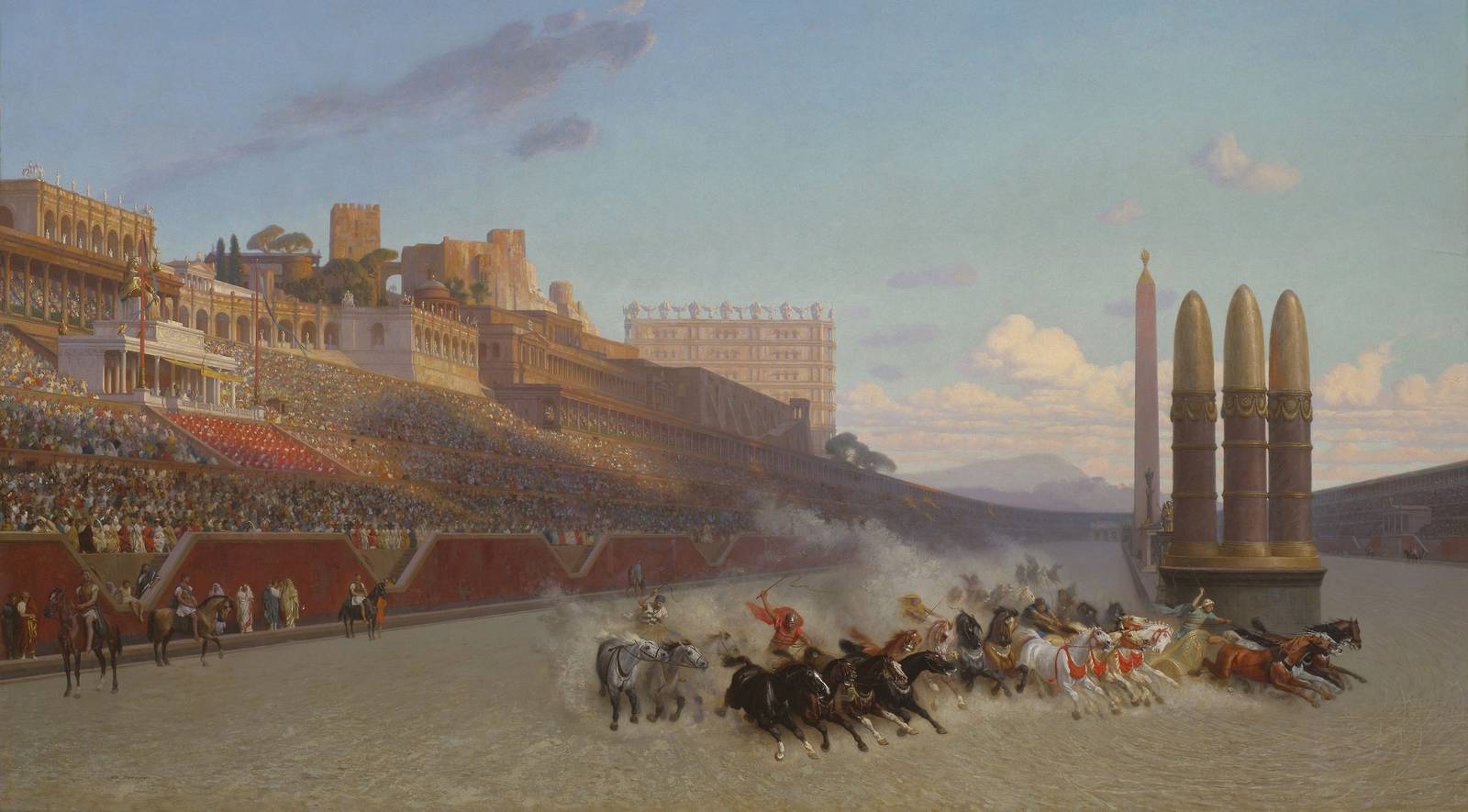
For most Romans, the biggest spectacle was not the gladiators but the chariot races, held in the Circus Maximus, the long racetrack in the valley between the Palatine and Aventine hills. Gérôme’s The Chariot Race (1876, Art Institute of Chicago) looks down the length of the track as the teams swing around the turning post. Above them rise the imperial palaces on the Palatine, and down the middle runs the central barrier, the spina, decorated with monuments, including an Egyptian obelisk. Augustus had an obelisk brought from Egypt and set up in the Circus; it now stands in Rome’s Piazza del Popolo.
The Spanish painter Ulpiano Checa (1860–1916), who spent much of his career in Paris, brought even more speed to the subject. His Roman Chariot Race (1890) puts us almost under the hooves, with teams of horses straining around the turn and dust flying. Few paintings in our collection have as much movement.
Checa also painted The Naumachia (1894), a staged naval battle. Romans really did put on these water spectacles: Julius Caesar had a basin dug for one, and ancient writers describe sea fights flooded into arenas and lakes, including the Fucine Lake battle where Suetonius placed the famous salute. Checa’s picture of ships ramming in an enclosed basin, ringed by spectators, makes a striking companion to Gérôme’s Ave Caesar.
Choosing an ancient Rome print
- For a study, library or office. Panini’s Pantheon or Canaletto’s Arch of Constantine: architecture, daylight and a sense of order.
- For a family room or man cave. Gérôme’s Pollice Verso or Checa’s chariot race, both full of drama and easy to talk about.
- For a long wall. The wide shapes of The Chariot Race and The Naumachia suit the space over a sofa or sideboard, especially in the Large size.
- As a gift. Anyone who loves history, classics, Gladiator or a trip to Rome will recognize these scenes at once.
- Size and price. Most works come framed in three sizes: Small at $195, Medium at $295 and Large at $395, printed at the original’s true shape without cropping. Each work page lists the exact dimensions and which sizes print sharpest.
A note on accuracy: Gérôme and Checa were painting a century and a half ago, and some details reflect the scholarship and imagination of their time rather than what archaeologists know today. That is part of their charm. These are pictures of how the nineteenth century dreamed of Rome.
For more history on your walls, see our gift guide for history lovers and our guide to Canaletto’s Venice, or browse the gladiator and chariot race collection.