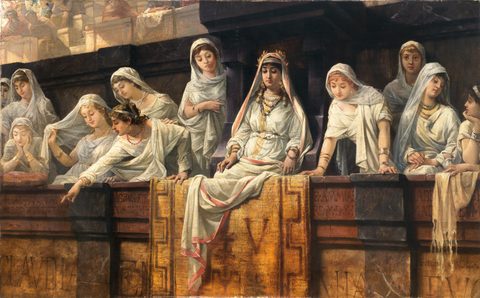
Vestal Virgins at the Colosseum
Louis Hector Leroux, 19th century
The Vestals in their white robes take their seats of honour in the Colosseum above the arena, with the crowd filling the tiers behind them.
About this work
A row of Vestal Virgins, the priestesses of Rome who kept the sacred fire of the goddess Vesta, sits in white veils at the front of their box in the Colosseum in this painting by the French artist Louis Hector Leroux. They lean on a carved and painted parapet hung with rich fabric, some watching the arena below, others talking, while the tiers of the amphitheater rise behind them.
Leroux specialized in carefully researched scenes of ancient Rome, especially of women, and was best known for a long series of paintings that he worked on throughout his career. This canvas, from around 1890, was once sold as a Byzantine scene; its true subject was identified from a study for it held at the museum in Verdun, his birthplace.
The scan is 7576 × 4703 pixels. The wide composition suits a living room, a hallway or a library, and makes a striking gift for anyone who loves Roman history or the Colosseum.
Sources: Wikimedia Commons · Wikipedia: Louis Hector Leroux
FAQ
Where can I buy a framed print of Vestal Virgins at the Colosseum?
Here. Vestal Virgins at the Colosseum is available as a framed print in three sizes: Small (20 × 12 in) for $195, Medium (24 × 15 in) for $295 and Large (36 × 22 in) for $395. Prices include the frame and US shipping; delivery takes 14–21 days, with 30-day returns.
What size works best for Vestal Virgins at the Colosseum?
The file is 7,576 × 4,703 px, so every size is sharp: even Large (36 × 22 in) prints at 210 ppi. Choose Large (36 × 22 in) for a large wall; Small (20 × 12 in) suits a narrower space.
Is it legal to print Vestal Virgins at the Colosseum?
Yes. Vestal Virgins at the Colosseum is in the public domain: its copyright, if it ever had one, expired long ago. In the United States a faithful photograph of a public-domain painting does not create a new copyright (Bridgeman v. Corel, 1999), so the image can be printed and sold freely.

















