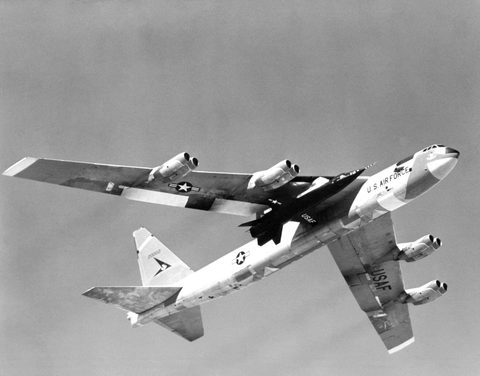
X-15 mated under the B-52
The black dart rides the bomber's wing. Eight engines, one rocket plane, and a sky that is about to get out of the way.
About this work
This NASA photograph from about 1959 shows one of the three X-15 rocket-powered research aircraft carried aloft under the wing of its B-52 mothership. The X-15 was launched in the air so that it would have enough fuel left to reach its high speeds and altitudes. In the dense lower atmosphere it flew with conventional aerodynamic controls, and in the thin air at the edge of space it used a reaction control system of small hydrogen peroxide thrusters in the nose and wings. NASA flew two modified B-52s as launch aircraft, the NB-52A and the NB-52B known as Balls 8, which dropped the X-15 on 106 of the program's 199 flights. Its right wing was reinforced and fitted with a pylon that could carry more than 50,000 pounds. The X-15 was built by North American Aviation and flown by the U.S. Air Force and NASA. Its fastest flight, at 4,520 miles per hour or Mach 6.7, was made by William J. Knight on October 3, 1967. NASA catalogues this image as GPN-2000-000109.
Sources: Wikimedia Commons · Wikipedia: North American X-15 · Wikipedia: Balls 8
FAQ
Where can I buy a framed print of X-15 mated under the B-52?
Here. X-15 mated under the B-52 is available as a framed print in three sizes: Small (20 × 16 in) for $195, Medium (24 × 19 in) for $295 and Large (36 × 28 in) for $395. Prices include the frame and US shipping; delivery takes 14–21 days, with 30-day returns.
What size works best for X-15 mated under the B-52?
The file is 5,100 × 4,000 px. Medium (24 × 19 in) is the largest size that prints at 150 ppi or more (211 ppi), the sharpest choice for close viewing; Large (36 × 28 in) prints at 142 ppi, fine from a few feet away but softer up close.
Is it legal to print X-15 mated under the B-52?
Yes. NASA made this photograph, and NASA material is not protected by copyright in the United States unless noted, so it can be printed and sold. A print does not imply NASA endorsement, and NASA's logos and insignia are not covered.

















