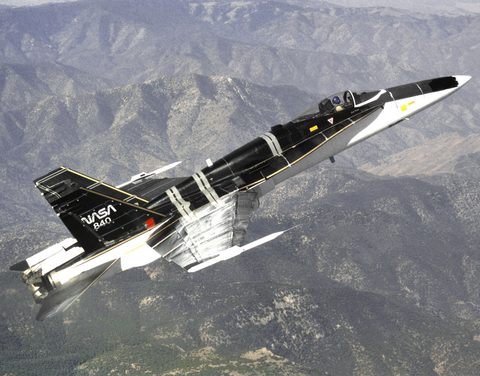
F-18 HARV
NASA, 1994
NASA's modified F-18 High Alpha Research Vehicle on an airflow study flight from the Dryden Flight Research Center, Edwards, California, in 1994.
About this work
On June 27, 1994, NASA's modified F-18 High Alpha Research Vehicle (HARV) flew an air-flow study from the Dryden Flight Research Center at Edwards, California, and this NASA photograph records it. Researchers coated the aircraft with oil so they could see how the air moved across the wing at different speeds and angles of attack, the angle between the wing and the oncoming air. For the high-angle-of-attack program, NASA fitted the jet's engines with a thrust-vectoring system: three paddles on each exhaust nozzle, linked to the flight-control computer, redirected the exhaust to steer the airplane. With them the HARV could fly in control at angles of attack up to 70 degrees, far beyond where a normal fighter's wings stall. The research, flown from 1987 to 1996, helped designers of later agile fighters. The modified Navy F/A-18 Hornet, in white and blue NASA colors, makes a crisp print for an engineer's office or a study.
Sources: Wikimedia Commons · Wikipedia: McDonnell Douglas F/A-18 Hornet
FAQ
Where can I buy a framed print of F-18 HARV?
Here. F-18 HARV is available as a framed print in three sizes: Small (20 × 16 in) for $195, Medium (24 × 19 in) for $295 and Large (36 × 28 in) for $395. Prices include the frame and US shipping; delivery takes 14–21 days, with 30-day returns.
What size works best for F-18 HARV?
The file is 5,100 × 4,000 px. Medium (24 × 19 in) is the largest size that prints at 150 ppi or more (211 ppi), the sharpest choice for close viewing; Large (36 × 28 in) prints at 142 ppi, fine from a few feet away but softer up close.
Is it legal to print F-18 HARV?
Yes. NASA made this photograph, and NASA material is not protected by copyright in the United States unless noted, so it can be printed and sold. A print does not imply NASA endorsement, and NASA's logos and insignia are not covered.

















