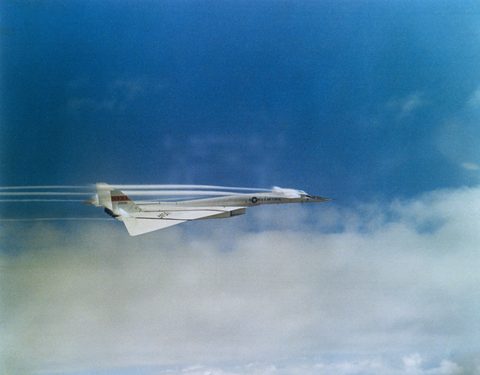
XB-70 Valkyrie
NASA, 1967
The North American XB-70A Valkyrie, the first of two triple-sonic bomber prototypes, photographed on 22 September 1967. NASA used the aircraft for high-speed research in the 1960s.
About this work
This NASA photograph, dated September 22, 1967, shows the North American Aviation XB-70 Valkyrie prototype No. 1, a six-engine bomber designed to cruise at three times the speed of sound. Only two XB-70s were built. The Air Force cancelled the bomber program, and the two aircraft became research planes; NASA used them in the mid-1960s to study high-speed flight, sonic booms and large supersonic aircraft for a planned American airliner. The second XB-70 was destroyed in a mid-air collision in June 1966 during a photo flight. The first made its last flight in 1969 to Wright-Patterson Air Force Base, Ohio, and it is now on display at the National Museum of the United States Air Force in Dayton. The long white delta, with its drooping wingtips and canard foreplanes, still looks futuristic. The print suits an office, a hangar lounge or the wall of anyone who grew up with the jet age.
Sources: NASA Image and Video Library · Wikipedia: North American XB-70 Valkyrie
FAQ
Where can I buy a framed print of XB-70 Valkyrie?
Here. XB-70 Valkyrie is available as a framed print in three sizes: Small (20 × 16 in) for $195, Medium (24 × 19 in) for $295 and Large (36 × 28 in) for $395. Prices include the frame and US shipping; delivery takes 14–21 days, with 30-day returns.
What size works best for XB-70 Valkyrie?
The file is 4,463 × 3,491 px. Medium (24 × 19 in) is the largest size that prints at 150 ppi or more (184 ppi), the sharpest choice for close viewing; Large (36 × 28 in) prints at 124 ppi, fine from a few feet away but softer up close.
Is it legal to print XB-70 Valkyrie?
Yes. NASA made this photograph, and NASA material is not protected by copyright in the United States unless noted, so it can be printed and sold. A print does not imply NASA endorsement, and NASA's logos and insignia are not covered.
















