Calutron Girls
Manhattan Engineer District, 1944
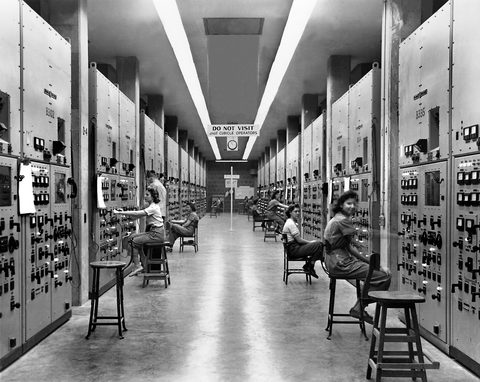
The Calutron Girls: operators at the calutron control panels in the Y-12 plant at Oak Ridge, Tennessee, in 1944, photographed by Ed Westcott. From the U.S. Department of Energy.
About this work
Young women sit at the control panels of calutrons in the Y-12 plant at Oak Ridge, Tennessee, in 1944, in a photograph by Ed Westcott, the official photographer of the Manhattan Project's secret city. It comes from the U.S. Department of Energy's Oak Ridge collection (Y-12-141). The calutron was a mass spectrometer developed by Ernest Lawrence at the University of California, which gave it its name, to separate the fissile isotope uranium-235 from ordinary uranium. The operators, many of them recent high-school graduates from rural Tennessee, watched dials and adjusted knobs to keep the uranium beams on target, without being told what the machines were for. Lawrence's team found that they ran the calutrons better than his PhD physicists. Uranium enriched at Y-12 was used in the Little Boy bomb dropped on Hiroshima on 6 August 1945. Because copper was scarce in wartime, the plant's enormous electromagnet coils were wound with about 14,700 tons of silver borrowed from the U.S. Treasury. Y-12 is still operated by the Department of Energy's National Nuclear Security Administration.
Sources: Wikimedia Commons · Wikipedia: Calutron · Wikipedia: Y-12 National Security Complex
FAQ
Where can I buy a framed print of Calutron Girls?
Here. Calutron Girls is available as a framed print in three sizes: Small (20 × 16 in) for $195, Medium (24 × 19 in) for $295 and Large (36 × 29 in) for $395. Prices include the frame and US shipping; delivery takes 14–21 days, with 30-day returns.
What size works best for Calutron Girls?
The file is 5,704 × 4,544 px, so every size is sharp: even Large (36 × 29 in) prints at 157 ppi. Choose Large (36 × 29 in) for a large wall; Small (20 × 16 in) suits a narrower space.
Is it legal to print Calutron Girls?
Yes. Ed Westcott took this photograph as the U.S. government's photographer for the Manhattan Project, and it is distributed by the Department of Energy; works of the U.S. federal government are in the public domain, so it can be printed and sold.

















