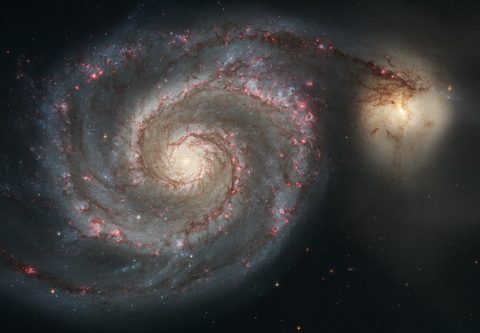
Whirlpool Galaxy
NASA / ESA / Hubble, 2005
One spiral, and a smaller one yanking its arm. It looks like water. It is stars. The neighbor is not finished stealing.
About this work
The Whirlpool Galaxy (M51a, NGC 5194) is a grand-design spiral galaxy in the constellation Canes Venatici, about 31 million light-years away and roughly 76,900 light-years across. It is interacting with its smaller companion, NGC 5195, seen at the end of one spiral arm; the pair can be seen in binoculars. Charles Messier discovered it on October 13, 1773, and William Parsons, 3rd Earl of Rosse, using a 72-inch telescope at Birr Castle in Ireland, found that it had a spiral structure, the first "nebula" known to have one. Such spiral nebulae were not recognised as separate galaxies until Edwin Hubble measured the distances to Cepheid variable stars in some of them. This image is the composite released by the Hubble Heritage Project in January 2005, made with Hubble's Advanced Camera for Surveys at 11,477 × 7,965 pixels. It highlights the galaxy's spiral arms and shows detail of some of the structures inside them.
Sources: Wikipedia · Wikimedia Commons
Print facts
- Native resolution
- 11,477 × 7,965 px
- Sharp at 150 ppi up to
- 76 × 53 in
- Sizes
- Small (20 × 14 in) · $100 · 569 ppi
Medium (24 × 17 in) · $150 · 469 ppi
Large (36 × 25 in) · $300 · 319 ppi - Price includes
- Frame and US shipping · 14–21 days · 30-day returns
FAQ
Where can I buy a framed print of Whirlpool Galaxy?
Here. Whirlpool Galaxy is available as a framed print in three sizes: Small (20 × 14 in) for $100, Medium (24 × 17 in) for $150 and Large (36 × 25 in) for $300. Prices include the frame and US shipping; delivery takes 14–21 days, with 30-day returns.
What size works best for Whirlpool Galaxy?
The file is 11,477 × 7,965 px, so every size is sharp: even Large (36 × 25 in) prints at 319 ppi. Choose Large (36 × 25 in) for a large wall; Small (20 × 14 in) suits a narrower space.
Is it legal to print Whirlpool Galaxy?
Yes. The image was released by NASA, ESA and the Space Telescope Science Institute. NASA and STScI material is not protected by copyright in the United States unless noted, and ESA publishes its copy under a Creative Commons Attribution 4.0 licence, so it can be printed with credit to NASA and the European Space Agency. A print does not imply endorsement by NASA or ESA.