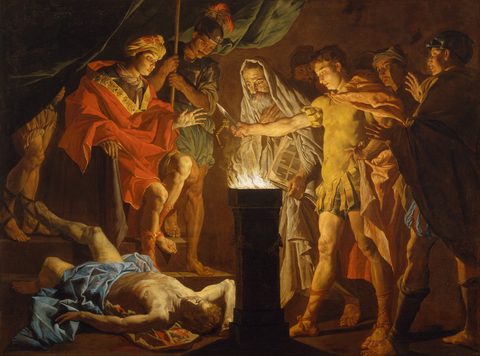
Mucius Scaevola before Lars Porsenna
Matthias Stom, early 1640s
Scaevola holds his hand in the flame before the king — Roman courage played as theater.
About this work
Matthias Stom painted Mucius Scaevola in the Presence of Lars Porsenna in the early 1640s. The oil on canvas is in the Art Gallery of New South Wales in Sydney and was photographed for the Google Art Project. The story comes from early Roman legend. In 508 BC, when the Etruscan king Lars Porsena of Clusium was besieging Rome, a young Roman named Gaius Mucius slipped into the enemy camp, with the Senate's approval, to kill the king. It was the soldiers' pay day, two similarly dressed men sat on the platform, and he killed the wrong one. Captured and brought before Porsena, he thrust his right hand into a fire and held it there to show how little he feared pain. The king, impressed, released him, and Mucius was afterwards called Scaevola, "left-handed." Stom, a Dutch or possibly Flemish painter born about 1600, is known only from work made in Italy. He was influenced by the Utrecht followers of Caravaggio, by Jusepe de Ribera and by Rubens.
Sources: Wikimedia Commons · Wikipedia: Matthias Stom · Wikipedia: Gaius Mucius Scaevola
FAQ
Where can I buy a framed print of Mucius Scaevola before Lars Porsenna?
Here. Mucius Scaevola before Lars Porsenna is available as a framed print in three sizes: Small (20 × 15 in) for $195, Medium (24 × 18 in) for $295 and Large (36 × 27 in) for $395. Prices include the frame and US shipping; delivery takes 14–21 days, with 30-day returns.
What size works best for Mucius Scaevola before Lars Porsenna?
The file is 5,001 × 3,708 px. Medium (24 × 18 in) is the largest size that prints at 150 ppi or more (206 ppi), the sharpest choice for close viewing; Large (36 × 27 in) prints at 137 ppi, fine from a few feet away but softer up close.
Is it legal to print Mucius Scaevola before Lars Porsenna?
Yes. Mucius Scaevola before Lars Porsenna is in the public domain: its copyright, if it ever had one, expired long ago. In the United States a faithful photograph of a public-domain painting does not create a new copyright (Bridgeman v. Corel, 1999), so the image can be printed and sold freely.

















