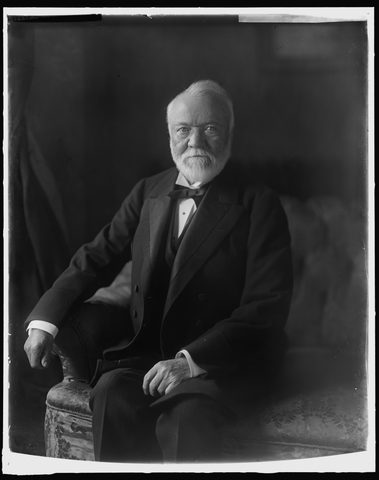
Andrew Carnegie
Library of Congress / Bain News Service, c. 1905
Steel and libraries — Carnegie seated as industrial titan.
About this work
This portrait of Andrew Carnegie was made by Harris & Ewing, the Washington, D.C. photographic studio, on an 8 by 10 inch glass transparency. It belongs to the Harris & Ewing Collection, which the firm gave to the Library of Congress in 1955. The Library dates it only by the studio's active years, 1905 to 1945; since Carnegie died in 1919, it was made in the first part of that span. George W. Harris and Martha Ewing opened the studio in 1905, and by the late 1930s it was the largest photographic studio in the United States. Carnegie (1835–1919) was born in Dunfermline, Scotland, and emigrated with his parents to the Pittsburgh area in 1848, at the age of 12. He began work in a cotton mill and as a telegrapher, then built Pittsburgh's Carnegie Steel Company, which he sold to J. P. Morgan in 1901 for $303,450,000; it formed the basis of U.S. Steel. In his 1889 article "The Gospel of Wealth" he called on the rich to use their wealth to improve society. In the last 18 years of his life he gave away about $350 million, almost 90 percent of his fortune, funding local libraries, Carnegie Hall in New York and the Peace Palace in The Hague.
Sources: Library of Congress · Wikimedia Commons · Wikipedia: Andrew Carnegie · Wikipedia: Harris & Ewing
FAQ
Where can I buy a framed print of Andrew Carnegie?
Here. Andrew Carnegie is available as a framed print in three sizes: Small (16 × 20 in) for $195, Medium (19 × 24 in) for $295 and Large (28 × 36 in) for $395. Prices include the frame and US shipping; delivery takes 14–21 days, with 30-day returns.
What size works best for Andrew Carnegie?
The file is 8,156 × 10,313 px, so every size is sharp: even Large (28 × 36 in) prints at 286 ppi. Choose Large (28 × 36 in) for a large wall; Small (16 × 20 in) suits a narrower space.
Is it legal to print Andrew Carnegie?
Yes. The Library of Congress, which holds this Harris & Ewing glass transparency, lists it with no known restrictions on publication, and Carnegie died in 1919, so the portrait is more than a century old. The print is made from the Library's copy.

















