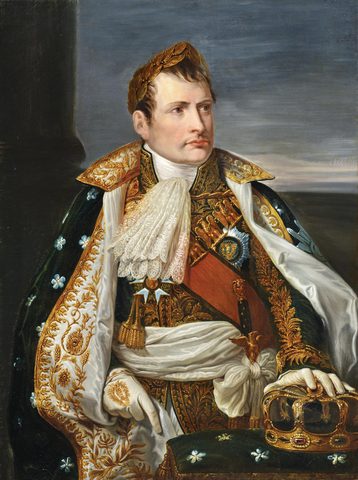
Napoleon as King of Italy
Andrea Appiani, 1805
Appiani circle — Napoleon crowned King of Italy, classical composure.
About this work
This three-quarter-length portrait shows Napoleon Bonaparte as King of Italy, the title he held from 1805 to 1814. The oil on canvas, 99 by 74 centimetres, was offered at the Vienna auction house Dorotheum as the work of the circle of Andrea Appiani, painted in the 19th century; a label on the back records an earlier private collection in England. Appiani, born in Milan in 1754, was the leading neoclassical painter of Napoleonic Lombardy. He drew a pencil portrait of Napoleon when the general entered Milan in 1796, went to Paris for the imperial coronation in 1804, where he met Jacques-Louis David, and in 1805 painted the official portrait of Napoleon as King of Italy now in the Kunsthistorisches Museum in Vienna. The Kingdom of Italy was a client state of the French Empire in northern Italy, governed for Napoleon by his stepson Eugène de Beauharnais as viceroy. It ended with Napoleon's fall. Appiani died in 1817.
Sources: Wikimedia Commons · Wikipedia: Andrea Appiani · Wikipedia: Kingdom of Italy (Napoleonic)
FAQ
Where can I buy a framed print of Napoleon as King of Italy?
Here. Napoleon as King of Italy is available as a framed print in three sizes: Small (15 × 20 in) for $195, Medium (18 × 24 in) for $295 and Large (27 × 36 in) for $395. Prices include the frame and US shipping; delivery takes 14–21 days, with 30-day returns.
What size works best for Napoleon as King of Italy?
The file is 3,731 × 5,000 px. Medium (18 × 24 in) is the largest size that prints at 150 ppi or more (207 ppi), the sharpest choice for close viewing; Large (27 × 36 in) prints at 138 ppi, fine from a few feet away but softer up close.
Is it legal to print Napoleon as King of Italy?
Yes. Napoleon as King of Italy is in the public domain: its copyright, if it ever had one, expired long ago. In the United States a faithful photograph of a public-domain painting does not create a new copyright (Bridgeman v. Corel, 1999), so the image can be printed and sold freely.

















