Certosa di Pavia
Maximilien De Hase, c. 1760
The Certosa façade as cathedral-scale monument under Italian daylight.
About this work
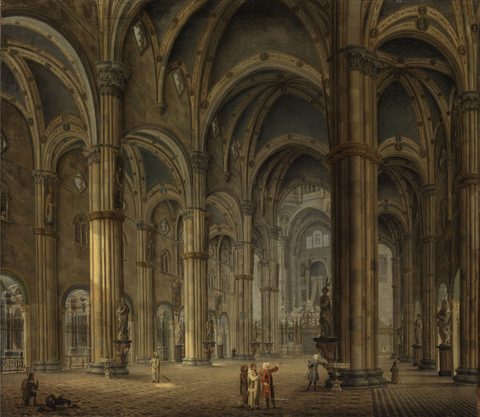
This eighteenth-century oil on canvas, attributed on Wikimedia Commons to Maximilien De Hase, looks inside the church of the Certosa di Pavia rather than at its famous façade. The German title recorded with it, Kircheninneres der Certosa di Pavia, means interior of the church, and it measures 67 by 75 centimetres; the image comes from Hampel Auctions. Clustered columns carry pointed arches down a Gothic nave, and small figures give a sense of its scale. The Certosa stands about eight kilometres north of Pavia in Lombardy. Gian Galeazzo Visconti, the first Duke of Milan, commissioned it from the architect Marco Solari and laid the foundation stone on 27 August 1396, and the complex was built until 1495. Its church, the last building of the complex and intended as the Visconti family mausoleum, has a nave and two aisles on a Latin cross plan, unusual for the Carthusian order; the Gothic nave was completed in 1465. Its cross vaults on Gothic arches were inspired, on a smaller scale, by Milan Cathedral. The Carthusians were expelled in 1782, and in 1866 the Certosa was declared a national monument. It is one of the largest monasteries in Italy, renowned for its mix of Gothic and Renaissance architecture.
Sources: Wikimedia Commons · Wikipedia: Certosa di Pavia
FAQ
Where can I buy a framed print of Certosa di Pavia?
Here. Certosa di Pavia is available as a framed print in three sizes: Small (20 × 17 in) for $195, Medium (24 × 21 in) for $295 and Large (36 × 31 in) for $395. Prices include the frame and US shipping; delivery takes 14–21 days, with 30-day returns.
What size works best for Certosa di Pavia?
The file is 5,767 × 5,010 px, so every size is sharp: even Large (36 × 31 in) prints at 160 ppi. Choose Large (36 × 31 in) for a large wall; Small (20 × 17 in) suits a narrower space.
Is it legal to print Certosa di Pavia?
Yes. Certosa di Pavia is in the public domain: its copyright, if it ever had one, expired long ago. In the United States a faithful photograph of a public-domain painting does not create a new copyright (Bridgeman v. Corel, 1999), so the image can be printed and sold freely.

















