Jumbo
Manhattan Engineer District, 1945
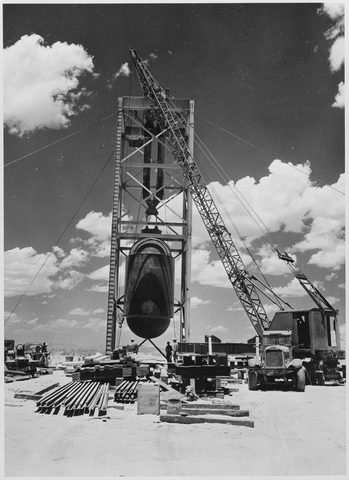
Jumbo, the steel containment vessel built for the 1945 Trinity test in New Mexico, which in the end was not used for the test. From the U.S. National Archives.
About this work
This photograph from the U.S. National Archives (NAID 558570) shows Jumbo, the giant steel containment vessel built for the Trinity test in New Mexico in 1945. The vessel hangs upright in a tall steel framework, with cranes, trucks and stacks of timber around its base in the desert. Jumbo was designed in case the first atomic bomb failed: the device would be set inside it, and if the explosion fizzled the thick walls would hold, so that its precious plutonium could be recovered. Robert W. Henderson and Roy W. Carlson of the Los Alamos Laboratory designed it, and Babcock and Wilcox, a company that normally made boilers for the Navy, built it in Barberton, Ohio. As delivered in May 1945 it was 10 feet in diameter and 25 feet long, with walls 14 inches thick, and weighed 214 tons. A special train carried it to the siding at Pope, and crawler tractors towed it 25 miles across the desert. By then there was enough plutonium for a second test, so Jumbo was not used; it was hoisted up a steel tower 800 yards away and survived the blast of 16 July 1945, though its tower did not.
Sources: U.S. National Archives · Wikipedia: Trinity (nuclear test)
FAQ
Where can I buy a framed print of Jumbo?
Here. Jumbo is available as a framed print in two sizes: Small (15 × 20 in) for $195 and Medium (17 × 24 in) for $295. Prices include the frame and US shipping; delivery takes 14–21 days, with 30-day returns.
What size works best for Jumbo?
The file is 2,180 × 3,000 px, so Small (15 × 20 in) is the sharpest choice at 145 ppi. Medium (17 × 24 in) prints at 125 ppi: fine from a few feet away, softer up close.
Is it legal to print Jumbo?
Yes. The photograph was made by the Manhattan Engineer District of the U.S. Army in 1945, and works made by U.S. federal employees as part of their official duties are not protected by copyright in the United States. The National Archives holds it as record 558570.
















