
Few painters can claim that their pictures helped change a law. Thomas Moran can. In the summer of 1871 he followed a government survey into the Yellowstone country, a region most Americans knew only from rumors and campfire stories. The watercolor sketches he brought back, shown alongside the photographs of William Henry Jackson, helped persuade Congress that the place was real and worth protecting. In March 1872 President Ulysses S. Grant signed the act that made Yellowstone the first national park. Moran spent the rest of his long career painting the West, and he never quite stopped painting Yellowstone.
This guide walks through Moran’s life and work through the paintings in the FrameAnyPhoto collection, from his early autumn woodlands in Pennsylvania to the canyons, cliffs and peaks that made his name, with some advice at the end on choosing a size and frame.
A young engraver in Philadelphia
Moran was born in 1837 in Bolton, Lancashire, in the north of England, and came to America as a child when his family settled near Philadelphia. Art ran in the family: his brothers Edward, Peter and John all became artists too. As a teenager Thomas was apprenticed to a wood engraver, and the habits of that trade, close looking and a sure sense of line, stayed with him. He soon turned to watercolor and oil, and in the early 1860s he traveled to England to study the paintings of J. M. W. Turner, whose blazing light and dissolving atmosphere left a lasting mark on his own work.
His early oils are rooted in the woods and streams around his adopted city. Autumn Afternoon, the Wissahickon, signed and dated 1864, looks at Wissahickon Creek near Philadelphia in full fall color; it belongs to the Terra Foundation for American Art. Valley of the Catawissa in Autumn, from about 1862 and now at Crystal Bridges Museum of American Art, is grander: a valley ablaze with leaves, a pine clinging to a cliff and the river running pale through the middle. And Mountain Scene of 1865, in the Dallas Museum of Art, shows him working in the full Hudson River School manner, with a deep gorge, falling water and a luminous sky. If you know Thomas Cole, you will recognize the inheritance.
Moran’s gift was to paint wonder without losing the facts: real rock, real water, real weather, arranged so that you feel what it was like to stand there.
1871: Into the Yellowstone
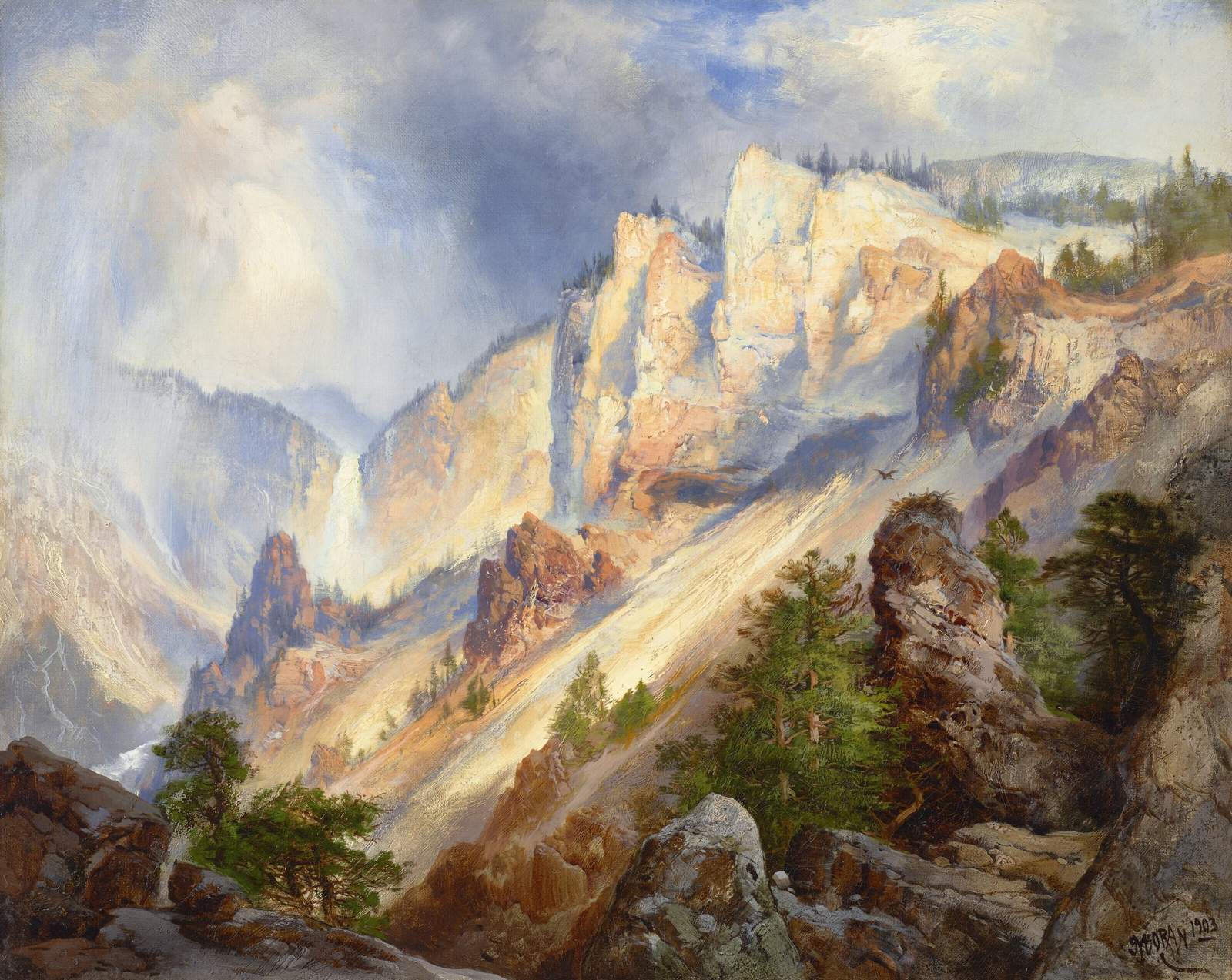
The turning point came in 1871, when Moran joined Ferdinand V. Hayden’s geological survey of the Yellowstone region as a guest artist. He had little experience of the West and reportedly had barely ridden a horse, but he spent weeks sketching geysers, hot springs, waterfalls and, above all, the Grand Canyon of the Yellowstone, with its walls of yellow, orange and white rock dropping to the river. Back in his studio he painted The Grand Canyon of the Yellowstone, a canvas more than seven by twelve feet. Congress bought it in 1872 for $10,000, and it hung in the Capitol; today it is in the Smithsonian American Art Museum.
Moran returned to the canyon again and again over the decades. A Passing Shower in the Yellowstone Cañon, painted in 1903, more than thirty years after his first visit, shows the same yellow walls under a softer sky, with rain drifting through the gorge and sunlight breaking behind it. It is signed with his monogram and “TMoran 1903” at the lower right. The association between artist and place became so strong that he was sometimes called Thomas “Yellowstone” Moran.
The Mountain of the Holy Cross
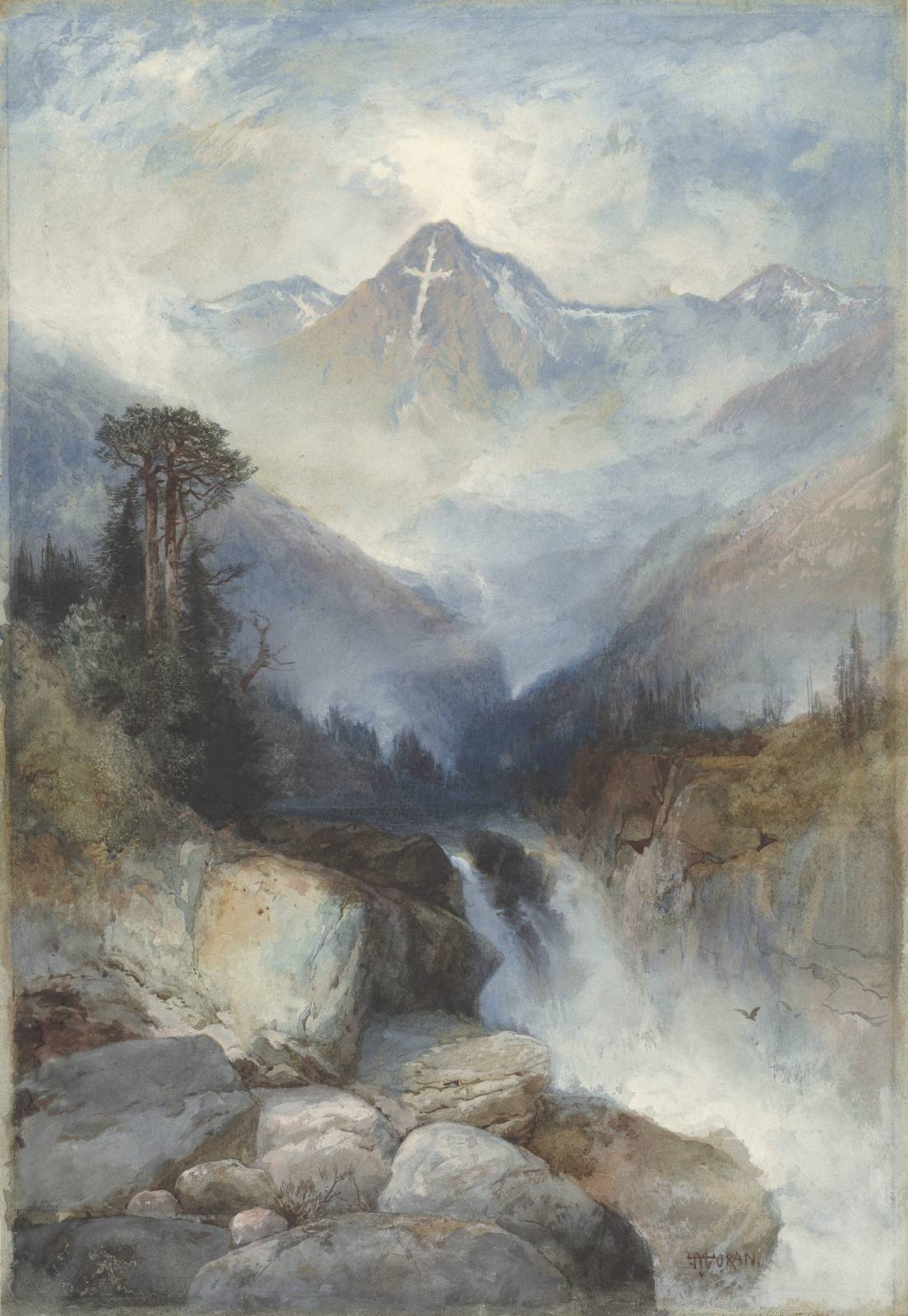
In Colorado’s Sawatch Range there is a peak whose face holds a cross of snow, formed where a deep vertical gully and a horizontal ledge hold snow long into summer. William Henry Jackson photographed it in 1873 for the Hayden survey, and Moran made the journey to see it himself in 1874. His large painting of the following year turned the mountain into a national symbol. He came back to the subject later, and our Mountain of the Holy Cross dates from 1890: the white cross shines high on the dark peak while a stream rushes over rocks in the foreground. It is a picture about scale, with the viewer standing in the cold water, looking a very long way up.
Green River and the Southwest
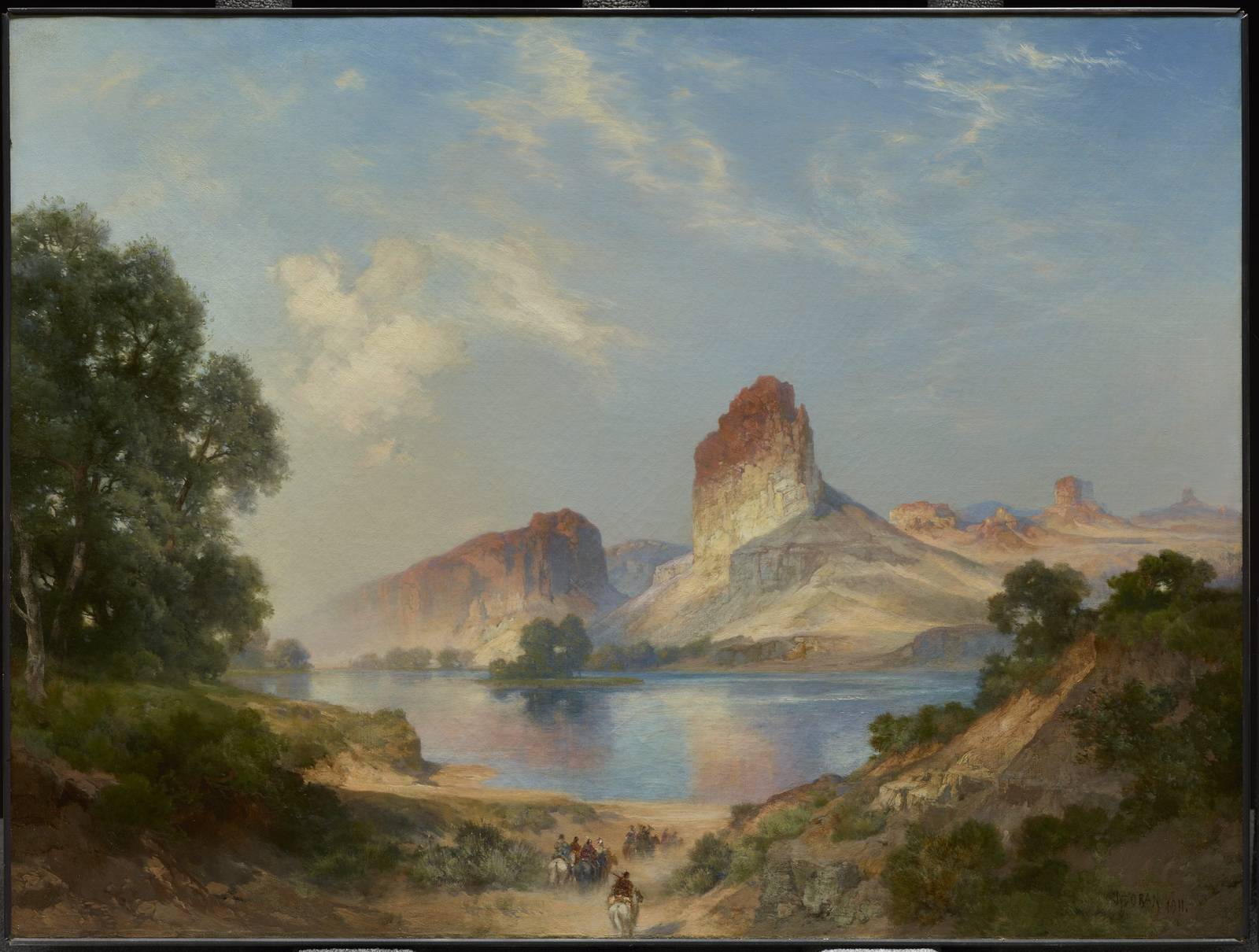
Moran first passed through Green River, Wyoming, on the train west in 1871, and its striped cliffs, rising above the river like a ruined fortress, became one of his favorite motifs. He painted them for decades. An Indian Paradise (Green River, Wyoming), from 1911 and now in the Dallas Museum of Art, was made when he was in his seventies. Riders move through the dust along the bank while a great red cliff stands in the river, glowing against the sky. It shows how far his color had traveled since the Pennsylvania woods: warmer, looser and full of light.
He also traveled to the Grand Canyon of the Colorado, which he painted many times from the 1870s on, and in his last years he settled in Santa Barbara, California, where he died in 1926 at the age of eighty-nine.
A quieter side: East Hampton
For all his canyons, Moran also had a gentler eye. From 1884 he and his wife, the etcher Mary Nimmo Moran, kept a home and studio in East Hampton, on Long Island, and the flat fields, ponds and dunes there gave him a very different kind of subject. Near East Hampton, Long Island, from 1894, shows a farmhouse among trees beside a pond under a broad sky. It is a calm, wide picture, and it is a good reminder that the painter of Yellowstone could make a small, ordinary place feel just as worth looking at.
Hang a Moran where the light changes during the day. His paintings are about weather, and they reward a room that has some.
Choosing a Moran for your wall
Moran’s paintings fall roughly into two groups, and each suits a different kind of room.
- The big western scenes, like the Yellowstone canyon, the Holy Cross and Green River, are statement pictures. They want a wall of their own, over a sofa, a fireplace or a console in an entry, and they look their best in the Large size.
- The eastern landscapes, like the Wissahickon, the Catawissa valley and East Hampton, are warmer and more intimate. They suit a study, a dining room or a hallway, and work well in Small or Medium.
Every FrameAnyPhoto print comes in up to three sizes, Small at $195, Medium at $295 and Large at $395, framed and ready to hang. Because we never crop a painting, the exact dimensions follow each work’s proportions, so check them on the work page. A gold frame brings out the warm yellows and reds that run through so much of Moran’s work, while black gives the western scenes a crisper, more modern look. Our guide to choosing a size and frame goes into more detail.
You can see every Moran we carry on the Thomas Moran artist page, and if his work appeals, the rest of our landscapes collection includes his contemporaries, among them Albert Bierstadt and Frederic Church.