
The rider in Thomas Cole’s The Mountain Ford is easy to overlook. There is so much mountain, so much tree and shadow, that a person on horseback might seem no more than a convenient measure of scale. Then the hesitation becomes the center of the picture. Water lies ahead; the far bank is not yet reached. Suddenly the landscape is no longer background. It has become a question addressed to someone small enough to resemble us. Cole’s gift was to make such questions feel inseparable from the pleasure of looking.
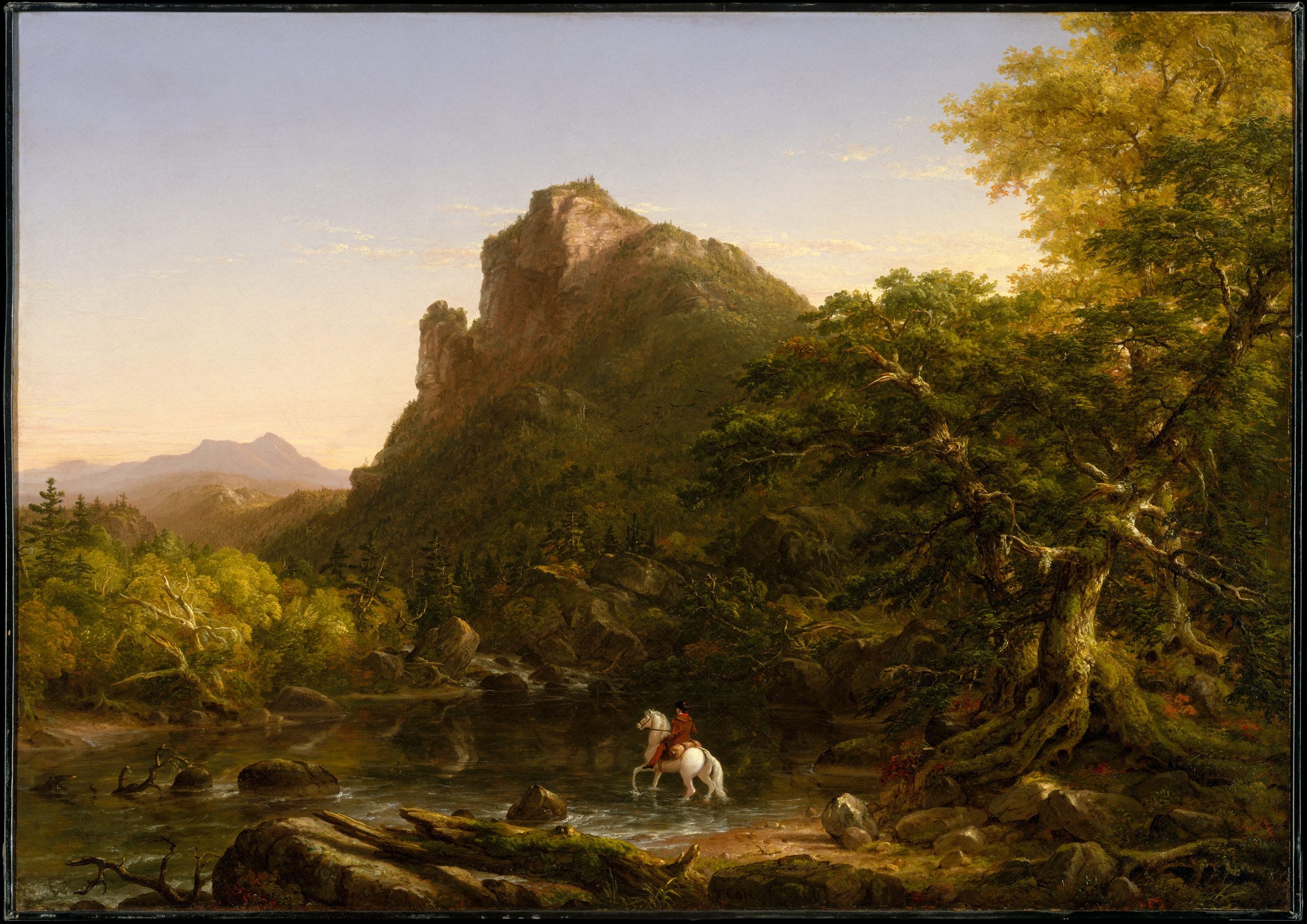
The Metropolitan Museum of Art dates the painting to 1846 and describes its scene as imagined and symbolically charged. That matters. It is tempting to approach nineteenth-century landscape as an early travel service: a useful record of where things stood before roads and buildings changed the view. Cole certainly attended to nature, but accuracy of location was not his only ambition. He could combine a convincing tree, an imposing slope and an uncertain crossing into a situation whose emotional meaning exceeds anything a map could give us.
A painter between worlds
Cole was born in England in 1801 and came to the United States in 1818, as the Met’s biographical essay records. He became a central figure in the landscape tradition known as the Hudson River School. Those facts are often made to sound like a neat beginning for a national style. The paintings themselves are less tidy. Cole’s scenery can feel welcoming and threatening within the same frame. Land offers room for human aspiration, but it also exposes how little control an aspiring human may have. Beauty is the invitation, not the final answer.
That double feeling is what makes his allegories worth meeting without embarrassment. We may be wary of a picture that arrives with an announced moral. Yet a story told through a changing river can reach us before its lesson does. We understand what it means for a channel to narrow, a sky to darken or a shore to recede. Cole turns those elementary visual experiences into a language. It is a language of transitions, and it works because moving through a landscape already resembles moving through time.
The river begins
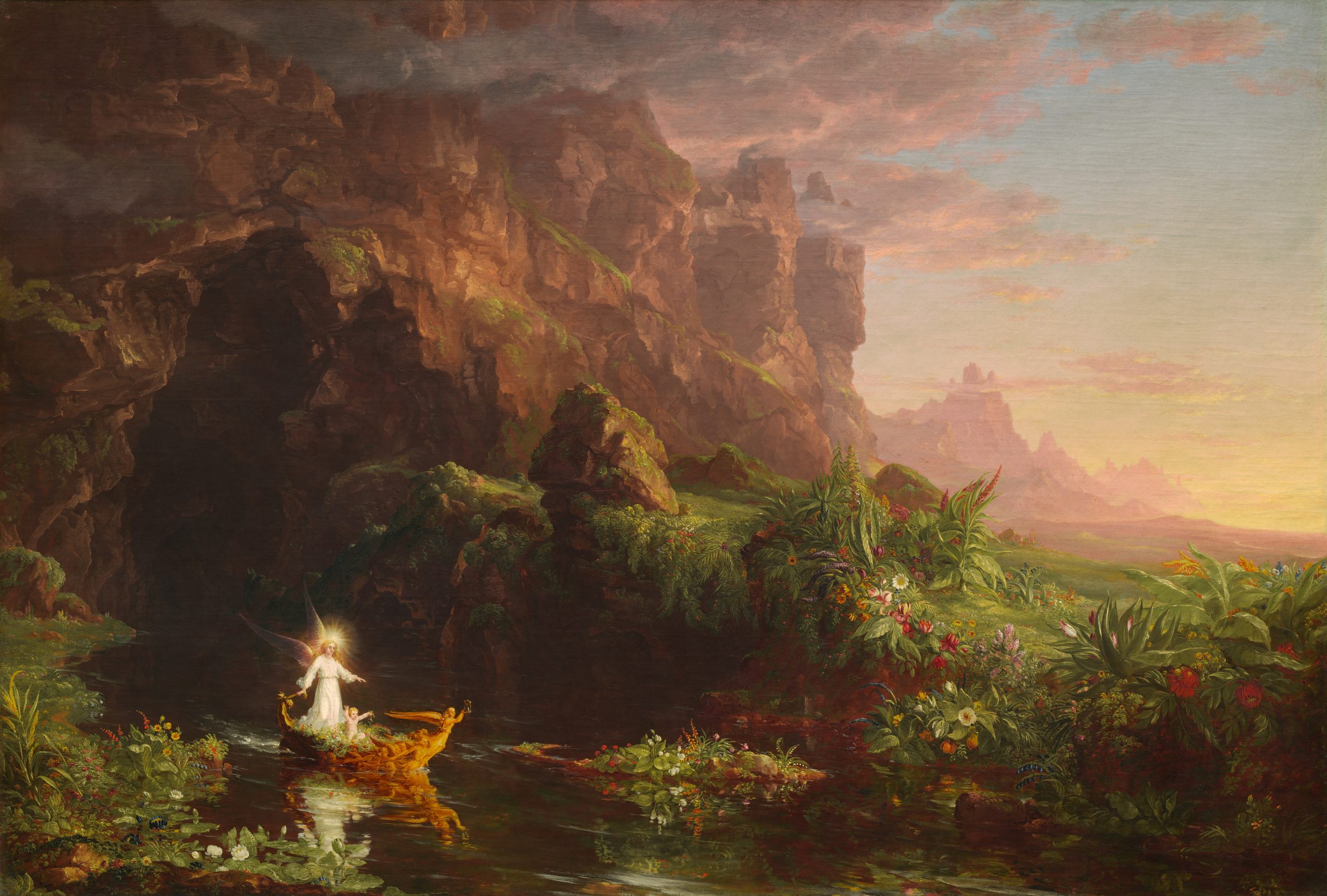
The National Gallery of Art’s The Voyage of Life is a four-part series dated 1842: Childhood, Youth, Manhood and Old Age. Its traveler moves through a succession of landscapes on a river, accompanied by an angel. The museum places the cycle within Christian ideas of death and salvation. We need not blur that religious purpose into a vague modern message about wellness. Cole was giving visible form to a specific spiritual understanding of human life, and the specificity is part of the pictures’ power.
In Childhood, the opening is sheltered and abundant. The boat, the flowers and the luminous distance seem to promise a world in which arrival and welcome are the same thing. The small figure cannot yet understand a route or its dangers. What the viewer sees, however, is already a beginning, which means a change must follow. That difference between the voyager’s knowledge and ours quietly generates the drama. A scene of innocence is moving because we cannot look at it innocently; we know there is more river beyond the frame.
Beauty is the invitation, not the final answer.
The next painting, Youth, carries the traveler toward an imagined castle in the air. The National Gallery interprets that distant building as an emblem of ambition and dreams of fame. Even without reproducing it here, it belongs in our reading of the sequence. The river’s direction and the voyager’s desire are not identical. Cole makes room for the thought that wanting something intensely does not mean life will carry us straight toward it. This is an unusually sharp observation to place inside so theatrical a landscape.
A landscape that will not obey
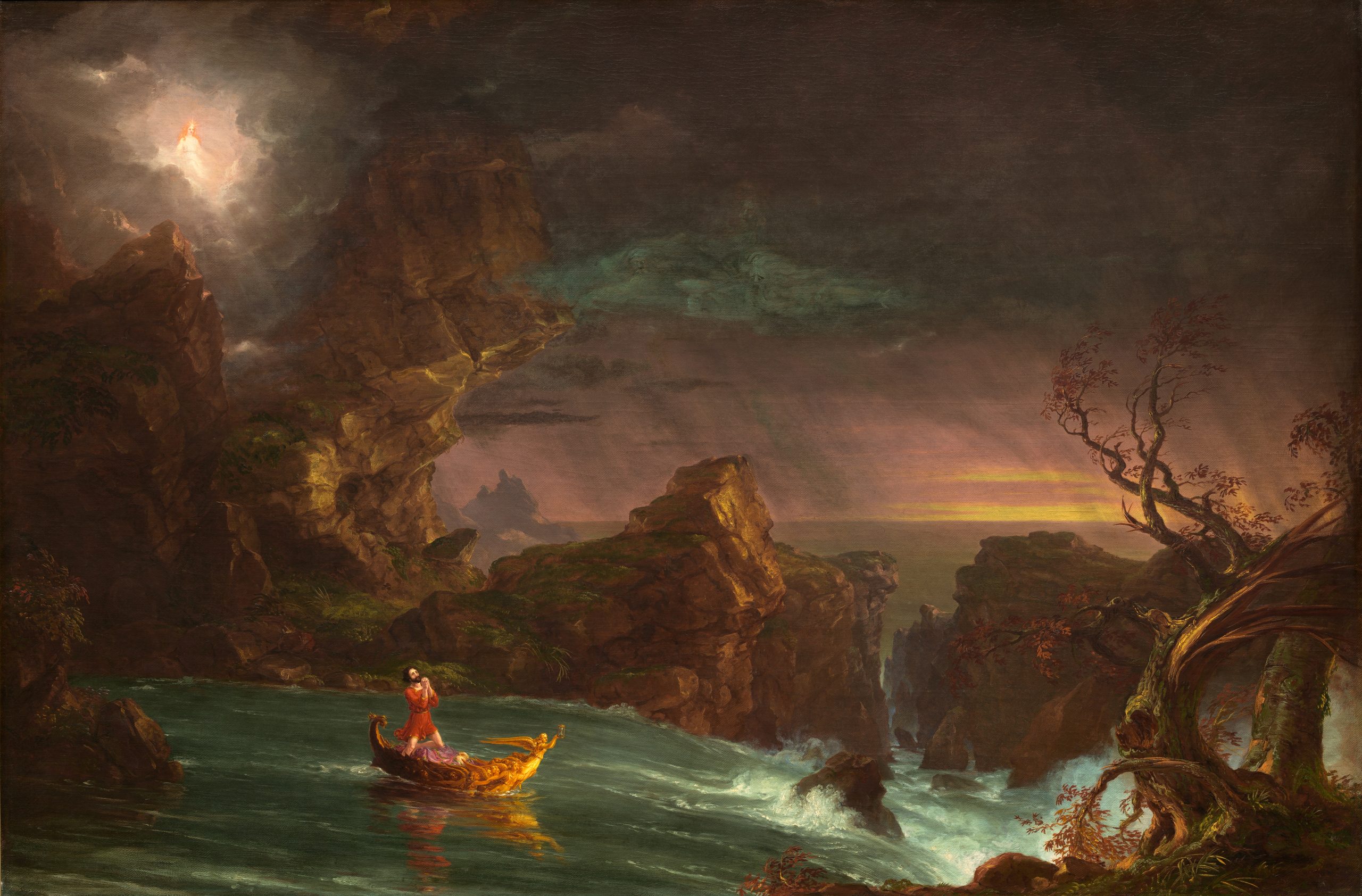
In Manhood, the world that once seemed to receive the voyager now confronts him. Dark rock and turbulent water press upon the boat; the sky offers no easy continuation of childhood’s reassurance. The National Gallery’s account emphasizes prayer as the traveler’s means of rescue. Visually, the change is just as important as the doctrine. The landscape no longer supplies a broad stage for self-confidence. Its forces overwhelm the scale on which a single person can act. Cole has changed the very kind of space available to his protagonist.
This is why the series is more than a set of illustrations to a message already settled in words. The paintings ask us to feel the difference between states of being. A warm opening and a constricted passage do not produce the same physical response in the viewer. We can read the titles and understand the outline quickly, but the shapes make us linger with it. The river, carrying the same life forward, becomes alternately an invitation, a deception and a threat. Continuity does not guarantee security.
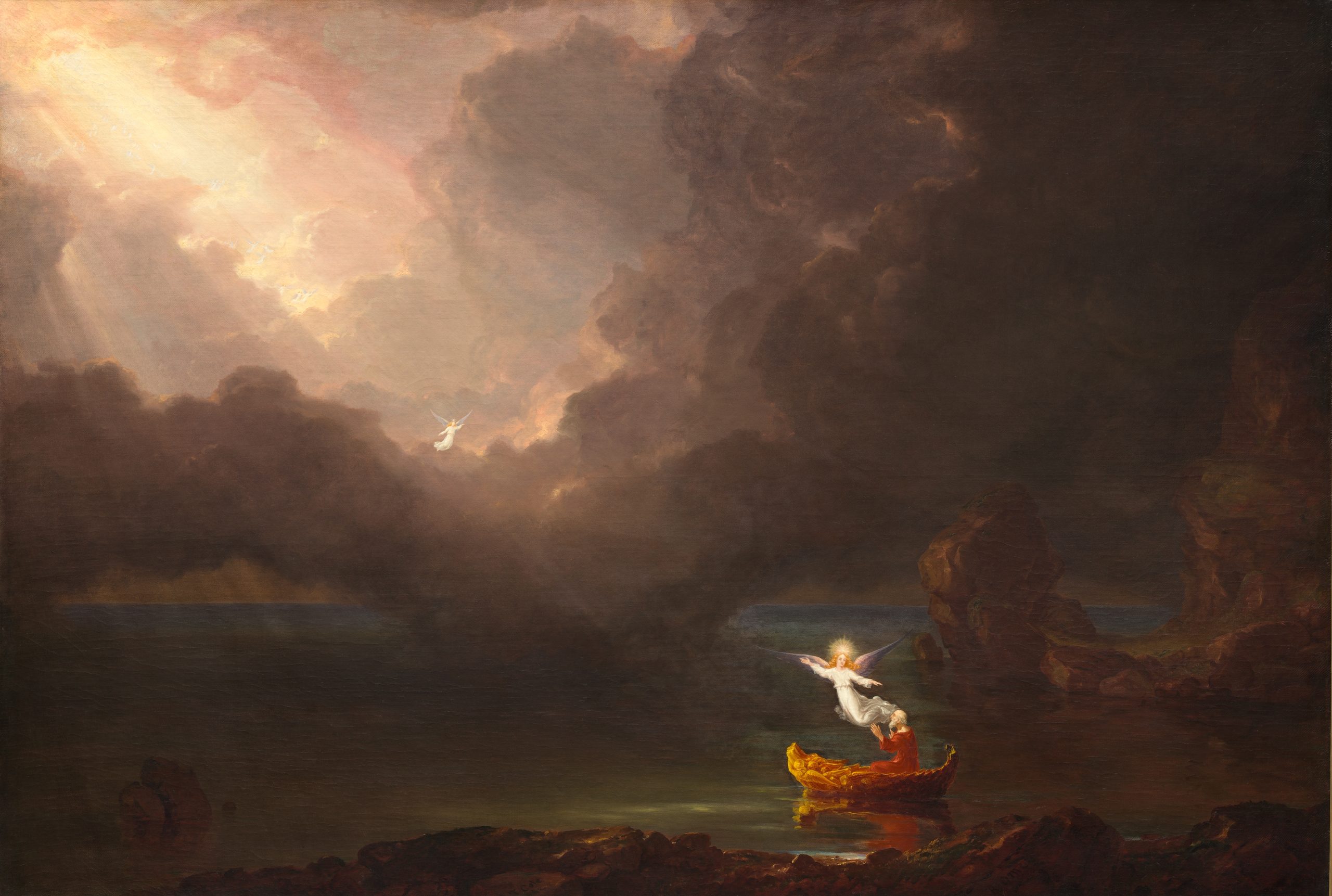
By Old Age, the drama changes again. The water is no longer a corridor leading toward worldly accomplishment. The aged voyager looks toward an opening beyond the darkness, and the angel directs attention away from the material journey. The National Gallery understands this ending as salvation, not simply exhaustion. Cole’s movement is therefore not a steady decline from an attractive beginning. He makes the last stage a different form of arrival, one that cannot be measured by the ambitions introduced earlier in the voyage.
How to look beyond the lesson
There is a rewarding way to spend time with these paintings without either surrendering to their instruction or dismissing it. Follow one element across them. Watch the water: the way it occupies the foreground, the way its route opens or closes, the way its light changes. Then follow the figure and notice how much less of the picture he commands than his role as protagonist might suggest. Cole gives the story to a human being, but he gives most of the canvas to everything that exceeds that human being.
Return after that to the horseman at the ford. His hesitation may look newly substantial. Here is the whole long voyage reduced to a moment before a crossing, without a sequence to tell us what follows. Cole does not have to show an enormous catastrophe to make choice visible. A bank, a dark pool and a distant height are enough. The landscape holds both possibility and resistance. That is why these pictures can remain companionable long after we have learned their plots: they do not let beautiful scenery excuse us from thinking about the life passing through it.
Explore more works by Thomas Cole in the collection.