
The light arrives before the geography. In an Albert Bierstadt landscape, it can seem to open a passage through weather, picking out a cliff or settling on water with the assurance of a stage cue. Only afterward do we begin to sort the mountains, trees and distances into a place. This order of arrival is part of the pictures’ extraordinary appeal. We are moved before we have oriented ourselves. Looking longer does not require us to renounce that first response. It asks us to notice how carefully the response has been prepared.
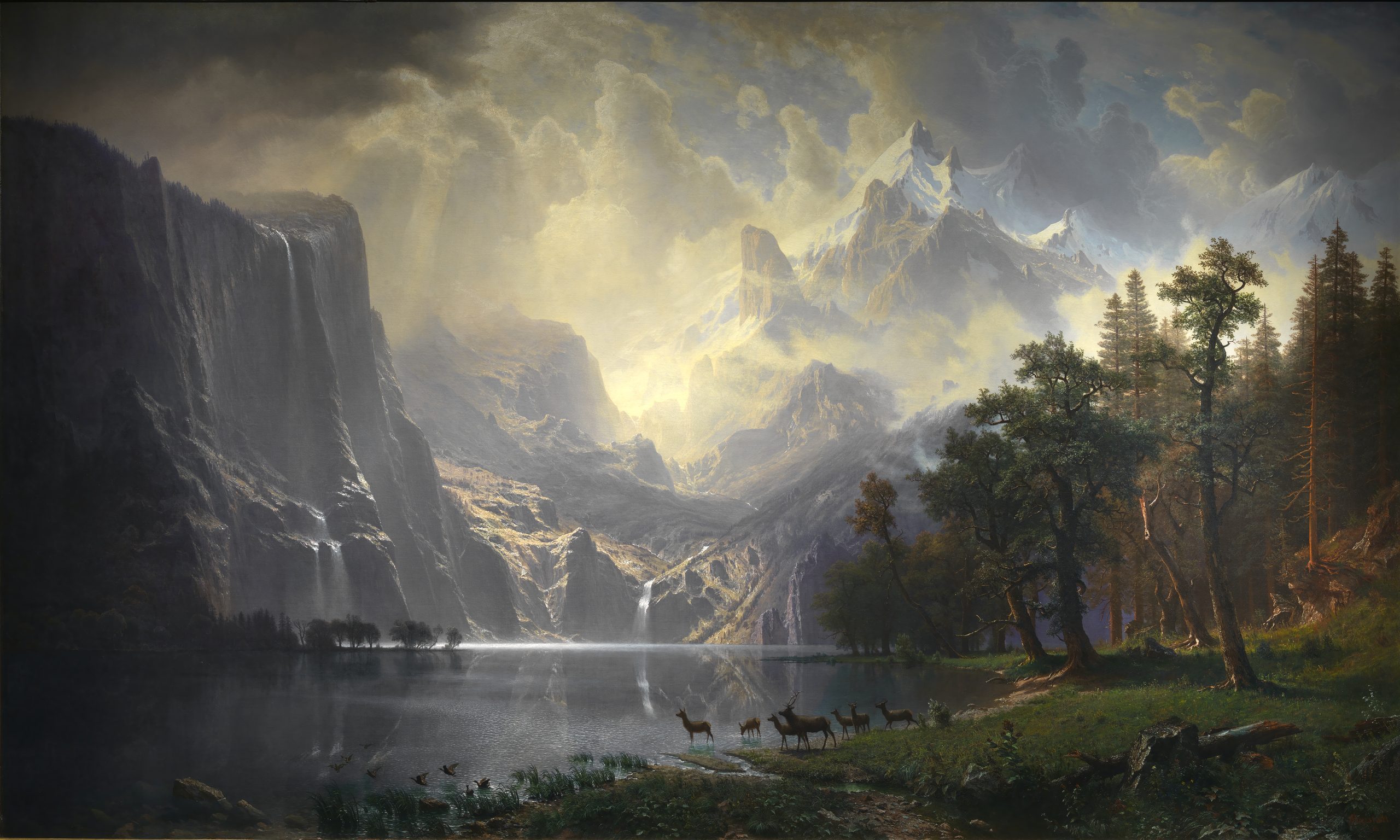
Consider Among the Sierra Nevada, California, dated 1868 and held by the Smithsonian American Art Museum. The title offers a location, but the experience is more like an unveiling. Darker forms at the edges help concentrate brightness within the picture; the water receives and steadies the spectacle above it. The Smithsonian’s account identifies the work as a studio creation painted in Rome, not a canvas completed before the California mountains. That distance between subject and place of production is a useful beginning. Bierstadt’s West is a remembered and arranged world, not an unedited window.
An invitation with a point of view
Calling a landscape constructed is not the same as calling it false. Any painting excludes more than it includes. Bierstadt makes the selection especially consequential because his views can look so complete. They seem to offer everything at once: a near shore, a middle distance, remote peaks and the weather that binds them. Yet the completeness is a sensation, not proof. A picture can make us feel that we have seen a region while giving us only one persuasive way to imagine it. That is both an achievement and a reason to keep asking questions.
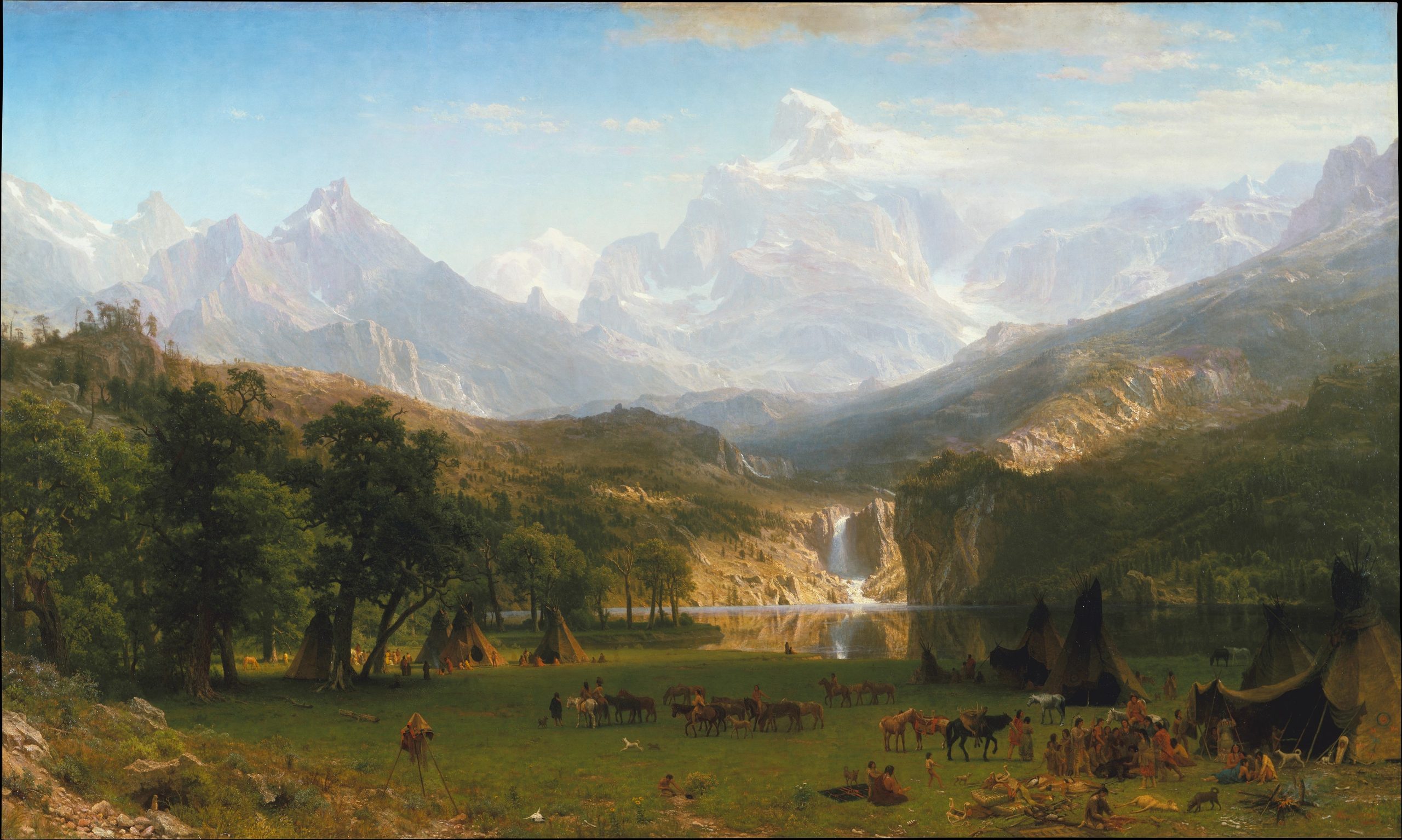
The Metropolitan Museum of Art’s The Rocky Mountains, Lander’s Peak, painted in 1863, provides a more specific historical anchor. The Met links it to Bierstadt’s 1859 western expedition with Frederick W. Lander. The immense finished canvas brings a mountain setting into relationship with a foreground encampment of Shoshone people. The museum notes the scene’s idealization. Its arrangement is not simply a transparent record of an encounter. The viewer’s impression of a whole world, apparently held still for inspection, has been created by a painter working toward a particular kind of grandeur.
This is where a contemporary viewer can look with two kinds of attention at once. We can admire the handling of distance while resisting the notion that a landscape becomes available merely because it is visible. People inhabit these pictures, but the artist decides how small they will appear, where they will stand and what role they will play in the view. Noticing those decisions is not an interruption of visual appreciation. It is a deeper appreciation of what pictures do: they give land a form, and they also give viewers a position in relation to it.
The completeness is a sensation, not proof.
Yosemite and the held breath
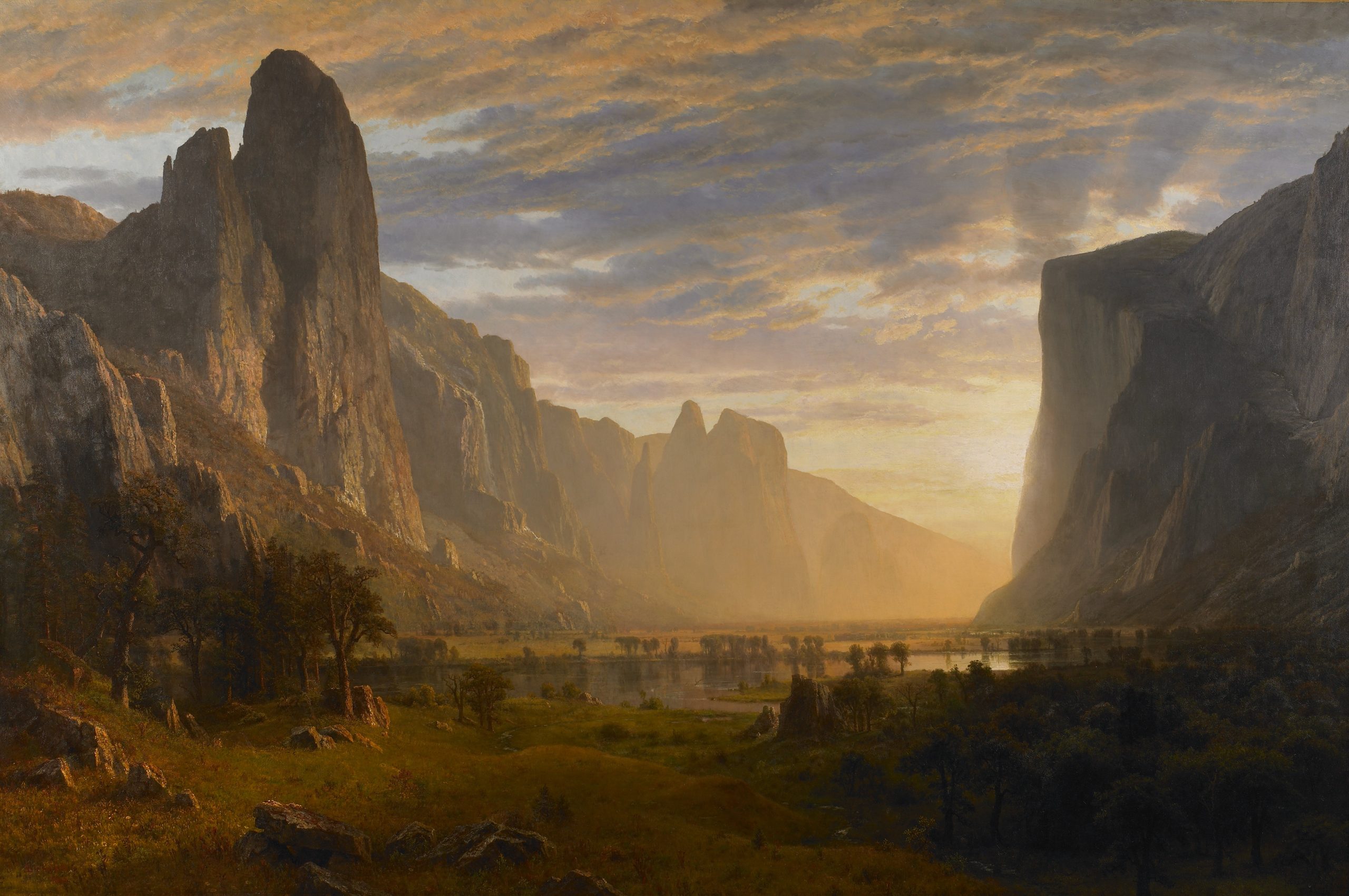
In Looking Down Yosemite Valley, California, dated 1865 and held by the Birmingham Museum of Art, the drama is less an encounter than a held breath. Cliffs frame a warm opening; the valley floor becomes a route for the eye. The picture’s directional force is so strong that looking can feel like traveling, even while our bodies stay still. Light is doing compositional work as well as describing an hour. It chooses a destination for attention, then makes the intervening space seem traversable. The view is welcoming because it has already organized our approach.
One way to recover the painting’s strangeness is to ignore the distant glow for a moment. Begin at an edge. Attend to the weight of a dark tree or the abruptness of a rock, then let the eye move toward the more open center. The passage from obstruction to release becomes palpable. Bierstadt has not merely painted a beautiful destination. He has painted a sequence of visual permissions. Each foreground resistance makes the eventual openness more satisfying, and each change in scale helps that openness feel larger than the canvas.
The risk of such eloquence is that we may stop at admiration. A grand view can make a place appear timeless, as if its most important truth were the absence of change. Yet the people making and first seeing these paintings lived in history, as did the lands represented. The paintings are not outside those pressures because their skies are expansive. A generous reading can hold the exhilaration of the image alongside the knowledge that a view, however beautifully organized, is never the whole account of a place.
Abundance painted at the edge of loss
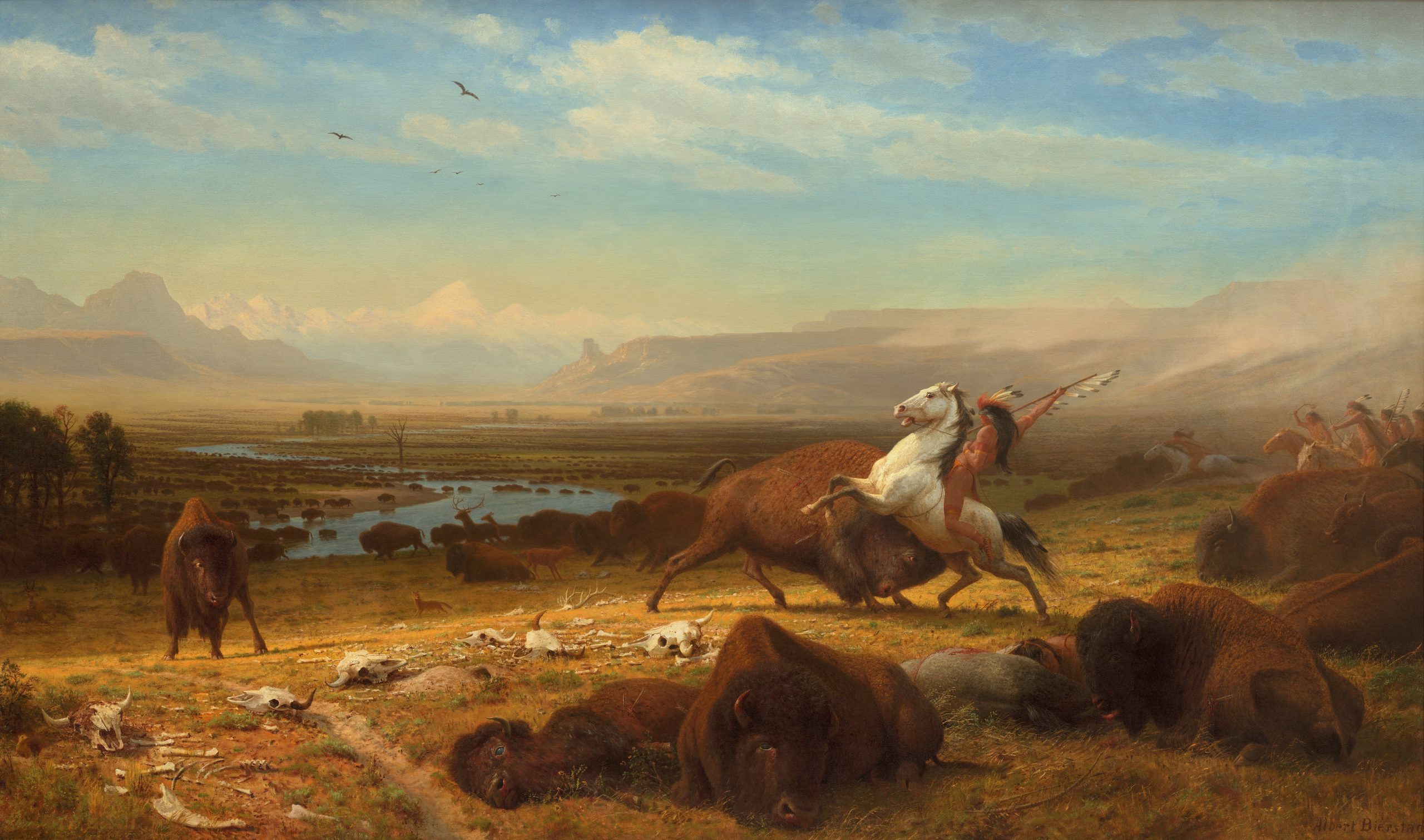
The tension becomes explicit in The Last of the Buffalo, which the National Gallery of Art now dates 1888–1889. Across an enormous landscape, animals seem to extend beyond counting. In the foreground, a mounted Indigenous hunter confronts a charging buffalo amid bodies and bones. The museum describes the scene as a composite and a romantic invention, painted when the buffalo population had already been devastated. Apparent abundance is therefore not straightforward evidence of abundance. The picture sets a sumptuous visual world against the knowledge that such a world was disappearing.
It is important not to mistake the foreground encounter for an adequate explanation of that destruction. The National Gallery’s discussion connects the picture to the losses accompanying encroaching settlement. Bierstadt’s chosen drama and the historical causes of the crisis are not identical. The distinction gives the painting a difficult power. It can lament loss while organizing that loss through conventions of spectacle. To look responsibly is to notice both, rather than allowing sympathy for the animals to make every part of the representation seem innocent or self-explanatory.
Keeping the wonder, widening the view
Bierstadt rewards a slower encounter than his immediate theatrical impact might suggest. Follow the light, then ask what it leaves in shadow. Admire a mountain, then notice the scale allotted to the people below it. Let the water carry your eye into the distance, then return to the foreground and its evidence of life. None of these acts requires us to distrust beauty on principle. They simply keep beauty from ending the conversation. The West in these canvases is powerful partly because it is made, and the making remains visible if we give ourselves time to see it.
Explore more works by Albert Bierstadt in the collection.