
At first, The Heart of the Andes seems to ask only for surrender. The distance is enormous, the air luminous, the mountain impossibly remote. Then a leaf catches the eye, or a path, or a tiny human presence, and the picture’s terms change. We are not merely watching a panorama. We are being invited to inspect it. Frederic Edwin Church could make grandeur behave like a cabinet of small discoveries. The surprise is not that he painted so much of the world, but that he found ways to make a large view reward intimate attention.
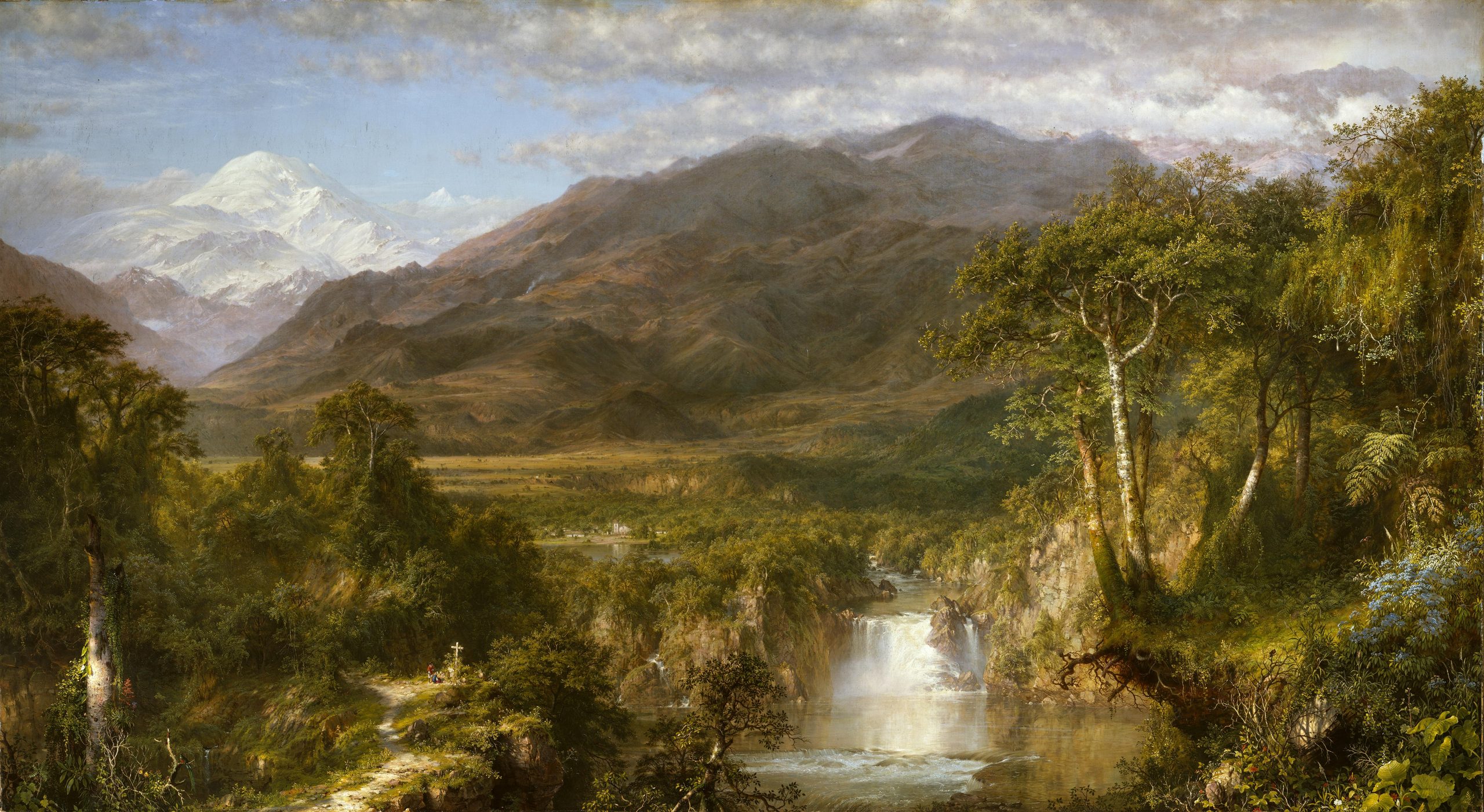
The Metropolitan Museum of Art dates the painting to 1859 and links it to Church’s journeys in South America in 1853 and 1857. An important intellectual companion was the German naturalist Alexander von Humboldt, whose writing encouraged artists to study the equatorial world. Church did not simply bring back a spectacular view. According to the Met, he synthesized many sketches into a scene encompassing a range of climates, from tropical vegetation to snow-covered heights. Observation supplied the parts. Composition made those parts into an experience no single viewpoint could provide.
A journey assembled in the studio
Olana, Church’s historic home, makes the distinction particularly clear in its account of the picture. The mountains, waterfall and plants derive from different studies and places. The result is not a literal portrait of one spot in Ecuador. That need not diminish its seriousness. A painter can be attentive to the structure of a plant and still move it in the service of a larger design. Church’s ambition was to make the natural world intelligible as a connected whole, rather than to offer a traveler’s certificate proving exactly where he stood.
That approach changes how we might look. Instead of asking only whether the view is accurate, we can ask what its arrangement allows us to notice. The near vegetation slows us down; the great distance accelerates our gaze. Light separates one zone from another without breaking the sense of a continuous world. The painting encourages a journey through several scales of attention. Its breadth is not an alternative to detail. Breadth and detail give one another meaning, much as a landscape becomes different when you have learned the names of a few plants within it.
Observation supplied the parts. Composition made those parts into an experience no single viewpoint could provide.
The picture as an event
Church also understood that looking has a setting. The Met describes Heart of the Andes displayed in a darkened room inside an elaborate, windowlike frame. Visitors were encouraged to use opera glasses to inspect its botanical detail. The painting was a public event, not just another canvas among many. This theatrical intelligence can seem at odds with close observation until we consider what it accomplished: a room arranged to concentrate attention, a frame proposing an opening, a tool that made distant detail available. The staging told viewers that the act of looking deserved time.
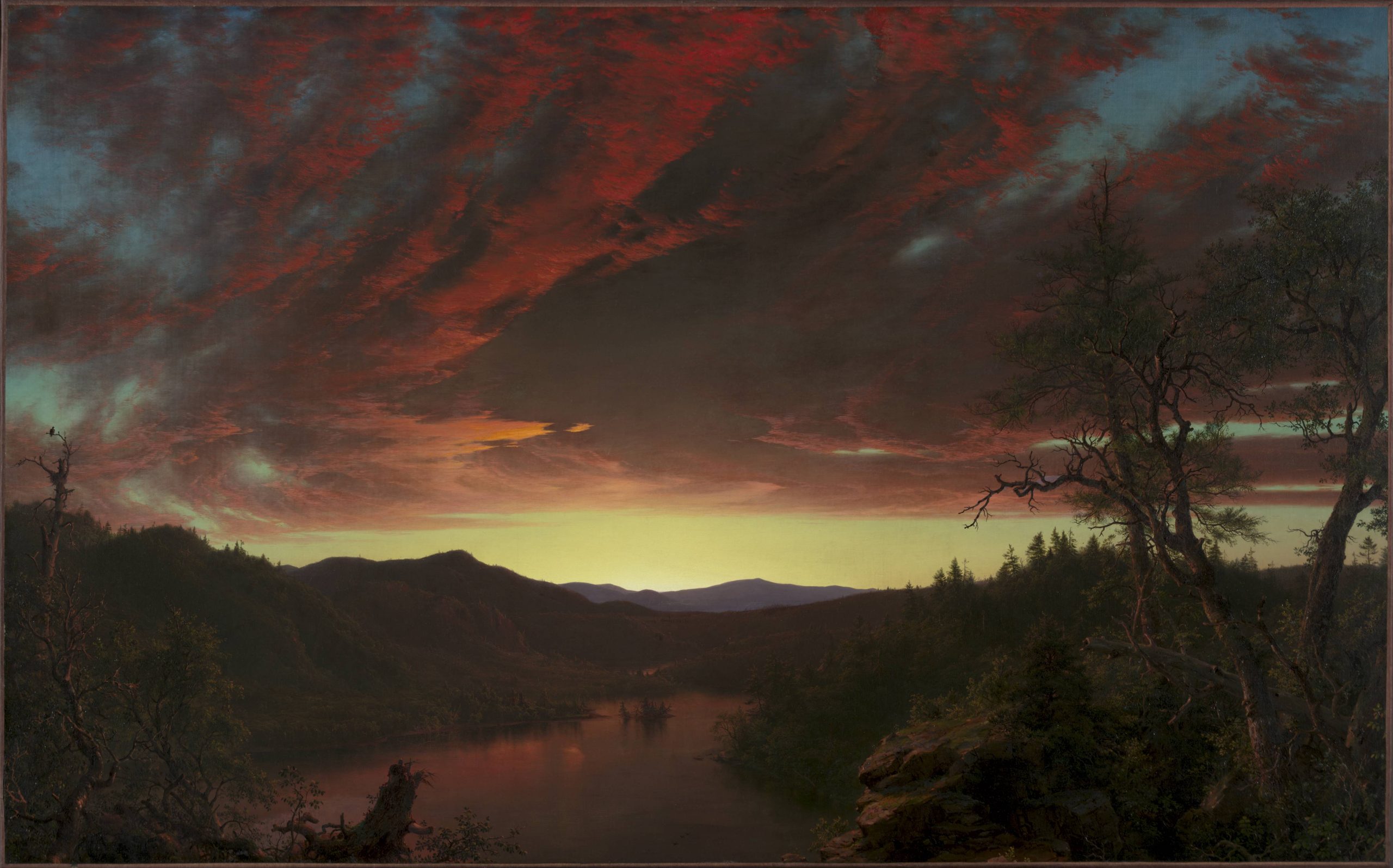
The same instinct for concentrated experience appears in Twilight in the Wilderness of 1860. The Cleveland Museum of Art explains that Church painted it in his New York studio, using studies from the region near Mount Katahdin in Maine. He exhibited the finished canvas on its own. Here there is no vast catalog of climate zones. There is instead a blazing sky held against a darkening foreground. The scale of feeling comes from the contrast: brilliance above, near-silence below, and a stretch of water that binds the two together.
Cleveland’s discussion also offers a possible historical reading. Painted on the eve of the Civil War, the sunset can suggest a coming national catastrophe. That is a persuasive interpretation, but it should remain an interpretation, not a coded message we claim to have definitively solved. A sky may carry the pressures of its time without becoming a one-to-one illustration of them. The picture keeps its force because the spectacle is also an uncertainty. We know that the light will pass; we cannot know, from within this moment, what the darkness will contain.
Stone, weather and distance
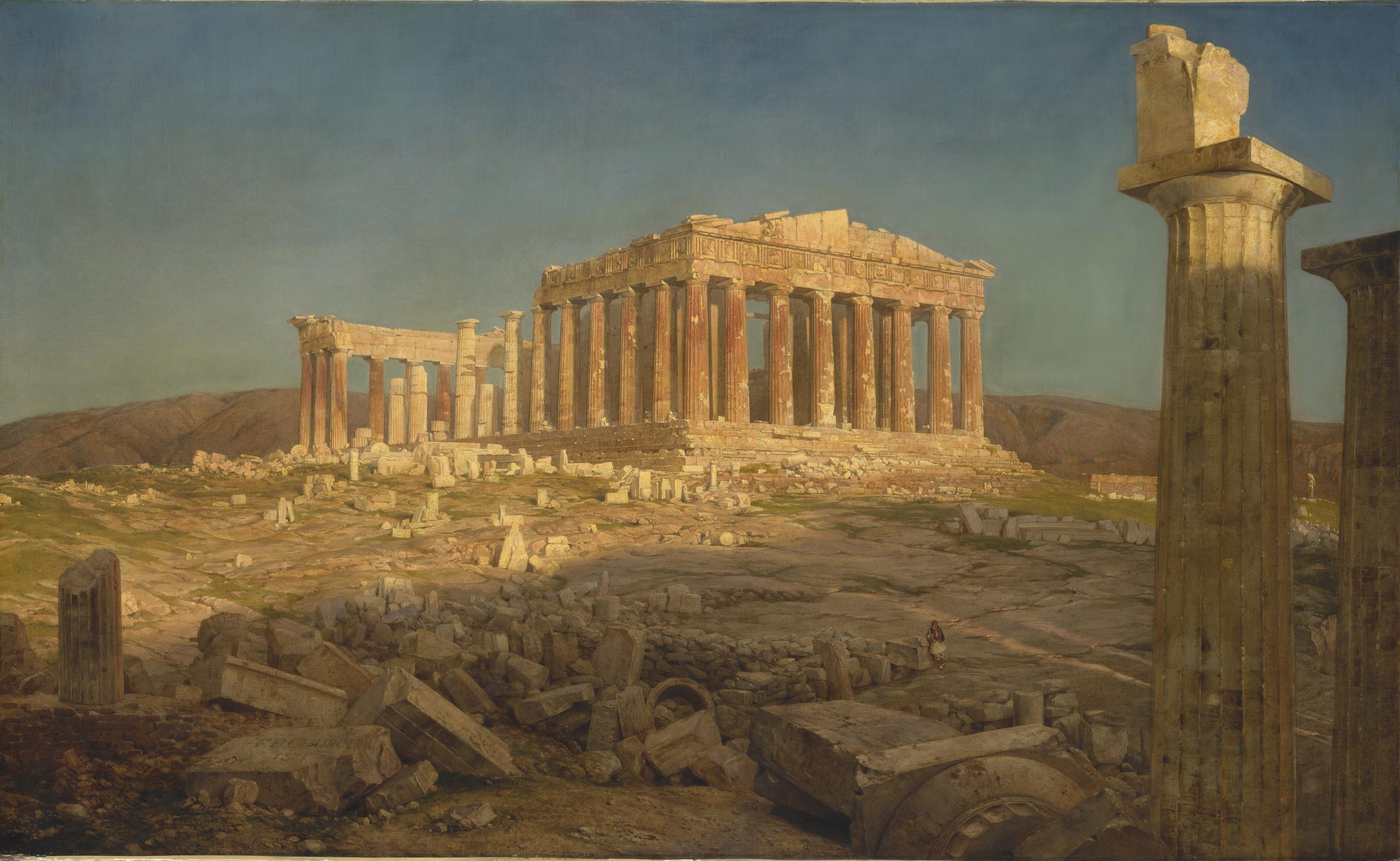
In The Parthenon, dated 1871, the natural world shares the stage with a building. The Met connects the canvas to studies Church made in Athens in 1869. Light makes the ruin seem both solid and vulnerable, its ordered columns set against a much less orderly expanse of sky and broken ground. This is a different kind of travel picture from the Andes, but the eye works in a related way. It moves between a commanding whole and its fragments, between a distant conception of a place and the texture of things immediately before us.
We do not need to treat every destination as evidence of an appetite to possess the world. Yet it is worth noticing the authority these pictures assume: they gather places, organize them and offer them to a viewer at a comfortable distance. Keeping that fact in mind need not cancel the visual pleasure. It can make our looking more alert. What seems complete has been chosen. What appears effortless has been constructed. Church’s paintings become richer, not poorer, when we remember that a convincing world is still a painter’s arrangement.
The quieter invitation
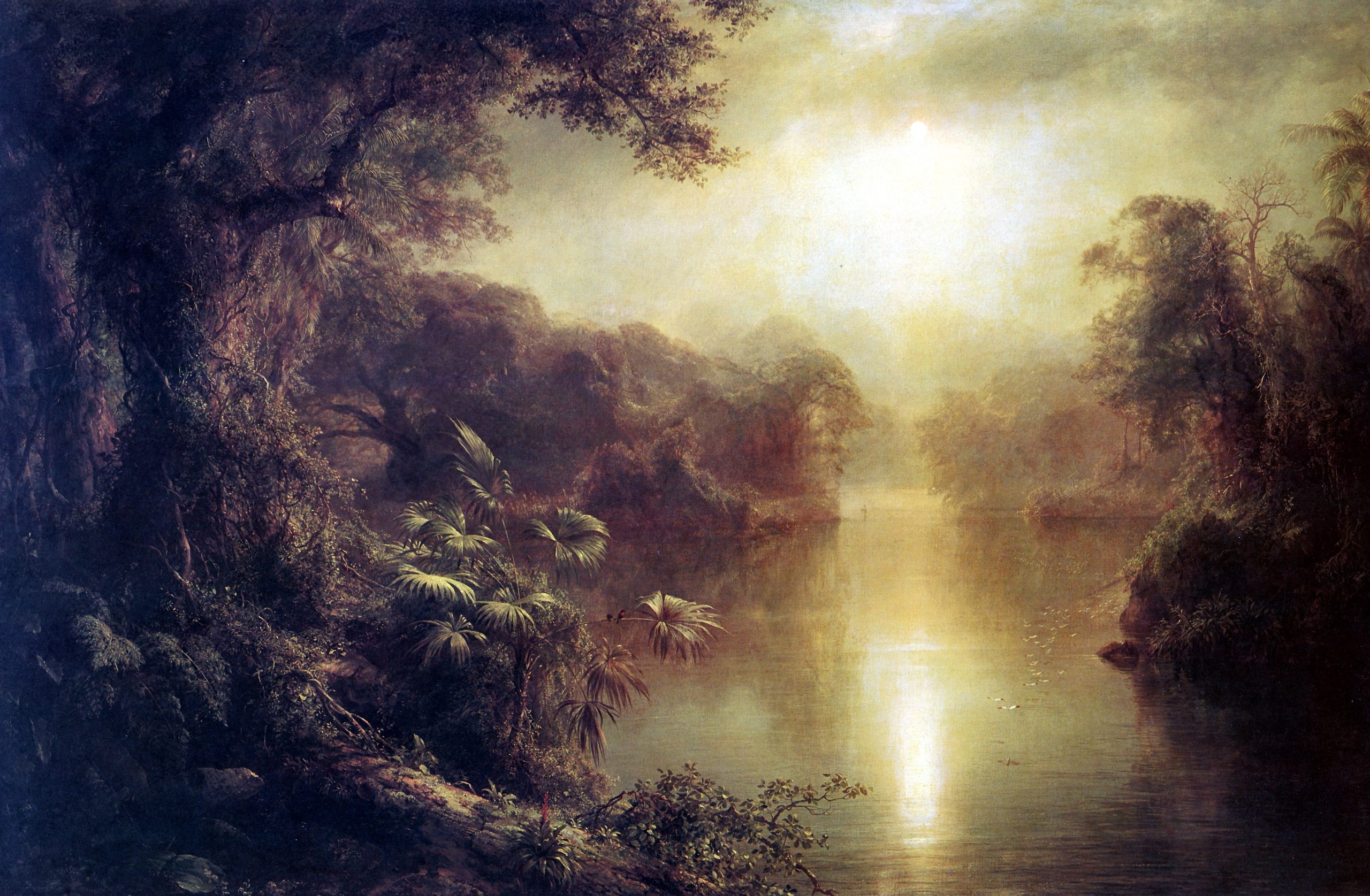
The 1877 painting catalogued by the National Gallery of Art as El Rio de Luz (The River of Light), also known as Morning in the Tropics, makes a quieter invitation. The museum directs attention to the river’s reflective surface, the sun’s passage through the air and a tiny canoe in the distance. There is ample vegetation to inspect, but the atmosphere seems to loosen the demand that every part be read immediately. Light is not merely illuminating an inventory. It is the event that holds the picture together, drawing the eye from water into mist.
Seen beside the Andes, this river suggests how flexible Church’s expansive vision could be. Sometimes the world presents itself as a grand assembly; sometimes it arrives as a gradual emergence. We can look for the boat before considering the light, or follow the light until the boat becomes almost incidental. Either route returns us to the same generous proposition: a large picture can contain many different experiences of scale. Church’s best landscapes do not require us to choose between wonder and examination. They make wonder last by giving examination somewhere to go.
Explore more works by Frederic Edwin Church in the collection.