
A sunset is the one landscape almost everyone stops to look at. It is also one of the hardest things to paint. The light changes by the minute, the colors run from gold to crimson to violet in a single sky, and a painter who overdoes it ends up with something that looks like a postcard. The artists in this guide managed it, and their evening skies still glow on a wall.
Below we walk through the sunset paintings in our collection, from the American wilderness to the harbors of New England and the Thames, then offer some practical ideas on colors, rooms and sizes. You can see every one of them in our sunset paintings collection.
A sunset is the one landscape almost everyone stops to look at, and one of the hardest to paint.
Frederic Church: the sky on fire
Frederic Edwin Church (1826–1900), who trained with Thomas Cole, painted some of the most dramatic skies in American art. His Twilight in the Wilderness (1860, Cleveland Museum of Art) is the masterpiece of the type: a wild northern valley under clouds lit red and orange from below, the last light reflected in a still river. It was painted on the eve of the Civil War, and many writers have read its burning sky as a sign of the conflict to come.
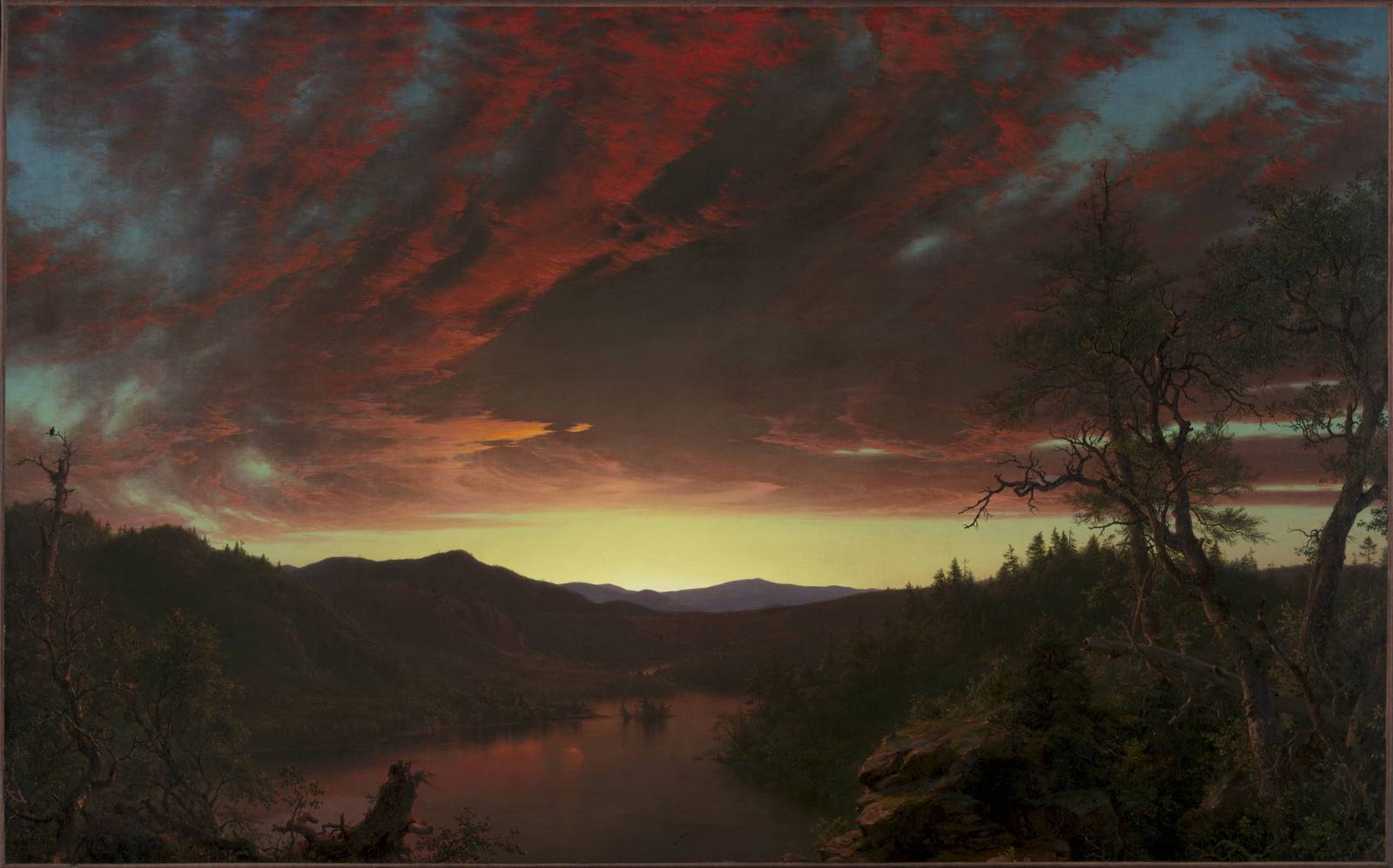
Seven years earlier, Church had painted Mount Ktaadn (1853, Yale University Art Gallery), Maine’s Mount Katahdin glowing at sunset above a lake, a mill and a few grazing cows. It is gentler and more pastoral, a good choice if you like the color but want something calmer.
And in 1861, after the attack on Fort Sumter, Church made Our Banner in the Sky, in which stripes of red evening cloud and a patch of starry blue form the American flag over a bare tree. It circulated widely as a print during the war and remains a moving patriotic picture.
The West at dusk: Bierstadt and Keith
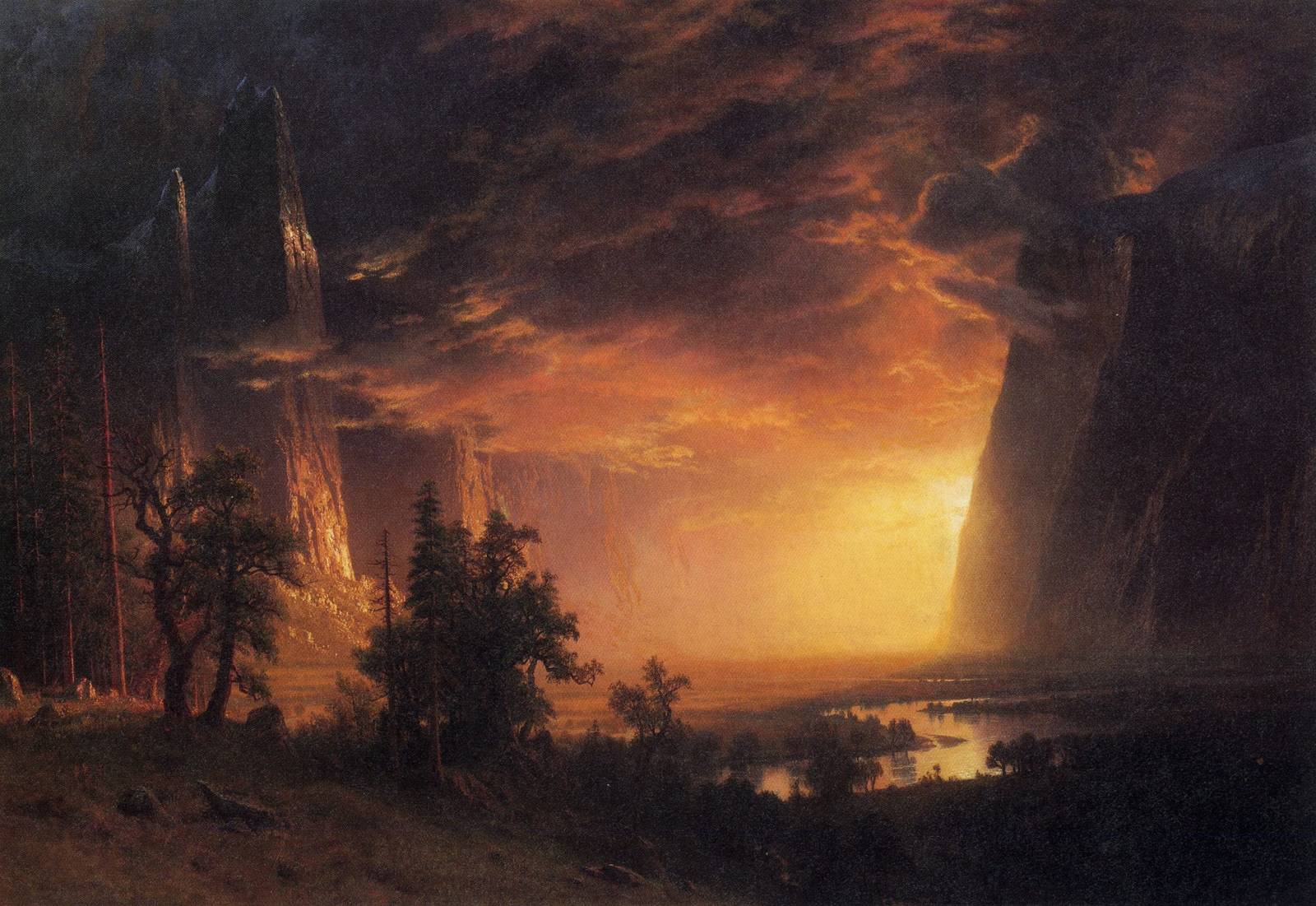
Albert Bierstadt brought the same blazing light to the American West. His Sunset in the Yosemite Valley (about 1868, Haggin Museum, Stockton, California) looks down the valley with the walls in deep shadow and the whole sky turned to gold and red. Bierstadt was famous for heightening what he saw, and this is one of his most theatrical pictures.
Closer to home for Californians, William Keith’s Sunset on Mount Diablo (1877) shows the familiar East Bay peak dark against a blazing sky. It is a wonderful gift for anyone who grew up in the Bay Area.
Back east, Jasper Francis Cropsey’s Sunset after a Storm in the Catskill Mountains (1860, Detroit Institute of Arts) catches the moment when a storm breaks and the low sun floods the hills with warm light.
Quiet water: Lane and Kensett
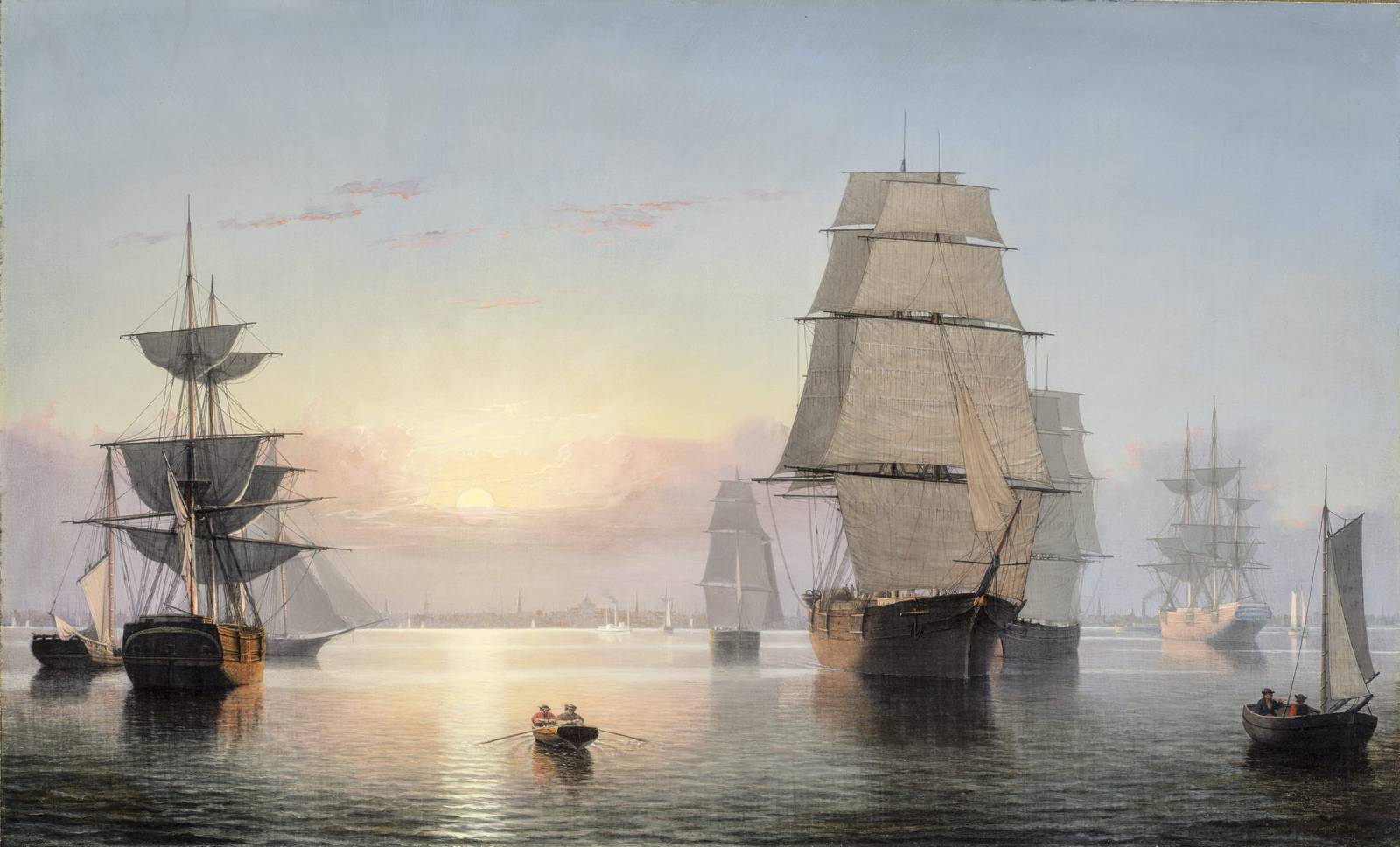
Not every sunset needs fireworks. A group of American painters, later grouped by art historians under the name luminism, specialized in calm water, clear air and soft, even light. Fitz Henry Lane (1804–1865), from Gloucester, Massachusetts, painted Boston Harbor, Sunset (1850–55, Los Angeles County Museum of Art), with tall ships resting on glassy water and the sky fading from gold to pale blue.
John Frederick Kensett went even further. His Sunset on the Sea (1872, The Metropolitan Museum of Art) has no shore, no ship and no figure, only open water under a glowing evening sky. He painted it in the last year of his life, and it is one of the most peaceful pictures in our collection.
Kensett’s Sunset on the Sea has no shore, no ship and no figure, only water and evening light.
Across the world, Ivan Aivazovsky’s Sunset over Yalta (1861) does something similar on the Black Sea, a low sun laying a path of gold across a calm Crimean bay.
Monet’s London sunset
For an Impressionist sunset, there is Claude Monet’s The Houses of Parliament, Sunset (1903, National Gallery of Art, Washington). Monet painted the Thames again and again on visits to London, working from a terrace at St Thomas’ Hospital across the river from Westminster and finishing many canvases back in his studio at Giverny. Here the Gothic towers are a dark silhouette and the sky and water dissolve into orange, purple and blue. It is less a picture of a building than of light and fog.
Decorating with sunset paintings
Sunset paintings are warm by nature, so they work best where you want a room to feel inviting. A few ideas:
- Pick up a color from the sky. The oranges and reds look rich against warm wood, brass, leather and terracotta. For contrast, try navy, deep teal or forest green walls; blue is the complement of orange and makes a sunset glow.
- Living rooms and dining rooms. Church’s Twilight in the Wilderness or Bierstadt’s Yosemite bring drama to a long wall and look especially good in evening lamplight.
- Bedrooms and reading corners. The quieter luminist pictures, Lane’s Boston Harbor or Kensett’s Sunset on the Sea, are restful rather than loud.
- Cool, north-facing rooms. A warm sunset can make a room with cool light feel noticeably cozier.
- Pairs. Hang a sunset with a moonlight picture for a simple day-into-night pair; see our guide to moonlight paintings.
- Size and price. Most works come framed in three sizes: Small at $195, Medium at $295 and Large at $395, printed at the original’s true shape without cropping. Many sunset paintings are wide, so over a sofa or bed the Large size usually looks best. Each work page lists exact dimensions; our size and frame guide has more tips.
For more landscapes, see our guides to Frederic Church and Albert Bierstadt, or browse all sunset paintings.