
Few cities have been painted and photographed as often as London, and few look as good on a wall. The Thames gives every view a long, open foreground; the dome of St Paul’s and the towers of Westminster give it a skyline you can recognize from across a room. For three centuries painters from Venice, Paris and London itself set up their easels along the river, and in the 1890s photographers added the first color pictures of Tower Bridge.
This guide walks through the London paintings and photographs in our collection, roughly in the order they were made, with notes on what each one shows and where it might hang. You can see them all together in our London art prints collection.
The Thames gives every London view a long, open foreground, and the skyline does the rest.
Canaletto’s London
The Venetian view painter Canaletto is famous for the Grand Canal, but he spent about ten years in England, from 1746 to 1756, and painted many views of London. His St. Paul’s Cathedral (about 1754, Yale Center for British Art) is unusual among them. St Paul’s appears in many of his river views, but according to the Yale Center this is the only one to show the whole building from close range.
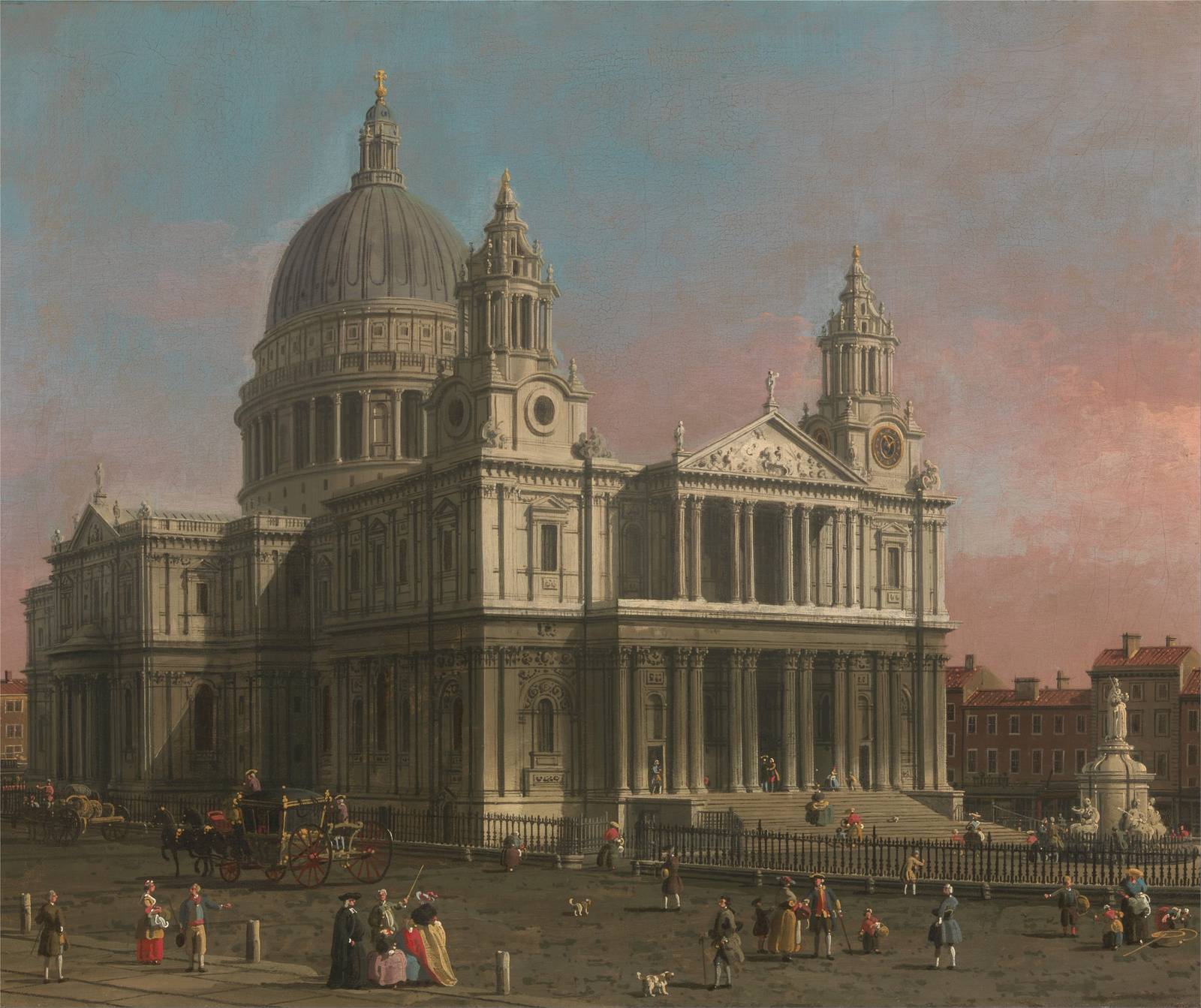
The cathedral was designed by Sir Christopher Wren after the Great Fire of 1666 destroyed the medieval church, and it was completed in 1710. Canaletto sets the west front and the great dome in clear daylight and fills the churchyard with people talking and carriages passing, so the building becomes a backdrop for everyday city life. He painted it for Thomas Hollis, one of his most important English patrons. It is a crisp, bright picture that works well in a study, an entry hall or anywhere you want architecture with a sense of calm order.
For something more playful, the Italian painter Antonio Joli made a Capriccio with St. Paul’s and Old London Bridge (The Metropolitan Museum of Art). A capriccio is an imaginary view that mixes real and invented places. Here we look through a grand classical portico, the kind you might find in Rome or Naples, across the Thames to St Paul’s and the houses on Old London Bridge. It makes a good conversation piece for a dining room.
Westminster before Big Ben
The old Palace of Westminster burned in 1834 and was rebuilt afterwards, so earlier views show Westminster Abbey as the great landmark on that stretch of the river, with the first Westminster Bridge, opened in 1750, crossing the water in front of it.
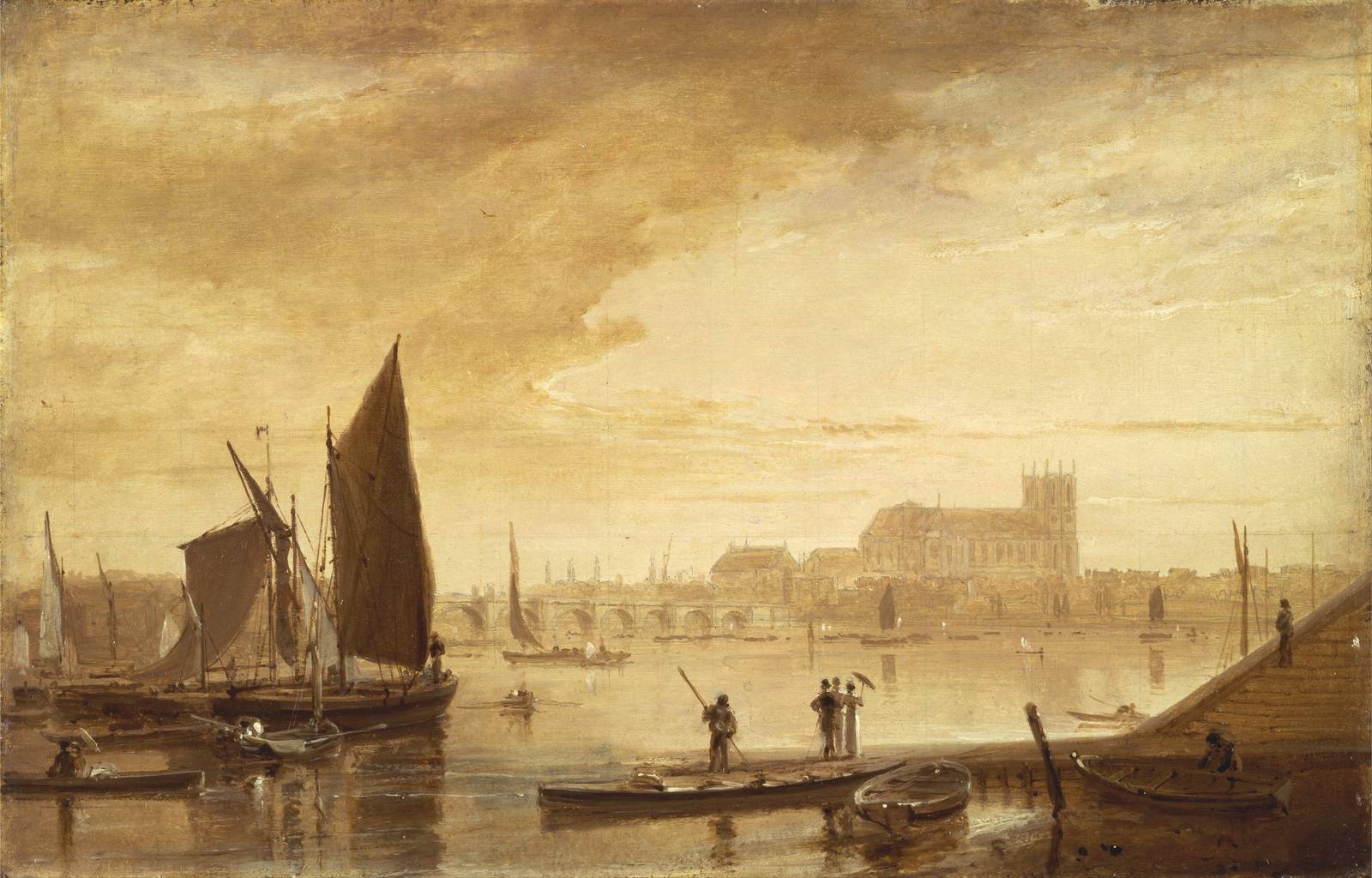
William Daniell’s Westminster Bridge and Abbey (Yale Center for British Art) is the warmest of these. Sailing barges rest on a still river, the long stone arches of the bridge cross the middle of the picture, and the abbey rises beyond in a golden haze. Its date is uncertain; sources place it between about 1800 and 1813.
Joseph Farington’s Westminster Abbey and Bridge (1790s) shows the same landmarks in a tall, upright format, with a pale sky filling more than half the picture. Farington is remembered as much for his diary as for his paintings: kept from 1793 until his death, it is one of the most important records of the London art world of his time. Because it is a portrait-shaped picture, it fits a hallway or a narrow wall beside a window.
John Varley’s watercolor Westminster Abbey from Tothill Fields (Yale Center for British Art) looks at the abbey from open ground to the west, with a big tree in the foreground and red roofs along the edge of the fields. That land was later built over, so the picture records a London that has disappeared.
The working river
For most of its history the Thames was a working highway, crowded with barges, colliers and ships. William Anderson’s London Bridge, with St. Paul’s Cathedral in the Distance (about 1815) is a wide, panoramic view of that traffic: tan-sailed barges in the foreground, ships moored at timber wharves, the many arches of the old bridge, and St Paul’s dome on the skyline. Its long, low shape makes it a natural choice above a sofa or a sideboard.
The river was also a playground. William Havell’s Yachts of the Cumberland Society Racing on the Thames (about 1815, Royal Museums Greenwich) shows a race in full swing while spectators wave their hats from a rowing boat. Royal Museums Greenwich explains that the Duke of Cumberland founded the Cumberland Fleet for Thames racing in 1775, and that it was the ancestor of the Royal Thames Yacht Club. It is a cheerful gift for anyone who sails.
Monet in the London fog
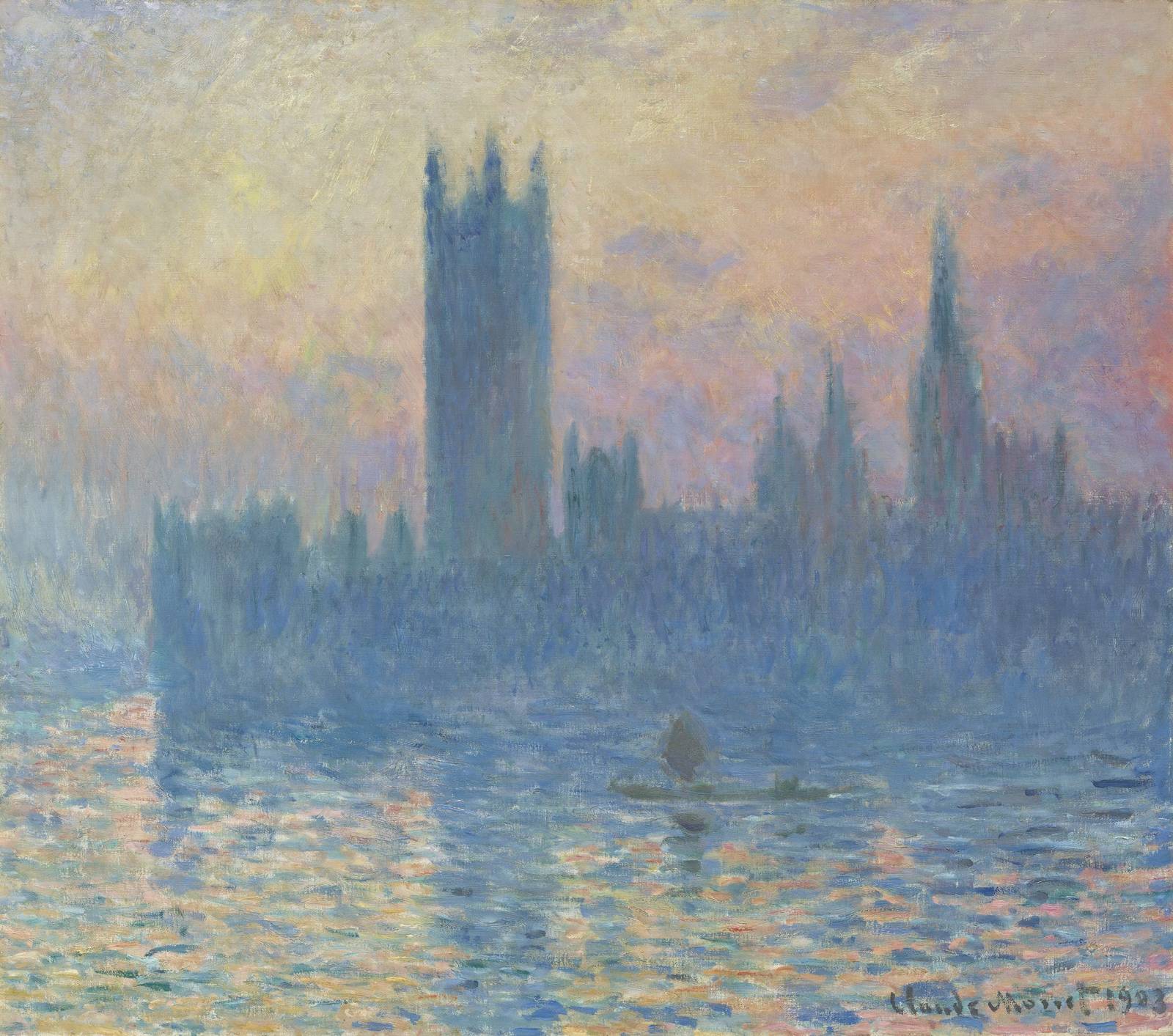
By 1900 the new Houses of Parliament had become London’s signature, and Claude Monet made them the subject of one of his great series. On visits between 1899 and 1901 he painted the building from St Thomas’ Hospital across the river, in the late afternoon, when the towers stood in silhouette against a sky colored by sun, fog and smoke. He made around twenty versions and finished many of them back at Giverny. The series was shown in Paris in 1904 to great success.
The Houses of Parliament, Sunset (1903, National Gallery of Art, Washington) is one of the most dramatic: dark Gothic towers against a burning orange and violet sky, reflected in the water below. It is less a portrait of a building than a portrait of London air, and it gives a living room real color.
Monet’s Parliament is less a portrait of a building than a portrait of London air.
Tower Bridge in early color
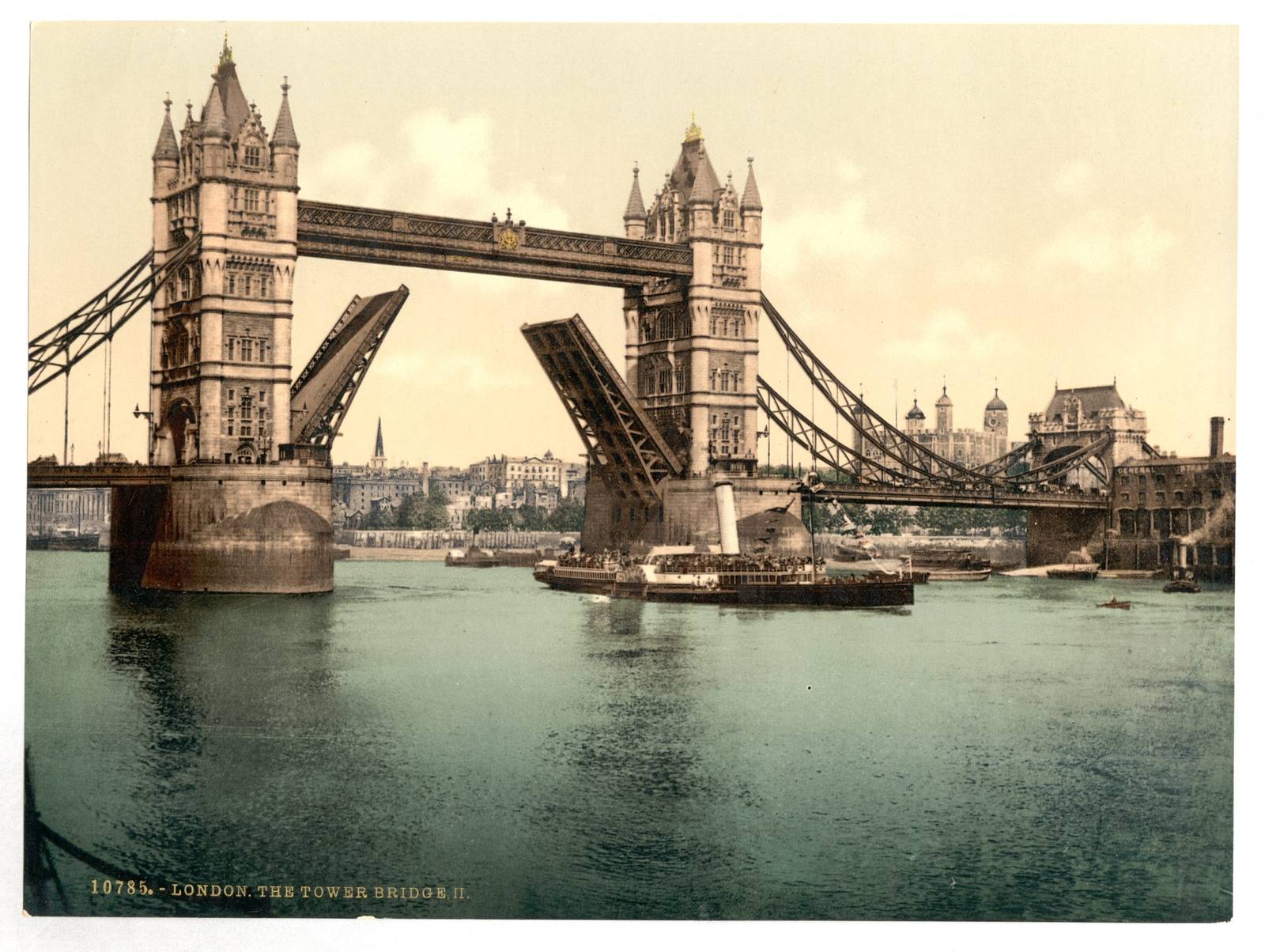
Tower Bridge was built between 1886 and 1894 to designs by the City Architect Horace Jones, with engineering by John Wolfe Barry. Its two bascules lift so tall ships can still reach the Pool of London, and the high walkways let people cross while the bridge is open. Two photochroms in our collection show it in both states: Tower Bridge (Open) with the bascules raised, and Tower Bridge (Closed) with the roadway down. Both are from the Detroit Publishing Company’s Views of the British Isles, now in the Library of Congress Photochrom Print Collection.
A photochrom is a color picture made from a single black-and-white negative, transferred onto a series of lithographic stones, one for each color. Hung as a pair, the open and closed views make a lovely set for a hallway or an office.
London in wartime
One London photograph needs no introduction. On the night of 29–30 December 1940, during one of the heaviest fire raids of the Blitz, the Daily Mail photographer Herbert Mason took a picture of St Paul’s dome standing clear above the smoke. It was published as St Paul’s Survives. It is a moving pairing with Canaletto’s sunlit view of the same building.
Choosing a London print
- For a living room. Monet’s Parliament for color, or Anderson’s wide Thames view for a long wall over a sofa.
- For a study or office. Canaletto’s St Paul’s, or the pair of Tower Bridge photochroms.
- For a hallway or narrow wall. Farington’s upright Westminster view.
- As a gift. Anyone who has lived in, studied in or honeymooned in London will know these places at a glance.
- Size and price. Most works come framed in three sizes: Small at $195, Medium at $295 and Large at $395, printed at the original’s true shape without cropping. Each work page lists exact dimensions and which sizes print sharpest.
For more city views, see our guides to Paris and Venice, or browse the London collection.