
Paris is one of the few cities that people fall in love with before they have ever been there. Part of the reason is that painters and photographers got there first. For more than a century, artists stood at hotel windows, on bridges and in dance gardens and made pictures that taught the rest of the world what Paris is supposed to look like: wide boulevards, grey rooftops, a river with a cathedral rising over it, and a crowd that never quite stops moving.
This guide walks through the Paris pictures in our Paris art prints collection, from an eighteenth-century map of every street to the photograph of the city’s liberation in 1944, with notes on what to look for and how to choose one for your own wall.
Painters taught the rest of the world what Paris is supposed to look like.
Before the boulevards: the old city
The best place to start is above the city. The Turgot Map of Paris was commissioned by Michel-Étienne Turgot, who as head of the city’s merchants wanted to show off Paris to visitors. The surveyor Louis Bretez spent years walking the streets and drawing them, and the result, engraved by Claude Lucas and published in 1739, is a bird’s-eye view in which every street, courtyard, church and garden appears in three dimensions. It is a map you can get lost in, and it rewards a large size.
Eduard Gaertner’s Rue Neuve-Notre-Dame in Paris (1826) shows what that crowded medieval city felt like at street level. The German painter looks down a narrow lane of tall houses toward the towers of Notre-Dame, with Parisians going about their business in the foreground. Much of this tight tangle of streets on the Île de la Cité was cleared later in the century, which makes the picture a small historical record as well as a handsome painting.
Four years later the same streets were full of barricades. Eugène Delacroix’s Liberty Leading the People (1830, Louvre) commemorates the July Revolution, when Parisians rose against King Charles X. Liberty, bare-footed and carrying the tricolor, strides over the fallen toward the viewer, and the towers of Notre-Dame appear through the smoke at the right. It is a picture about France as much as about Paris, and it hangs best where it has room to be loud.
The new Paris of the Impressionists
Between 1853 and 1870, under Napoleon III, the prefect Georges-Eugène Haussmann cut long, straight boulevards through the old city and lined them with uniform stone apartment buildings. The Impressionists grew up with this new Paris and made it their subject: traffic, crowds, cafés and weather on wide streets designed to be looked down.
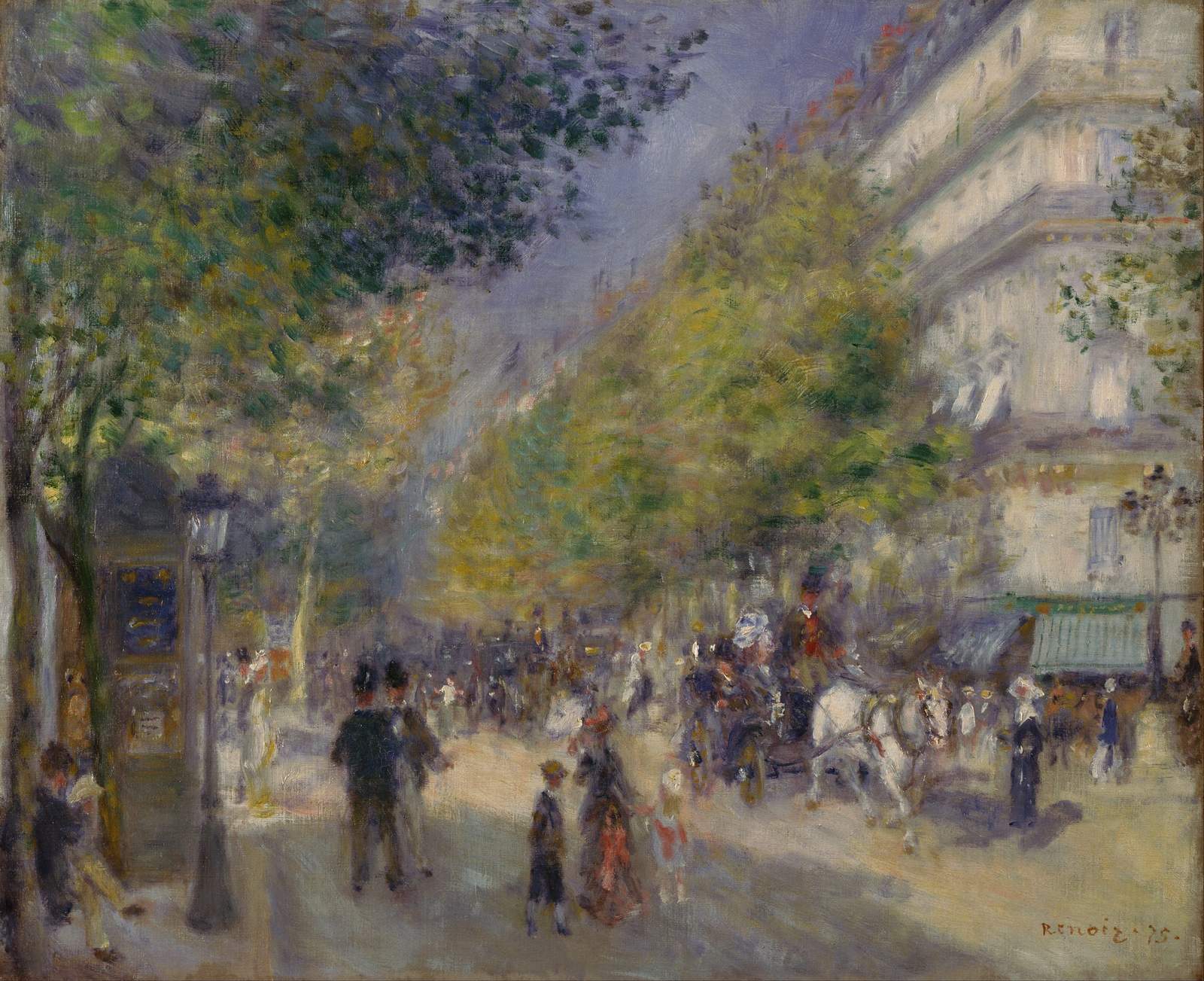
Pierre-Auguste Renoir’s The Grands Boulevards (1875, Philadelphia Museum of Art) is the sunny version: dappled shade under young trees, a carriage, strollers, and a light, feathery touch that makes the whole street seem to flicker. A year later Renoir painted Dance at Le Moulin de la Galette (1876, Musée d’Orsay), set in an open-air dance garden on the hill of Montmartre where working people and artists spent Sunday afternoons. Light falls through the leaves in patches onto dresses and straw hats, and the painting has become one of the best-loved pictures in Paris. If you want a single joyful Paris painting for a living room, it is hard to beat.
Gustave Caillebotte, a wealthy painter who also bought and exhibited his friends’ work, looked at the city differently. His View of Rooftops (Snow Effect) (1878–79, Musée d’Orsay) is almost all roofs and chimney pots under snow, painted in soft greys. There are no people at all, just the quiet of a winter morning above the street. It is a favorite with people who know Paris well enough to love its rooftops.
Édouard Manet took the city’s pleasures outdoors to the racecourse. The Races at Longchamp (1866, Art Institute of Chicago) shows the horses charging straight at the viewer at the track in the Bois de Boulogne, a daring head-on view at a time when racing pictures usually showed horses in profile. Its long, narrow shape suits a spot above a sofa or a sideboard.
Pissarro at the hotel window
Late in life Camille Pissarro, troubled by an eye infection that made working outdoors difficult, began painting Paris from hotel rooms. In 1897 he took a room at the Grand Hôtel de Russie and painted the Boulevard Montmartre below him again and again in different seasons, weather and times of day, a series of fourteen canvases.
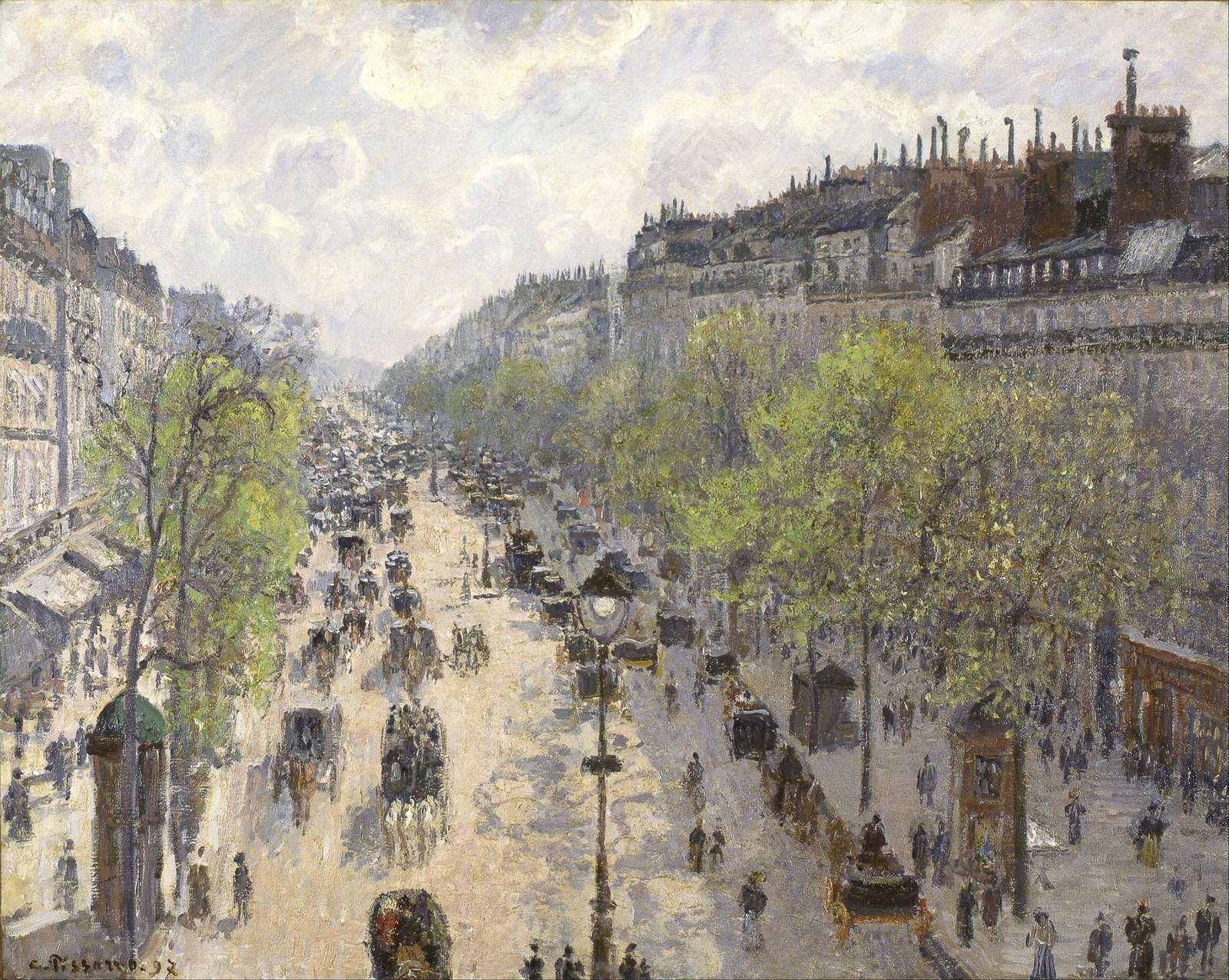
Two of them are in our collection. Boulevard Montmartre, Spring is fresh and pale, with new leaves on the trees and the street disappearing into a soft haze. Boulevard Montmartre on a Winter Morning (Metropolitan Museum of Art) shows the same view in cold grey light, with dark carriages and walkers threading through. Hung side by side, they make a lovely pair, and they show exactly what Pissarro was after: not the street itself but the changing light on it.
The following year he moved to the Hôtel du Louvre and painted the Avenue de l’Opéra. Avenue de l’Opéra, Morning Snow (1898, Pushkin Museum, Moscow) catches the avenue under a thin layer of snow, with carriages and pedestrians leaving dark marks in the white. For a winter wall or a holiday season, it is one of the most atmospheric Paris pictures we sell.
The river and the cathedral
Notre-Dame and the Seine are the other great Paris subject. Albert Lebourg’s Pont Saint-Michel and Notre-Dame (about 1895, Musée Carnavalet) dissolves the bridge and the cathedral into hazy riverside light. Maximilien Luce’s The Quai Saint-Michel and Notre-Dame (1901, Musée d’Orsay) is its bright, sunny opposite, built from the separate strokes of color Luce learned from the Neo-Impressionists. After the 2019 fire, pictures of the cathedral’s skyline have taken on extra meaning for many people.
The tower and the twentieth century
The Eiffel Tower was built in about two years for the Exposition Universelle of 1889, which marked the centenary of the French Revolution, and it stood as the tallest structure in the world until the Chrysler Building in New York surpassed it in 1930. Photographers recorded it rising piece by piece. Louis-Émile Durandelle’s Eiffel Tower Under Construction, 1888 shows the iron legs joined and the tower halfway up over the rooftops, and Hippolyte Blancard’s Eiffel Tower Nearing the Top catches it in its final months. Browse the full set in our Eiffel Tower construction photographs; engineers, builders and anyone who has climbed the tower tend to love them.
Finally, the Liberation of Paris photograph of August 1944 shows crowds lining the Champs-Élysées as General Leclerc’s Free French 2nd Armored Division passes the Arc de Triomphe. It is a moving gift for anyone with a family connection to the Second World War.
How to choose a Paris print
- Pick a mood. Renoir for warmth and sunshine, Pissarro and Caillebotte for quiet grey elegance, the Eiffel photographs for something graphic and modern.
- Think in pairs. Pissarro’s spring and winter boulevards, or two Eiffel construction stages, make an easy matched pair for a hallway or either side of a bed.
- Match the frame. A black frame sharpens the black-and-white photographs and the Turgot map; a gold or walnut frame warms the Impressionist paintings.
- Size it. Every work comes framed and ready to hang in up to three sizes, Small at $195, Medium at $295 and Large at $395, printed at the original’s true proportions without cropping. Exact dimensions are on each work page.
For more, see every work by Camille Pissarro and Pierre-Auguste Renoir, or browse our wider Impressionist paintings collection.