
Some people are easy to buy for in December. The sailor in your life is not usually one of them. They already own the good foul-weather jacket, they have strong opinions about knots, and anything nautical from a gift shop tends to end up in a drawer. A great marine painting is different. It speaks their language, it lasts, and it puts the water on the wall for the months the boat is hauled out.
Below are the ship and harbor pictures in our collection that we would give to someone who sails, races, fishes or simply grew up near a harbor, grouped by the kind of person they suit. Every one is a real work from a museum or archive, printed at its true shape and sent framed and ready to hang. You can browse more in our sailing collection and clipper and tall ship paintings.
A great marine painting speaks a sailor’s language, and it puts the water on the wall for the months the boat is hauled out.
For the weekend sailor: Winslow Homer’s Breezing Up
If you give one picture from this list, make it Winslow Homer’s Breezing Up (A Fair Wind) (1873–76, National Gallery of Art, Washington). A man and three boys ride a small catboat heeled over in a fresh wind, one boy holding the tiller, the hull lifting over green water. The boat’s name, Gloucester, is painted on the stern. It is about the plain pleasure of a good afternoon on the water, which is exactly what most sailors are thinking about in January.
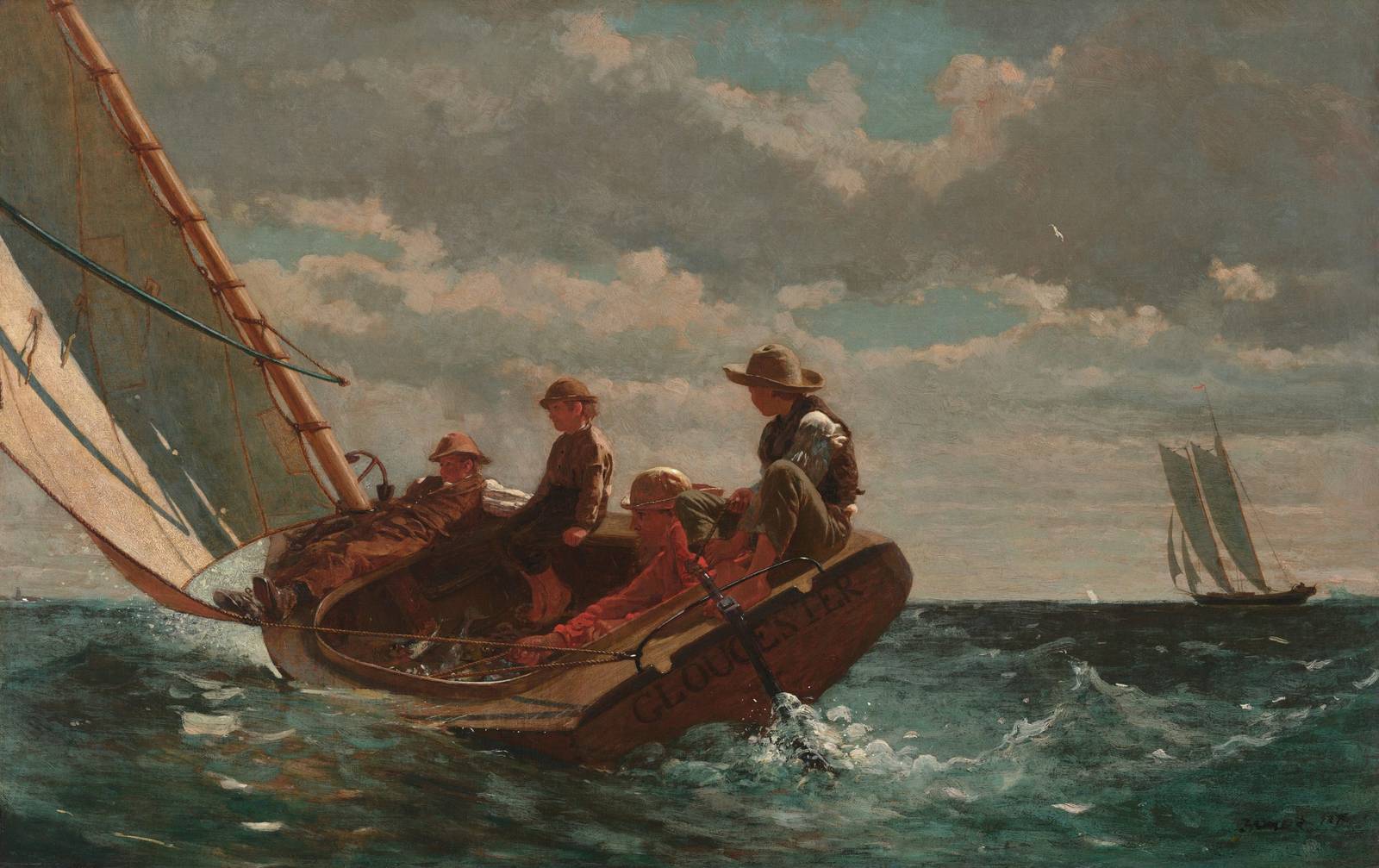
Homer spent much of his later life on the Maine coast, and his sea pictures grew darker and stronger over time. Our guide to Winslow Homer’s sea paintings covers the rest, including The Fog Warning and The Herring Net, two good choices for someone who fishes.
For the tall ship lover: clippers under full sail
The clipper ship era, roughly the 1840s to the 1860s, produced the most beautiful merchant ships ever built. They were long, narrow and carried enormous spreads of canvas, and the California Gold Rush made speed around Cape Horn to San Francisco worth paying for. Marine painters recorded them like portraits.
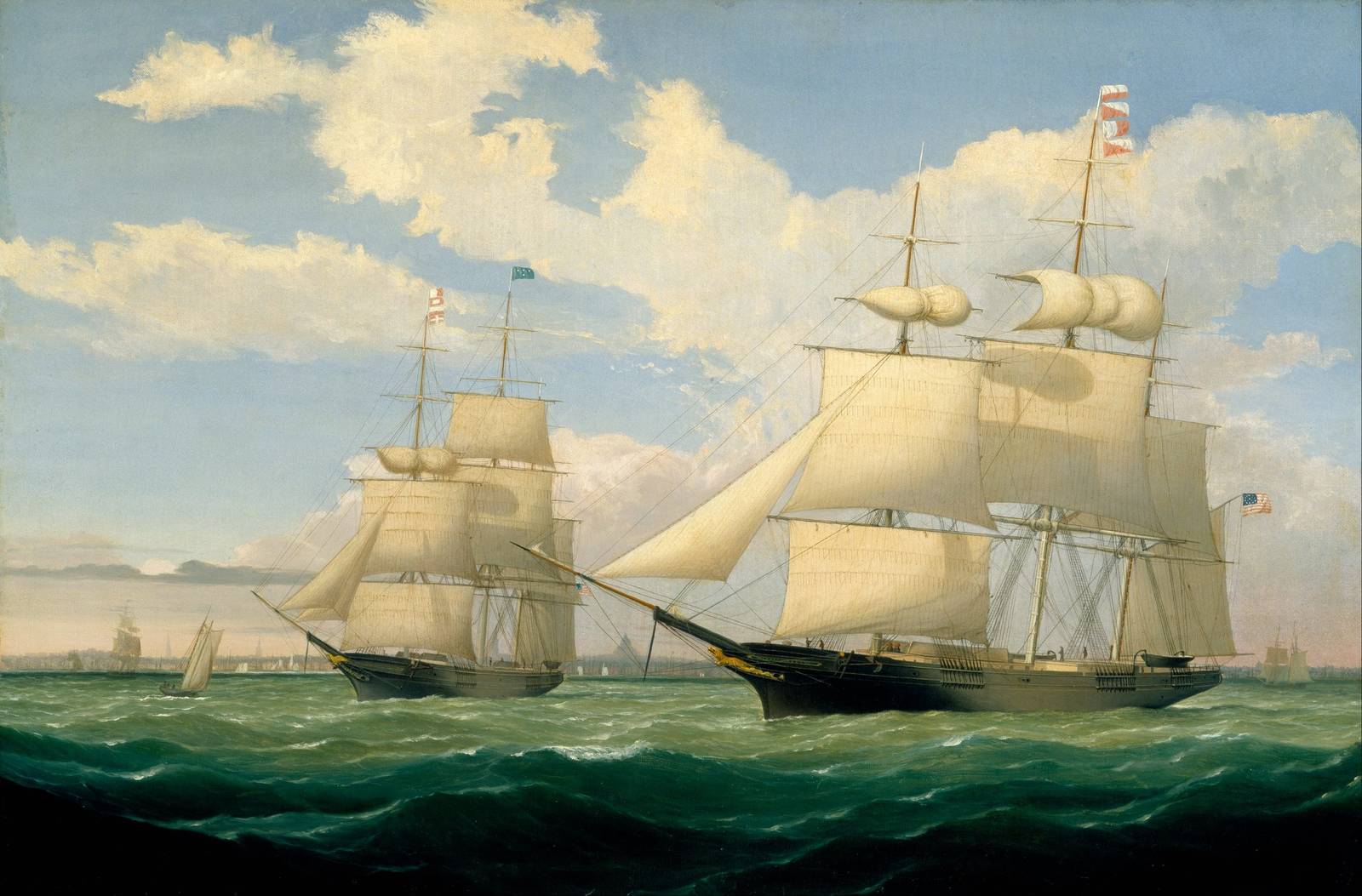
Fitz Henry Lane, of Gloucester, Massachusetts, painted The Ships Winged Arrow and Southern Cross in Boston Harbor in 1853, at the height of the clipper years. Two ships ride the harbor under clear light, every line of rigging drawn with care. Lane is remembered as one of the great American luminists, painters of calm water and still, glowing air, and this is a fine example of his ship work.
For more motion, there is Thomas Somerscales’s A Clipper Running before the Wind (1901). Somerscales, an Englishman who spent much of his career in Chile, painted the ship bow-on and coming straight at you through blue-green swells, every sail drawing. Antonio Jacobsen, a Danish-born painter who worked in New York and made a living painting ship portraits, offers a calmer, side-on view in The British Clipper Ship Laomene under Full Sail (1883).
For the racer: America and the America’s Cup
Anyone who follows sailboat racing knows the story of the schooner America. In 1851 the New York yacht crossed the Atlantic and won a race around the Isle of Wight against the best of the British fleet. The silver trophy she brought home became the America’s Cup, the oldest prize in international sport still contested today. John Fraser’s The Schooner Yacht America, from the collection of Royal Museums Greenwich, shows her low black hull and two raked masts driving across open water.
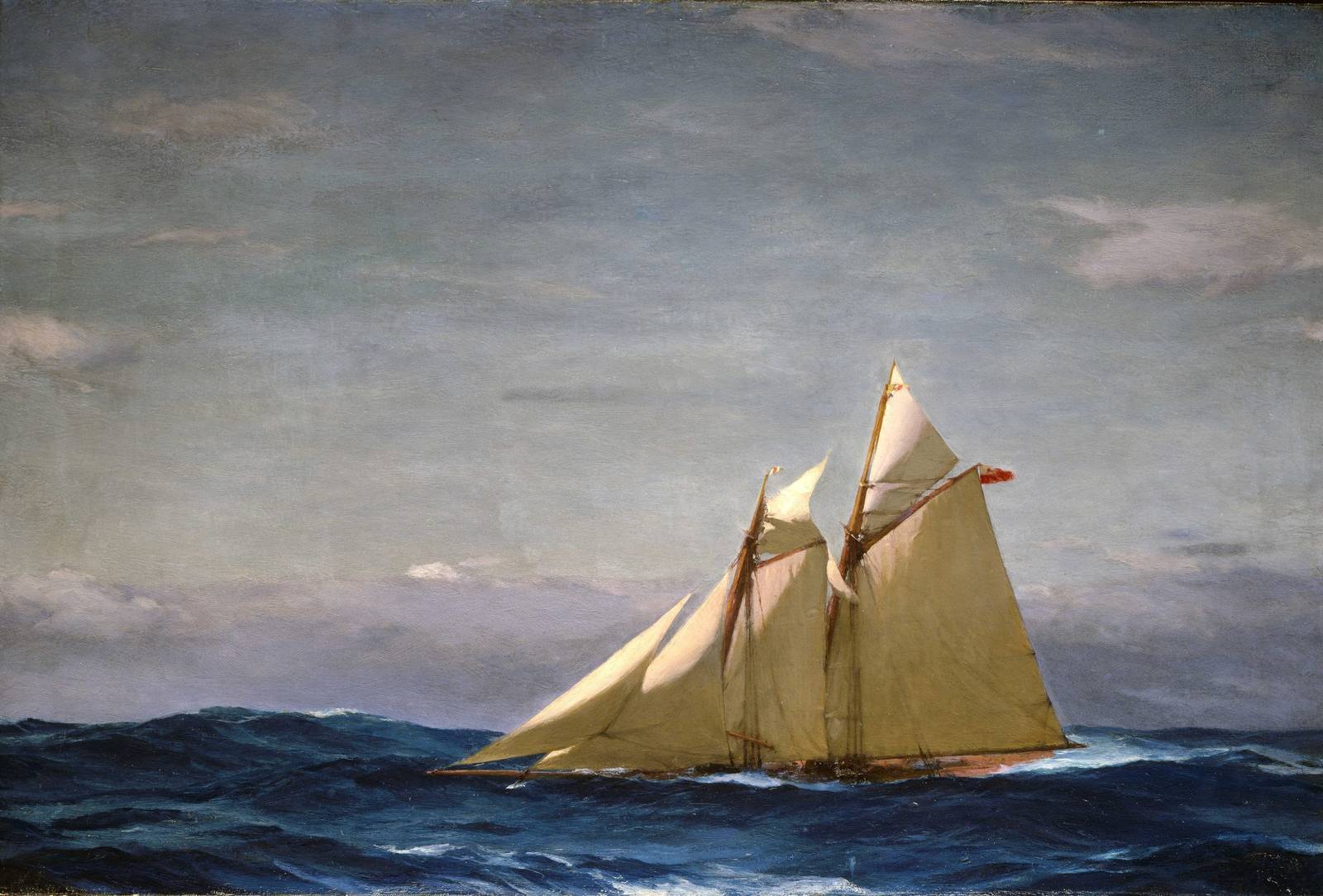
Pair it with a photograph. Henry G. Peabody, a Boston photographer known for his yachting pictures, made Valkyrie II in 1893, the year that British cutter came to challenge for the Cup. The tall white mainsail fills almost the whole frame, and in black and white it looks wonderfully modern. Painting and photograph together tell four decades of the same race.
For a lighter mood, Claude Monet’s Regatta at Sainte-Adresse (1867, The Metropolitan Museum of Art) shows small sailboats on a bright summer day near Le Havre, with spectators on the beach. It suits someone who loves the social side of racing as much as the competition.
For the history buff: navies and famous ships
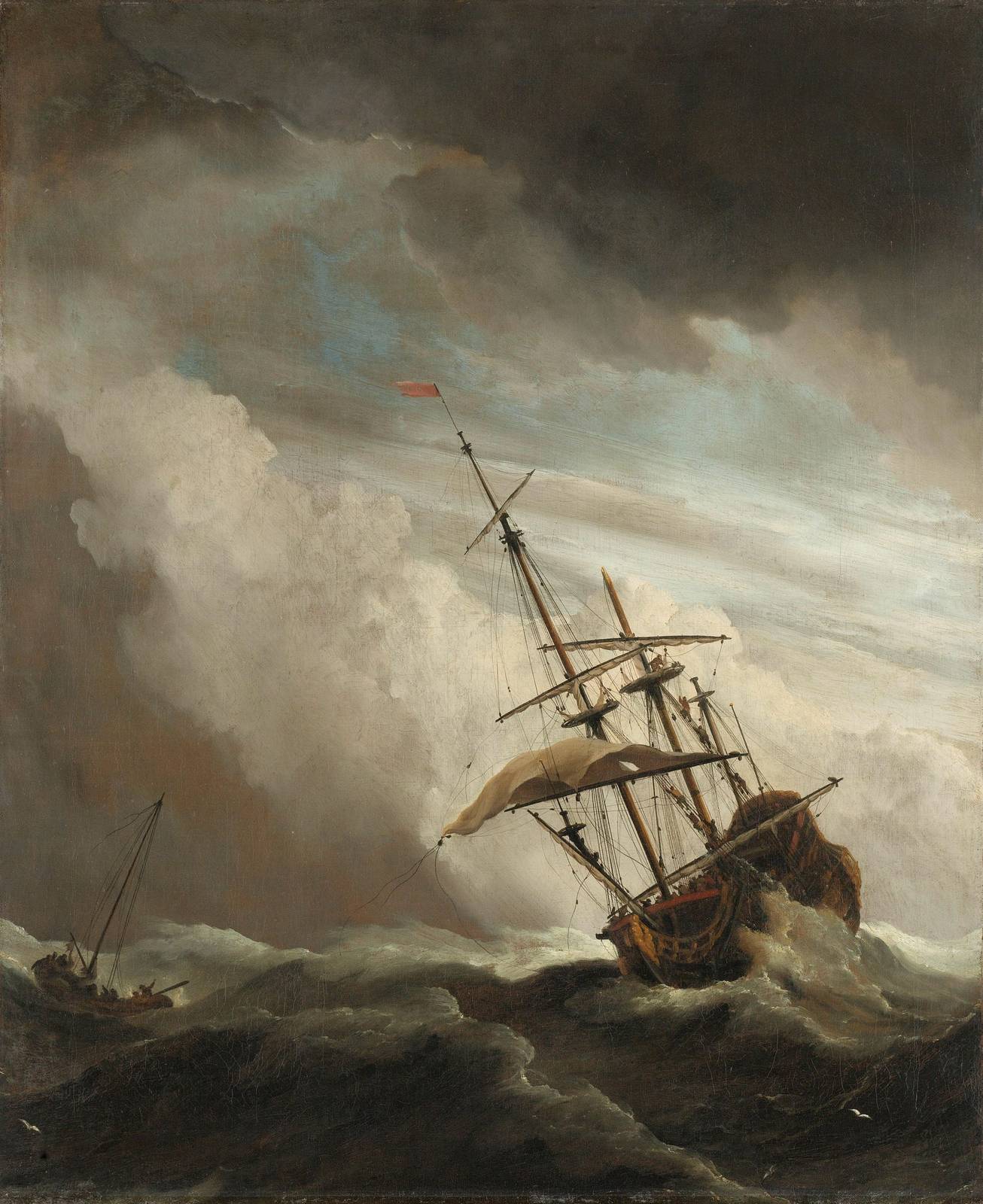
Some sailors are really naval historians. For them, the Dutch and English marine painters of the seventeenth century are the source. Willem van de Velde the Younger and his father moved from Amsterdam to England in the early 1670s and worked for King Charles II. His A Ship on the High Seas Caught by a Squall, Known as ‘The Gust’ (c. 1680, Rijksmuseum, Amsterdam) shows a ship heeled hard over in a sudden wind under a heavy sky. Anyone who has been caught by a squall will feel it.
J. M. W. Turner’s The Victory Returning from Trafalgar (c. 1806) shows Nelson’s flagship, HMS Victory, sailing home after the 1805 battle in which Nelson was killed. For an American Civil War reader, Édouard Manet’s The Battle of the Kearsarge and the Alabama (1864, Philadelphia Museum of Art) records the June 1864 fight off Cherbourg, France, in which the Union sloop Kearsarge sank the Confederate raider Alabama. Manet painted it the same year, with the sea rising almost to the top of the canvas. More battle scenes are in our naval battle paintings collection.
Painting and photograph together tell four decades of the same race.
Practical notes for giving
- Sizes and prices. Most works come framed in three sizes: Small at $195, Medium at $295 and Large at $395, with free shipping in the US. We print each work at its original shape, so exact inches vary; every work page lists them.
- Which size. Ship pictures have lots of rigging detail, so Medium or Large shows them off best on a living room or den wall. A Small works well in a hallway, a powder room or next to a desk.
- Which frame. The gold Wood Ornament frame suits the older paintings, like Van de Velde, Lane and Turner. The slim Black Metallic frame looks sharp on the Peabody photograph and gives any painting a cleaner, modern look.
- Timing. Every frame is made to order, and delivery takes about 14 to 21 days, so order by early December if you want it under the tree. Details are on our shipping and returns page.
- Not sure of their taste? A calm harbor scene is the safest bet; a storm or a battle is for someone you know likes drama.
For more ideas, see our guide to Ivan Aivazovsky’s seascapes, our broader holiday gift guide to framed art, or browse the harbor paintings and tall ship paintings collections.