
Few painters have spent a lifetime on a single subject as completely as Ivan Aivazovsky spent his on the sea. Over a career of more than six decades he painted calm bays and wrecking storms, moonlit harbors and sunrise breaking over survivors clinging to a mast. His canvases are known for water that seems lit from within, and that quality is exactly why his work translates so well into a framed print: it carries light into a room. This guide covers who he was, how he worked and how to choose an Aivazovsky seascape for your own walls.
A painter from the Black Sea coast
Aivazovsky was born in 1817 in Feodosia, a port town on the Crimean coast of the Black Sea, into an Armenian family. The sea was the backdrop of his childhood, and it remained the center of his life. His talent was noticed early, and in 1833 he entered the Imperial Academy of Arts in St. Petersburg, where he studied landscape painting and began to concentrate on marine subjects.
After graduating he traveled through Europe, spending several years in Italy in the early 1840s. Naples, Venice, Sorrento and the Amalfi coast gave him a new range of southern light, and his Italian pictures sold well and built his reputation abroad. Back in Russia he was attached to the Main Naval Staff as its painter, which brought commissions for harbors, fleets and naval engagements. Yet he chose to make his home not in the capital but back in Feodosia, where he built a studio, painted for the rest of his life and opened a gallery of his work to the public. He died there in 1900.
Painting the sea from memory
What set Aivazovsky apart from many of his contemporaries was his method. Rather than painting outdoors in front of the motif, he worked in the studio, drawing on memory and on years of watching water closely. He was famously fast, and his output was enormous; the figure most often given is around six thousand paintings. Working from memory freed him to compose for drama. Waves could rise exactly where the picture needed them, and the sun or moon could sit precisely where it would light the crest.
His other signature is translucency. In his best pictures the light does not just fall on the waves; it passes through them, so a curling crest glows green or gold against a darker sea. That effect, built up in thin, luminous layers of paint, is what makes his storms feel thrilling rather than gloomy, and what makes even his darkest canvases bright on a wall.
In his best pictures the light does not just fall on the waves; it passes through them.
The Ninth Wave and the great storms
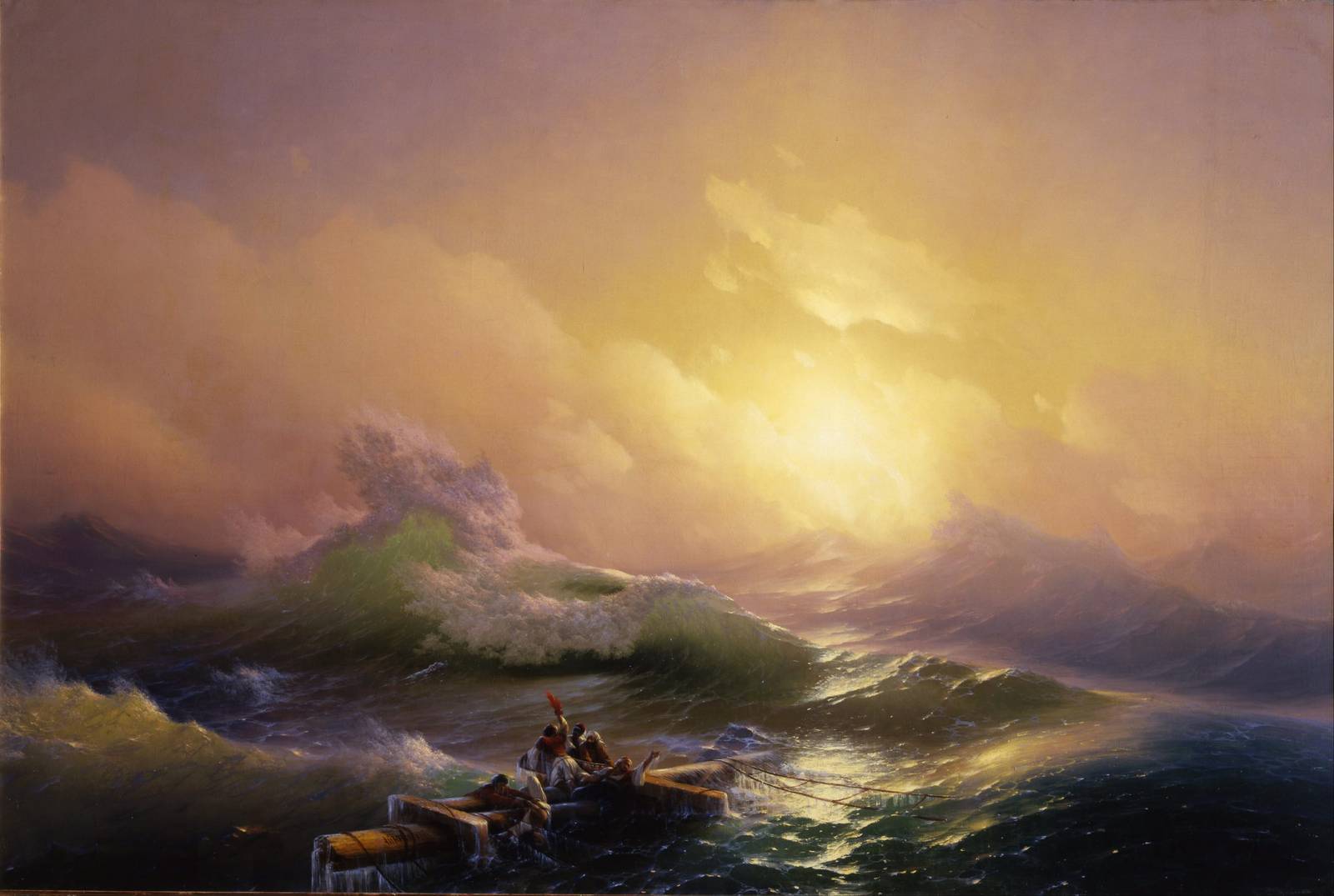
The Ninth Wave of 1850 is his most celebrated painting and hangs in the State Russian Museum in St. Petersburg. Its title comes from an old sailors’ belief that waves build in sets and the ninth is the largest and most dangerous. After a night of storm, a handful of survivors cling to a piece of broken mast as another enormous wave rises above them. The sky, though, is flooded with warm sunrise, and that light turns a scene of peril into one of endurance and hope. It is a painting about holding on.
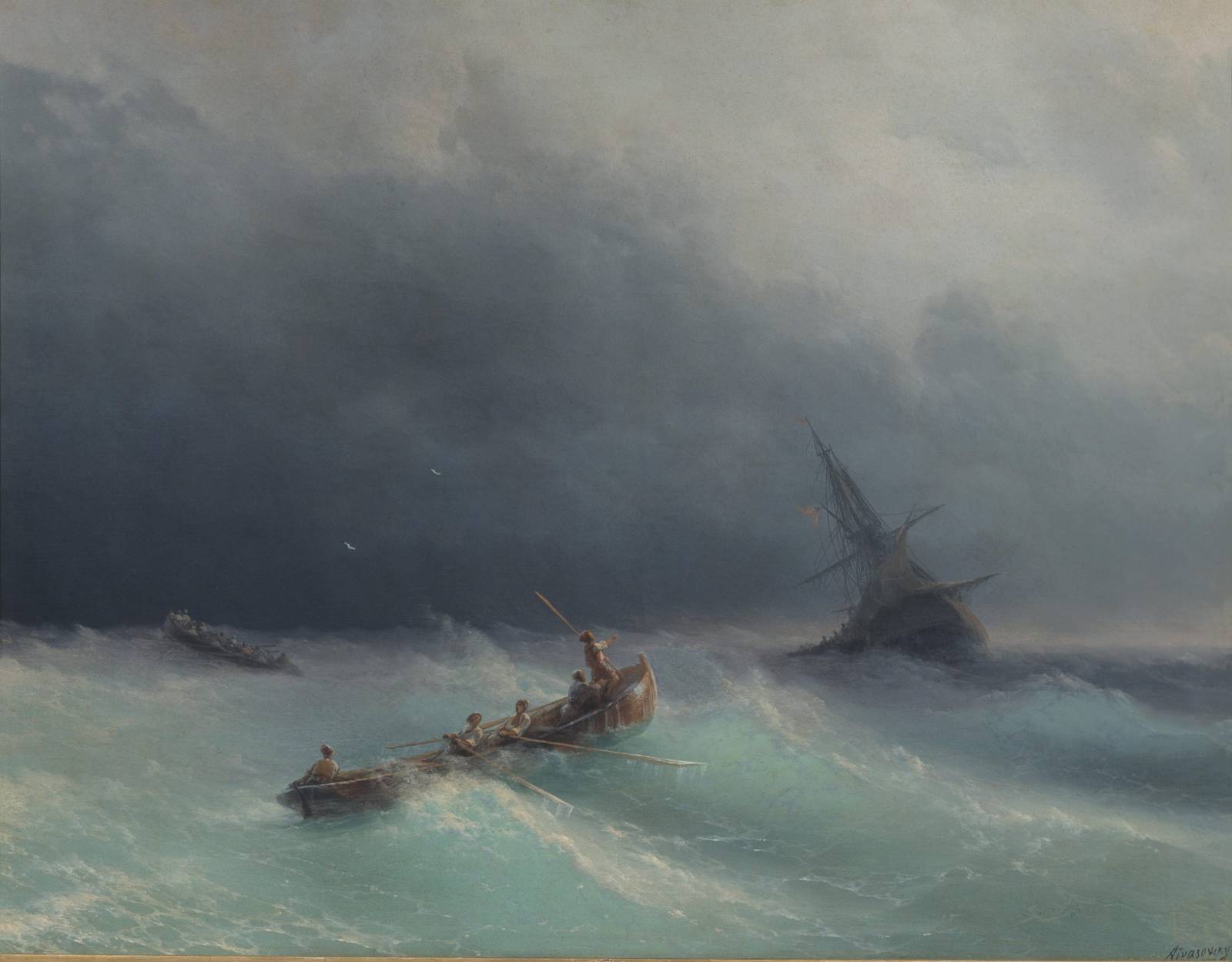
For a wall that wants energy, his storms are hard to beat. Storm at Sea (1873) is a classic of the genre, all motion and spray, while Storm over Yevpatoria (1861) brings the drama close to the Crimean shore he knew best. These pictures suit a study, a library or a living room with deep wall colors, where their glowing crests become the brightest thing in the room.
Calm water, moonlight and southern harbors
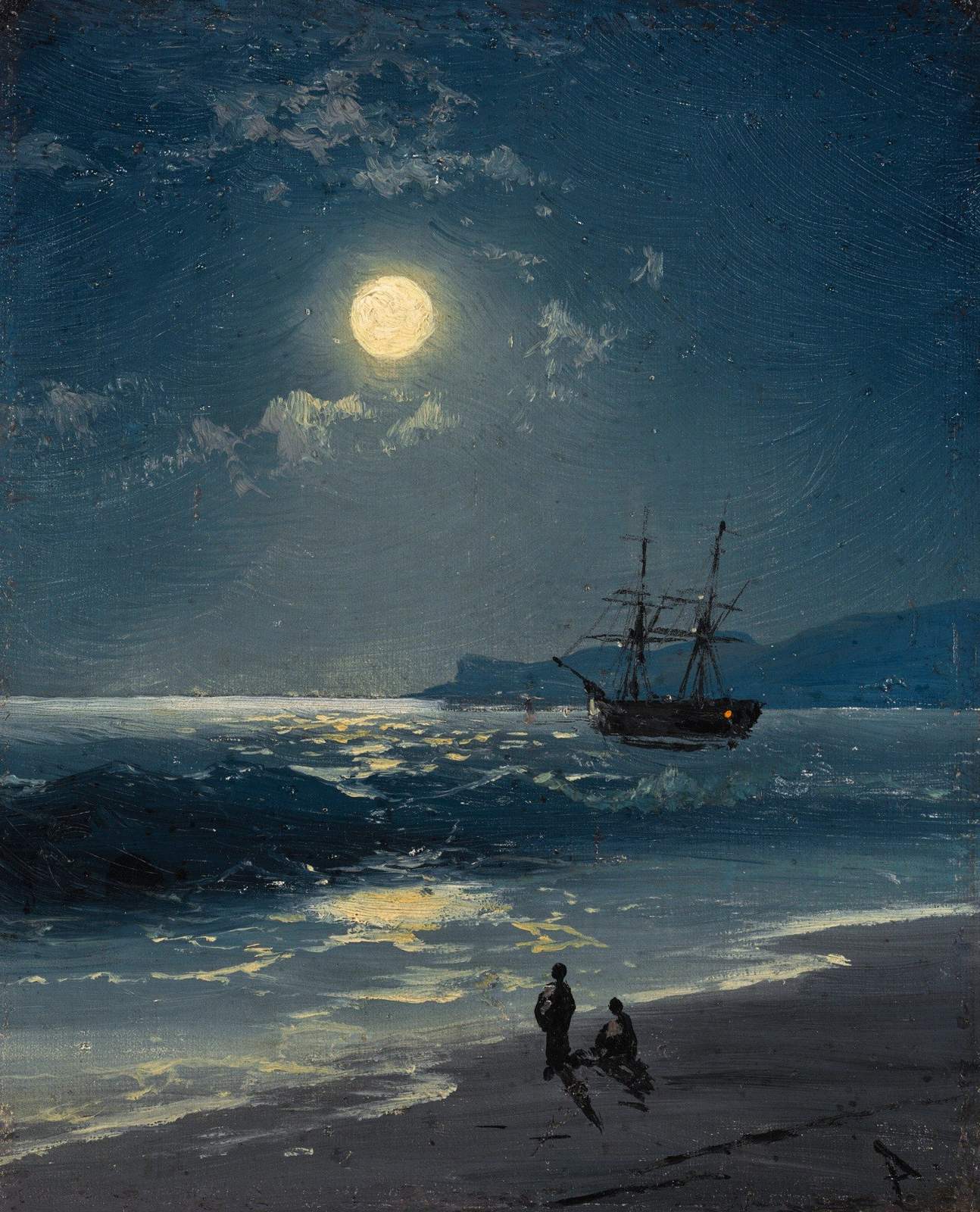
Aivazovsky was just as gifted at stillness, and his quiet pictures are often the easier choice for a bedroom or a dining room. Sailing Ship on a Calm Sea by Moonlight (1897), painted late in his life, shows his love of a full moon laying a silver path across smooth water. Fog over the Sea (1895), from the State Tretyakov Gallery, is softer still, a nearly monochrome study in mist that works beautifully in a calm, minimal room.
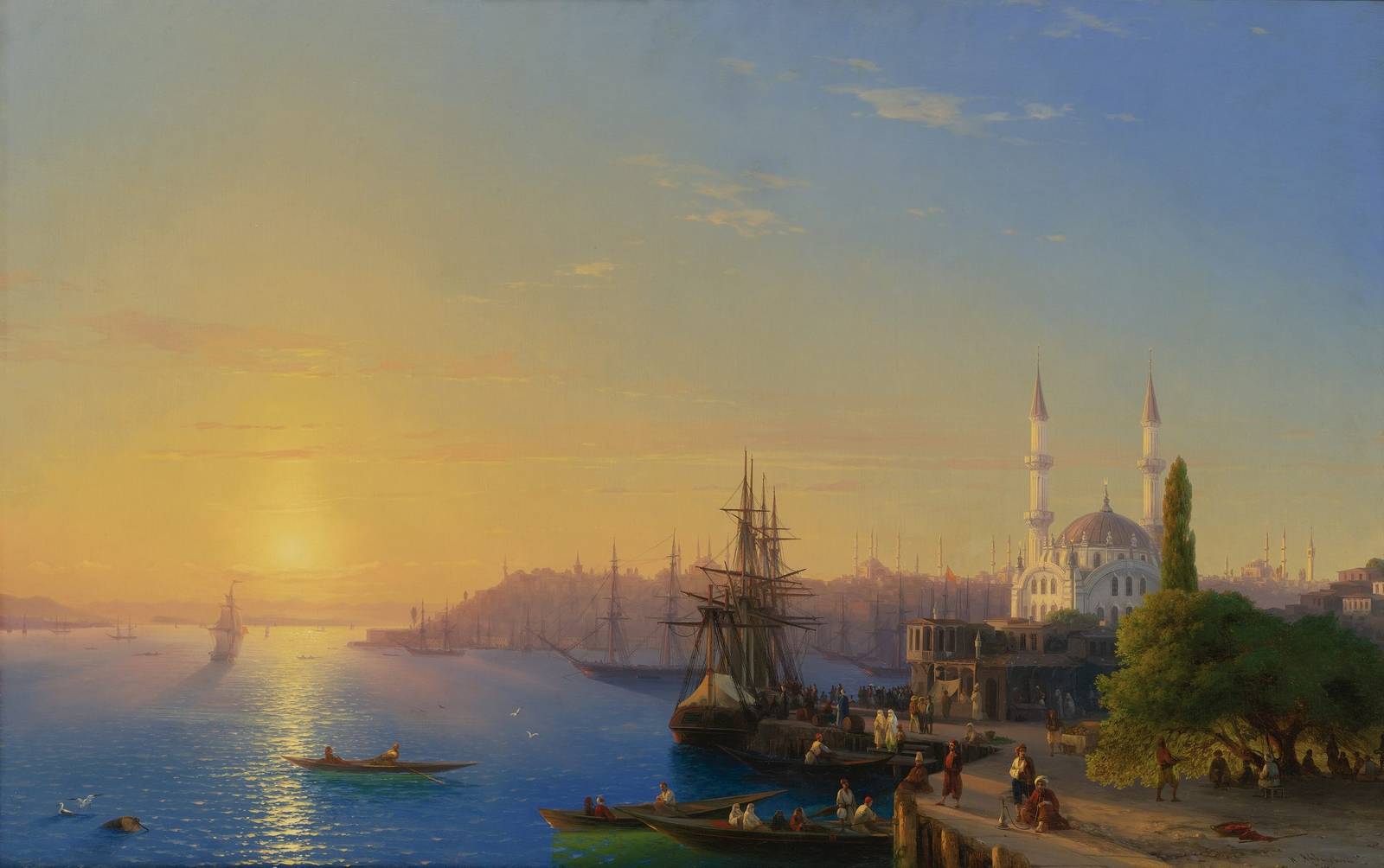
His travels gave him a gallery of warm, golden harbors too. The Bay of Naples (1841) comes from his Italian years, and Sunset over Yalta (1861) returns to the Crimean coast in evening light. View of Constantinople and the Bosphorus (1856) frames the domes and minarets of the city across glowing water, a favorite for anyone who loves Istanbul or travel scenes in general.
Choosing the right Aivazovsky for your room
- Living room or above a sofa: a wide storm or a sunrise scene such as The Ninth Wave gives a strong focal point with plenty of movement.
- Bedroom: moonlight and calm water, like Sailing Ship on a Calm Sea by Moonlight, are restful and still glow softly in low light.
- Office or library: Storm at Sea or Storm over Yevpatoria pair well with dark wood, leather and deep green or navy walls.
- Coastal or beach house: the golden harbors, from Naples to Yalta, bring warmth without feeling like a cliché seascape.
Sizes and frames
Every FrameAnyPhoto print is made at the painting’s own proportions, with nothing cropped, so the exact dimensions vary slightly from work to work. Most Aivazovsky works are offered in three sizes: Small at $195, Medium at $295 and, where the source image has enough detail, Large at $395. The Ninth Wave, for example, runs from about 20 × 13 inches up to 36 × 24 inches. A few works, like Fog over the Sea, are offered in Small only because that is what the scan supports at full quality.
For frames, the black metallic option gives a crisp, modern edge that lets the light in the painting do the work, while the ornate wood frame leans into the nineteenth-century salon look and suits traditional rooms. Over furniture, aim for art about half to two-thirds the width of the piece below it. A Large storm alone above a sofa makes a statement; two Mediums, one storm and one calm, make a pleasing pair that shows both sides of the painter.
See every work in our Aivazovsky paintings collection or on the Ivan Aivazovsky artist page, and explore more drama on the water in stormy sea paintings and moonlight paintings.
