
Late November is the season when American landscape painting feels most at home. The leaves are mostly down by Thanksgiving in much of the country, but the colors of October linger in memory, and the holiday itself invites a certain kind of picture: harvest, home, a long view over hills and water, people gathered outdoors in good light. No group of painters captured that mood better than the artists of the Hudson River School, who made the American autumn one of their signature subjects in the middle of the nineteenth century.
This guide gathers some of the finest autumn landscapes in our catalog, explains what makes each one special and offers practical advice on hanging them in a dining room, entry or living room before the guests arrive.
The American autumn became one of the great subjects of the Hudson River School.
Why autumn mattered to American painters
European visitors in the 1800s were often astonished by the fall foliage of the northeastern United States, which can be far more vivid than the gentler autumn of much of Britain and Western Europe. American painters knew they had something distinctive. Scarlet maples, orange oaks and gold birches gave them a palette no Old Master had painted, and the subject fit a broader ambition: to make the wilderness of the young nation into art worthy of a great museum.
Autumn also carried meaning. It was the season of harvest and thanksgiving, but also of change and passing time, themes these painters returned to again and again. Thanksgiving itself became a national holiday in 1863, when President Abraham Lincoln proclaimed a day of thanks for the last Thursday of November, after years of campaigning by the magazine editor Sarah Josepha Hale. Several of the paintings below were made in the same decades, and they share its spirit of gratitude for land and plenty.
Thomas Cole: where the tradition begins
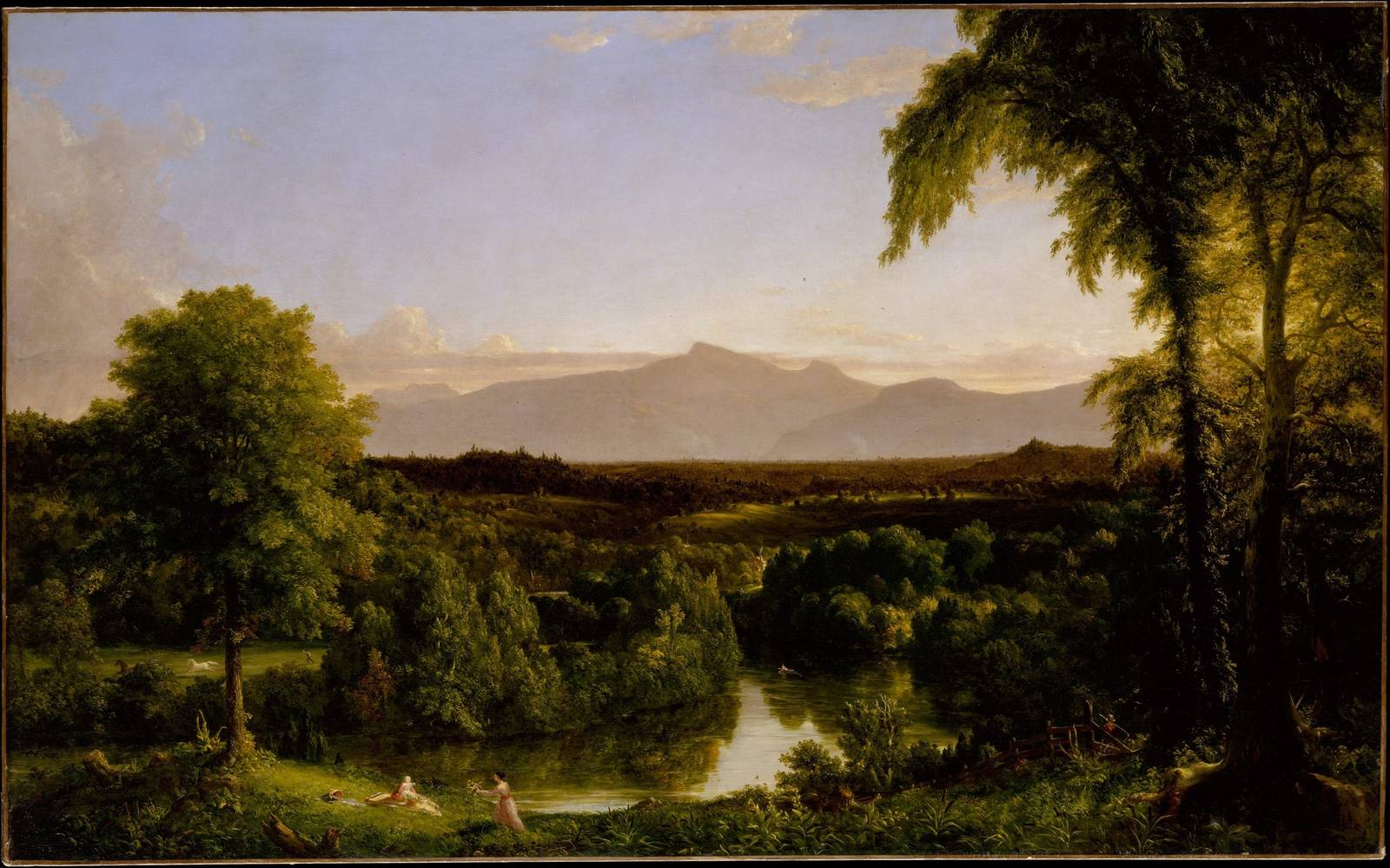
Thomas Cole, the English-born painter usually credited with founding the Hudson River School, lived in the town of Catskill, New York, and painted the creek and mountains near his home many times. View on the Catskill, Early Autumn, painted in 1836–37, shows Catskill Creek winding toward the distant blue mountains under trees just beginning to turn. It is a calm, settled picture of a cultivated valley, and the children of the merchant who commissioned it later gave it to the Metropolitan Museum of Art in his memory.
For a gathering, Cole’s The Pic-Nic of 1846, now in the Brooklyn Museum, could hardly be more fitting. A party of friends relaxes under autumn trees beside a lake, sharing food and music in golden light. It is one of the few Hudson River School paintings that puts people and their pleasures at the center, and it looks wonderful above a sideboard in a dining room. You can see more of his work in our Thomas Cole paintings collection.
The harvest in the wilderness
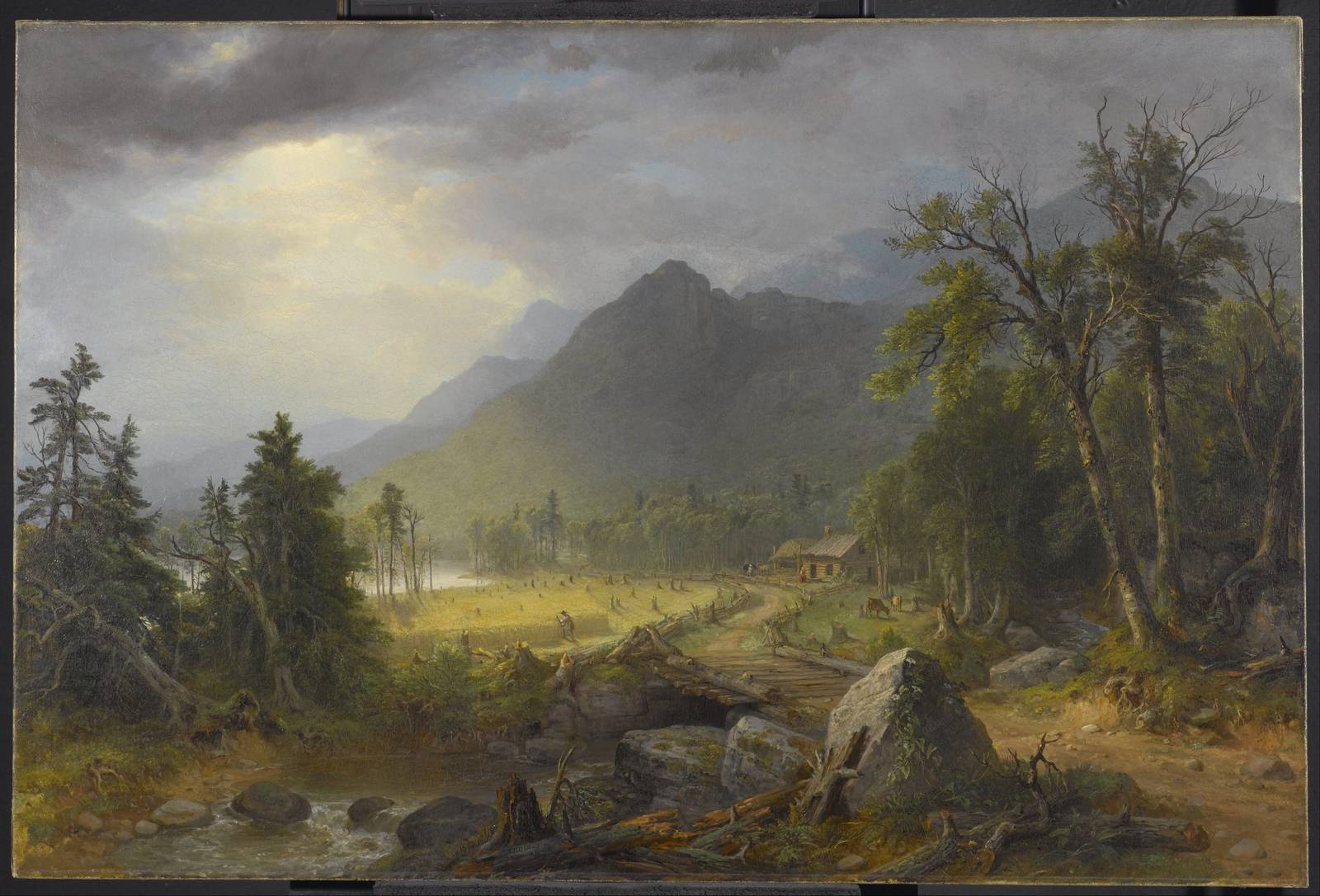
Asher B. Durand, Cole’s friend and the leading figure of the school after Cole’s death in 1848, painted The First Harvest in the Wilderness in 1855. Its subject is right there in the title: a settler’s clearing cut from the forest, with the first crop gathered in. For a Thanksgiving table, it is about as close to the meaning of the holiday as a landscape gets, a picture of hard work rewarded and a home made in a new place. It is in the Brooklyn Museum.
A similar theme runs through Jasper Francis Cropsey’s The Backwoods of America of 1858, in which a log cabin and a few cattle stand in a clearing beside a lake. Hung as a pair, the Durand and the Cropsey tell a story of settlement and harvest that suits a farmhouse kitchen or a dining room with wood furniture.
Cropsey, the painter of fall color
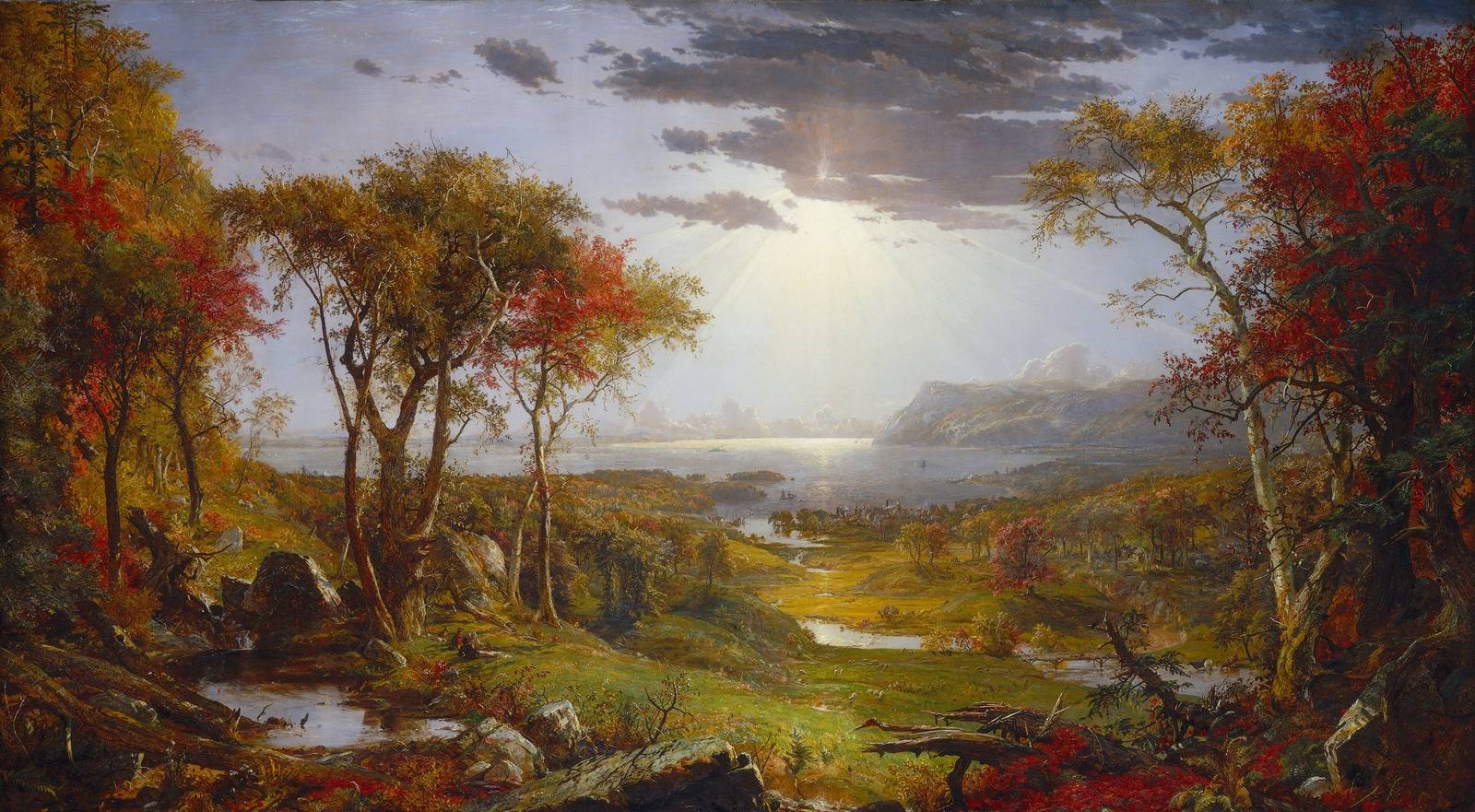
If one painter made autumn his specialty, it was Cropsey. He painted Autumn — On the Hudson River in London and finished it in 1860, a canvas nearly nine feet wide showing the Hudson Valley ablaze with red and orange foliage. It was shown in London, where some viewers reportedly found its colors hard to believe until they saw real American leaves. The painting is now at the National Gallery of Art in Washington. In print, it is a natural choice for the wall above a sofa, where a wide landscape can stretch out and fill the space.
A wide autumn landscape over the sofa warms a room before anyone lights a candle.
Golden light and quiet afternoons
Not every autumn painting is a riot of color. Sanford Robinson Gifford, one of the painters later grouped under the name Luminism, cared most about light and atmosphere. His A Gorge in the Mountains (Kauterskill Clove) of 1862, in the Metropolitan Museum of Art, looks into a Catskills ravine filled with warm, hazy autumn light, the trees reduced to glowing tones of gold and rust. Gifford’s later Autumn, a Wood Path of 1876, at the Cleveland Museum of Art, is more intimate: a simple path through the woods that suits a hallway or entry, where guests pass by on the way in.
John Frederick Kensett’s An October Day in the White Mountains of 1854, also at Cleveland, moves the scene to New Hampshire, while William Trost Richards’s October of 1863, at the National Gallery of Art, is a closely observed woodland study that rewards a long look. Thomas Moran, better known for his later paintings of Yellowstone, painted Pennsylvania in autumn early in his career; his Valley of the Catawissa in Autumn of about 1862 is at Crystal Bridges Museum of American Art.
Inness and the softer autumn
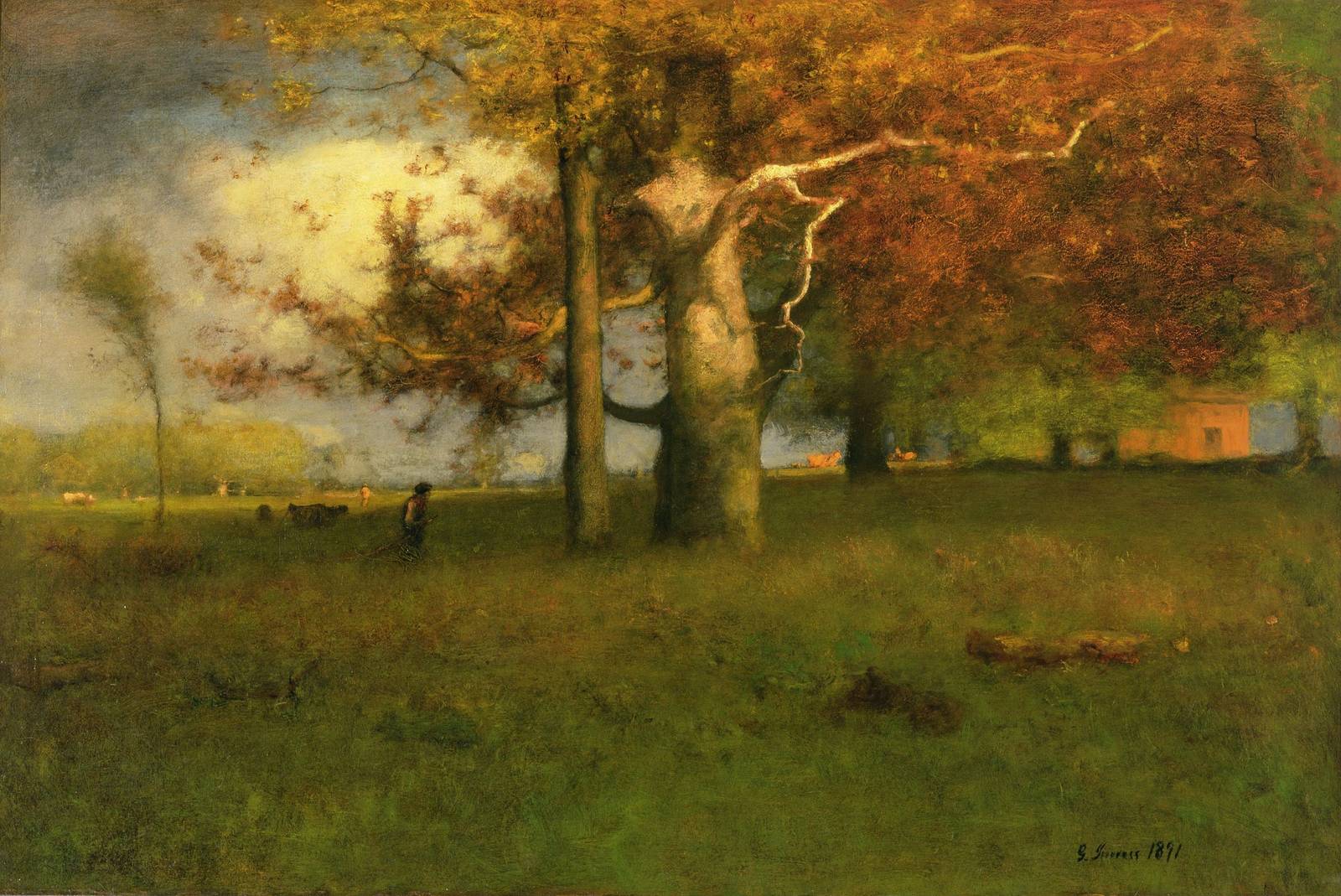
By the end of the century, taste had shifted toward a more poetic, suggestive kind of landscape. George Inness, who lived and worked in Montclair, New Jersey, in his later years, painted Early Autumn, Montclair in 1891. Its soft edges and muted color belong to the movement now called Tonalism. His Sunny Autumn Day of 1892 is warmer and brighter. Both are ideal for a room where you want calm rather than drama, such as a bedroom or a reading corner.
How to hang autumn art for the holidays
- Let the dining room lead. The table is where Thanksgiving happens, so a wide autumn landscape above the sideboard or buffet does the most work. Cole’s The Pic-Nic or Durand’s harvest scene make a fine centerpiece for the wall.
- Choose the frame for warmth. Our gilded Wood Ornament frame flatters nineteenth-century landscapes and their warm reds and golds, and it looks at home beside wood furniture. The slim Black Metallic frame gives the same paintings a crisper look in a modern room.
- Size to the furniture. Above a sideboard or sofa, aim for a picture about two-thirds of the furniture’s width. Each work comes framed in up to three sizes, Small at $195, Medium at $295 and Large at $395, printed at its true proportions. Our guide to choosing a size and frame has more detail.
Prints are made to order and ship free within the US, so if you want one on the wall for a holiday gathering, order with time to spare. Browse the full autumn landscape paintings collection, or explore the wider Hudson River School. For the season that follows, our guide to winter landscape paintings picks up where this one leaves off.