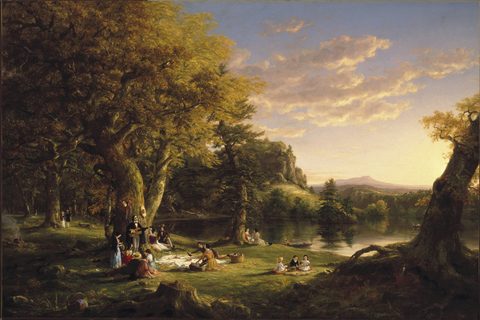
The Pic-Nic
Thomas Cole, 1846
A summer party gathers by a Hudson Valley lake under blazing autumn trees.
About this work
Thomas Cole painted A Pic-Nic Party, signed and dated "T Cole / 1846" at lower centre, on commission from the wealthy New York banker and philanthropist James Brown; he began it in the autumn of 1845. The canvas, 121.6 by 184.2 centimetres, is in the American Art collection of the Brooklyn Museum (67.205.2, Healy Purchase Fund B). The museum explains that Cole chose a picnic to show the ideal coexistence of nature and civilisation, at a time when outdoor leisure pursuits such as picnics were growing in popularity among city dwellers. It also points to an axe-cut tree stump in the foreground as a hint of time's passage and mortality within the lighthearted scene. The central figure playing a guitar is thought to be a tribute to Cole's friend, the painter Cornelius Ver Bryck, who had died two years earlier, and the other figures radiate from him; a rowboat can be seen on the water. Cole (1801–1848), born in Bolton le Moors in Lancashire, emigrated to the United States in 1818 and founded the Hudson River School. Largely self-taught, he worked after 1827 from a studio at Cedar Grove in Catskill, New York, and his paintings often framed the American landscape as a natural Eden.
Sources: Brooklyn Museum · Wikimedia Commons · Wikipedia: Thomas Cole
FAQ
Where can I buy a framed print of The Pic-Nic?
Here. The Pic-Nic is available as a framed print in three sizes: Small (20 × 13 in) for $195, Medium (24 × 16 in) for $295 and Large (36 × 24 in) for $395. Prices include the frame and US shipping; delivery takes 14–21 days, with 30-day returns.
What size works best for The Pic-Nic?
The file is 5,640 × 3,761 px, so every size is sharp: even Large (36 × 24 in) prints at 157 ppi. Choose Large (36 × 24 in) for a large wall; Small (20 × 13 in) suits a narrower space.
Is it legal to print The Pic-Nic?
Yes. The Pic-Nic is in the public domain: its copyright, if it ever had one, expired long ago. In the United States a faithful photograph of a public-domain painting does not create a new copyright (Bridgeman v. Corel, 1999), so the image can be printed and sold freely.

















