Europa
NASA / JPL-Caltech / SETI, 1998
Ice cracked like a frozen sea. Lines that run for hundreds of miles. The picture stops at the shell. Something may move under it. We can see the lock. We cannot see the room.
About this work
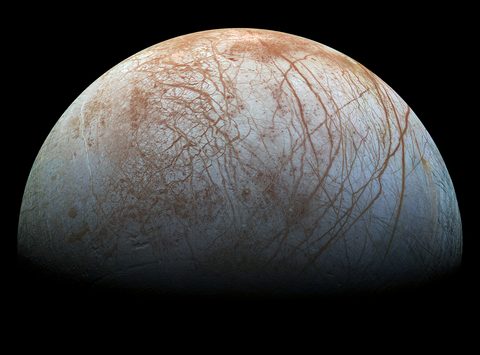
The puzzling surface of Jupiter's icy moon Europa looms large in this color view, reprocessed in 2014 from images taken by NASA's Galileo spacecraft in the late 1990s. It shows the largest portion of Europa's surface at the highest resolution of any color view from Galileo, assembled to approximate how the moon would look to the human eye.
Long, straight cracks and ridges crisscross the surface, interrupted by areas of disrupted terrain where the ice crust has broken up and refrozen into new patterns. Areas that look blue or white are relatively pure water ice, while reddish and brownish areas contain more non-ice material. The polar regions, at the left and right of the view, are noticeably bluer than the whiter equatorial areas.
The pale, fractured surface, laced with rust-colored lines, has the elegance of marble. The scan is 3680 × 2720 pixels in landscape format, good for medium prints. It suits a study, a bedroom or a classroom, and is a great gift for anyone curious about the search for life beyond Earth. Image: NASA/JPL-Caltech/SETI Institute.
Sources: Wikimedia Commons
FAQ
Where can I buy a framed print of Europa?
Here. Europa is available as a framed print in three sizes: Small (20 × 15 in) for $195, Medium (24 × 18 in) for $295 and Large (36 × 27 in) for $395. Prices include the frame and US shipping; delivery takes 14–21 days, with 30-day returns.
What size works best for Europa?
The file is 3,680 × 2,720 px. Medium (24 × 18 in) is the largest size that prints at 150 ppi or more (151 ppi), the sharpest choice for close viewing; Large (36 × 27 in) prints at 101 ppi, fine from a few feet away but softer up close.
Is it legal to print Europa?
Yes. NASA's Jet Propulsion Laboratory says images on its public websites may be used for any purpose without prior permission, provided they carry the credit given and do not imply endorsement. That credit is shown on this page, and a print does not imply endorsement by NASA or JPL.

















