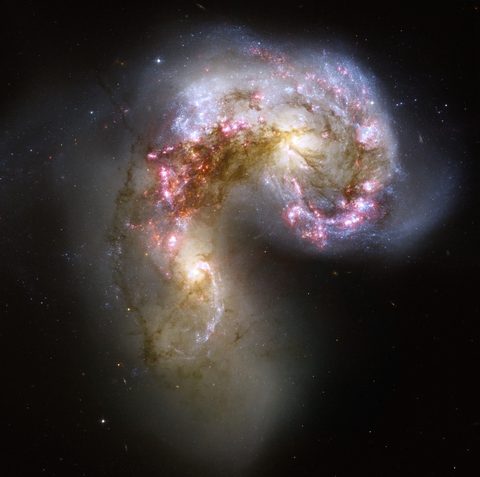
Antennae Galaxies
NASA / ESA / Hubble Heritage, 2006
Two galaxies colliding. Tails of stars thrown out like feelers. The crash is not over. New suns are being born in the wreck. The wreck is the birth.
About this work
This Hubble Space Telescope image of the Antennae galaxies, NGC 4038 and NGC 4039, was the sharpest yet of this merging pair when it was released in October 2006. The two spiral galaxies began to interact a few hundred million years ago, which makes them one of the nearest and youngest examples of colliding galaxies.
During the collision, billions of stars will form. The brightest and most compact birth regions are called super star clusters, and nearly half of the faint objects in the picture are young clusters of tens of thousands of stars. The orange blobs left and right of center are the cores of the two original galaxies, made mostly of old stars and crossed by brown filaments of dust. Brilliant blue star-forming regions are surrounded by glowing hydrogen gas, which appears pink.
The swirl of blue, pink, orange and brown makes this one of Hubble's most painterly images. The scan is 3915 × 3885 pixels, nearly square, good for medium and large prints. It suits a living room or a bedroom, and is a lovely gift for astronomy fans. Image: NASA, ESA and the Hubble Heritage Team (STScI/AURA)-ESA/Hubble Collaboration.
Sources: Wikimedia Commons
FAQ
Where can I buy a framed print of Antennae Galaxies?
Here. Antennae Galaxies is available as a framed print in three sizes: Small (20 × 20 in) for $195, Medium (24 × 24 in) for $295 and Large (36 × 36 in) for $395. Prices include the frame and US shipping; delivery takes 14–21 days, with 30-day returns.
What size works best for Antennae Galaxies?
The file is 3,915 × 3,885 px. Medium (24 × 24 in) is the largest size that prints at 150 ppi or more (162 ppi), the sharpest choice for close viewing; Large (36 × 36 in) prints at 108 ppi, fine from a few feet away but softer up close.
Is it legal to print Antennae Galaxies?
Yes. Wikimedia Commons lists this Hubble image as public domain because it was created by NASA, and NASA material is generally not subject to copyright in the United States. The credit NASA, ESA and the Hubble Heritage Team is shown on this page, and a print does not imply endorsement by NASA or ESA.

















