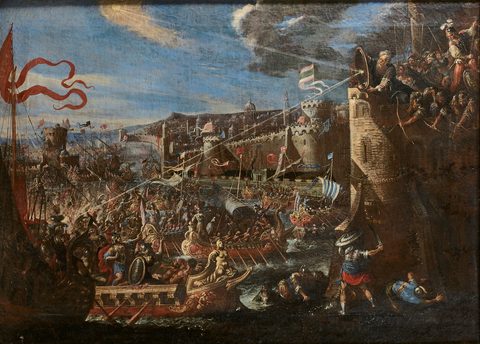
Archimedes at the Siege of Syracuse
Attributed to Scipione Compagno, 17th century
214–212 BC: Marcellus's Roman fleet attacks Syracuse while Archimedes' war machines and burning mirrors defend the walls. The city fell, and Archimedes was killed in the sack.
About this work
Roman galleys crowd the harbor and soldiers swarm the walls in this 17th-century painting of the siege of Syracuse, attributed to the Italian painter Scipione Compagno. Between 214 and 212 BC, a Roman fleet under Marcellus attacked the Greek city in Sicily, which was defended by the war machines of the mathematician Archimedes. Here, flags and banners fly above the struggle, smoke billows across the sky, and towers and battlements rise at the right.
The city eventually fell, and Archimedes was killed in the sack, by tradition while still working on a problem.
The scan is 3321 × 2383 pixels, suited to small and medium prints. It makes a fine gift for an engineer, a mathematician or anyone who loves the story of Archimedes.
Sources: Wikimedia Commons
FAQ
Where can I buy a framed print of Archimedes at the Siege of Syracuse?
Here. Archimedes at the Siege of Syracuse is available as a framed print in two sizes: Small (20 × 14 in) for $195 and Medium (24 × 17 in) for $295. Prices include the frame and US shipping; delivery takes 14–21 days, with 30-day returns.
What size works best for Archimedes at the Siege of Syracuse?
The file is 3,321 × 2,383 px. Small (20 × 14 in) is the largest size that prints at 150 ppi or more (166 ppi), the sharpest choice for close viewing; Medium (24 × 17 in) prints at 138 ppi, fine from a few feet away but softer up close.
Is it legal to print Archimedes at the Siege of Syracuse?
Yes. Archimedes at the Siege of Syracuse is in the public domain: its copyright, if it ever had one, expired long ago. In the United States a faithful photograph of a public-domain painting does not create a new copyright (Bridgeman v. Corel, 1999), so the image can be printed and sold freely.

















