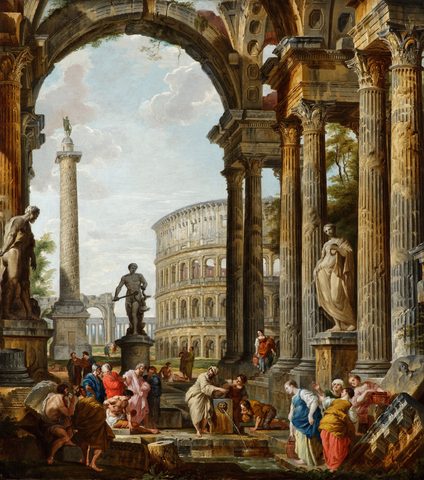
The Massacres of the Triumvirate
Antoine Caron (attributed), 1560s
The proscriptions of 43 BC: Octavian, Antony and Lepidus have their enemies hunted down and killed across a fantastical Rome of temples and obelisks.
About this work
Soldiers hunt down and kill their victims across a fantastical Rome of temples, arches, columns and obelisks in this painting of the massacres of the Second Triumvirate. In 43 BC, Octavian, Mark Antony and Lepidus drew up lists of their enemies, and those named were hunted down and killed. The painter turns the city into a stage set, with a tall column and a round amphitheater among the buildings and small figures struggling in the streets and squares.
The subject is best known from Antoine Caron's painting of 1566 in the Louvre. This version is attributed to Caron in our catalog, but its Wikimedia Commons record lists it as by an unknown artist and dates it to the 1660s, so its authorship and date are uncertain.
The scan is 3955 × 4473 pixels. The detailed architecture rewards close looking, and the print suits a library or a study. It makes an unusual gift for a collector of history paintings.
Sources: Wikimedia Commons
FAQ
Where can I buy a framed print of The Massacres of the Triumvirate?
Here. The Massacres of the Triumvirate is available as a framed print in three sizes: Small (18 × 20 in) for $195, Medium (21 × 24 in) for $295 and Large (32 × 36 in) for $395. Prices include the frame and US shipping; delivery takes 14–21 days, with 30-day returns.
What size works best for The Massacres of the Triumvirate?
The file is 3,955 × 4,473 px. Medium (21 × 24 in) is the largest size that prints at 150 ppi or more (186 ppi), the sharpest choice for close viewing; Large (32 × 36 in) prints at 124 ppi, fine from a few feet away but softer up close.
Is it legal to print The Massacres of the Triumvirate?
Yes. The Massacres of the Triumvirate is in the public domain: its copyright, if it ever had one, expired long ago. In the United States a faithful photograph of a public-domain painting does not create a new copyright (Bridgeman v. Corel, 1999), so the image can be printed and sold freely.

















