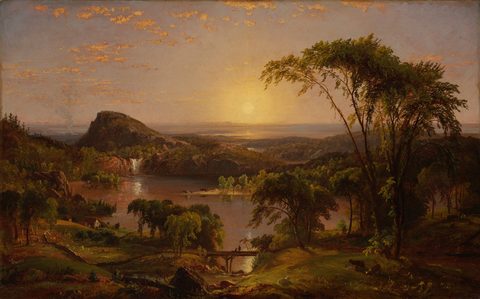
Summer, Lake Ontario
Jasper Francis Cropsey, 1857
The sun is on the lake. A thin fall drops off the near cliff.
About this work
Summer, Lake Ontario is an oil on canvas of 15 by 24 inches painted by Jasper Francis Cropsey in 1857. It belongs to the Indianapolis Museum of Art at Newfields (71.13), the gift of the Friends of the Museum in 1971. The museum records that it was painted in England: Cropsey had moved to London in 1856, and the picture was with Gambart and Co. in London in 1857 before passing through a dealer in St. Louis and collectors in Indiana. A low sun glows over a calm bay, a rocky headland rises at the left, tidy farm buildings sit among the trees, and a great tree arches over the shore at the right. The museum's label describes a romantic image of people and nature in harmony and notes that the canvas is an idealized composition combining motifs from several places rather than a single view. Lake Ontario is the last and smallest by area of the five Great Lakes, bounded by the Canadian province of Ontario to the north and west and by New York State to the south and east, with the border running through its centre. Cropsey, born on Staten Island in 1823, lived in London for seven years and sent his pictures to the Royal Academy before returning to New York.
Sources: Newfields · Wikipedia: Lake Ontario · Wikipedia: Jasper Francis Cropsey
FAQ
Where can I buy a framed print of Summer, Lake Ontario?
Here. Summer, Lake Ontario is available as a framed print in three sizes: Small (20 × 12 in) for $195, Medium (24 × 15 in) for $295 and Large (36 × 22 in) for $395. Prices include the frame and US shipping; delivery takes 14–21 days, with 30-day returns.
What size works best for Summer, Lake Ontario?
The file is 6,522 × 4,062 px, so every size is sharp: even Large (36 × 22 in) prints at 181 ppi. Choose Large (36 × 22 in) for a large wall; Small (20 × 12 in) suits a narrower space.
Is it legal to print Summer, Lake Ontario?
Yes. Summer, Lake Ontario is in the public domain: its copyright, if it ever had one, expired long ago. In the United States a faithful photograph of a public-domain painting does not create a new copyright (Bridgeman v. Corel, 1999), so the image can be printed and sold freely.
















