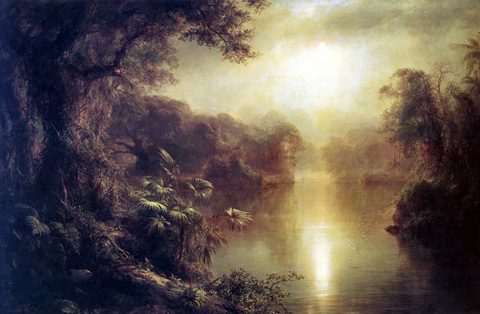
Morning in the Tropics
Frederic Edwin Church, 1877
Green so thick it drinks the light. A quiet river. Morning that never quite finishes arriving.
About this work
Morning in the Tropics, also known as El Rio de Luz (The River of Light), is an 1877 oil painting by Frederic Edwin Church and his last large painting of South America. A quiet river winds into a dense, misty jungle, its banks thick with trees, vines and ferns, while soft morning light seeps through the haze; a small canoe and a few birds are almost lost in the scene. The painting is in the National Gallery of Art in Washington. Like his earlier South American pictures, The Andes of Ecuador (1855) and The Heart of the Andes (1859), it is a composite made from sketches and drawings Church had made on his travels in Colombia and Ecuador some twenty years before. Unlike those panoramas, full of sharp detail and grand mountains, El Rio de Luz is hushed and atmospheric, and its veiled light has been compared to the work of the Luminists. Church, born in Hartford, Connecticut, in 1826, was the leading figure of the second generation of the Hudson River School. Rheumatism increasingly limited his painting after the 1870s, and he died in 1900.
Sources: Wikipedia: El Rio de Luz · Wikipedia: Frederic Edwin Church
FAQ
Where can I buy a framed print of Morning in the Tropics?
Here. Morning in the Tropics is available as a framed print in three sizes: Small (20 × 13 in) for $195, Medium (24 × 16 in) for $295 and Large (36 × 24 in) for $395. Prices include the frame and US shipping; delivery takes 14–21 days, with 30-day returns.
What size works best for Morning in the Tropics?
The file is 3,967 × 2,595 px. Medium (24 × 16 in) is the largest size that prints at 150 ppi or more (162 ppi), the sharpest choice for close viewing; Large (36 × 24 in) prints at 108 ppi, fine from a few feet away but softer up close.
Is it legal to print Morning in the Tropics?
Yes. El Rio de Luz is in the public domain: Frederic Edwin Church died in 1900, so its copyright expired long ago. In the United States a faithful photograph of a public-domain painting does not create a new copyright (Bridgeman v. Corel, 1999), so the image can be printed and sold freely.
















