Earthrise
NASA / Bill Anders, 1968
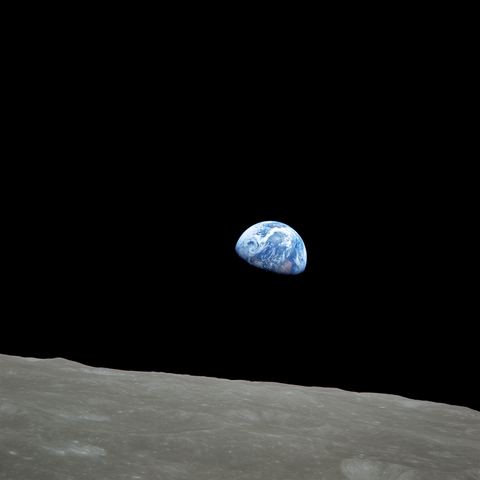
They went out to look at a dead rock. Then the Earth came up over the edge, blue and small and terribly alive. Christmas Eve. The Moon was only the curb.
About this work
Earthrise was taken by astronaut William Anders on December 24, 1968, during Apollo 8, the first crewed voyage to orbit the Moon. NASA's caption for frame AS08-14-2383 places the rising Earth about five degrees above the lunar horizon, which lies some 570 kilometres from the spacecraft; on Earth, 240,000 miles away, the sunset terminator crosses Africa, and North and South America are under cloud. The crew took the picture at around 10:40 a.m. Houston time. The mission audio records the moment: Anders called out the Earth coming up and asked for a roll of colour film, and several photographs were taken. For years it was said that commander Frank Borman took the picture, but Anders took all three frames. He used a modified Hasselblad 500 EL with a 70 mm magazine of custom Ektachrome film. The nature photographer Galen Rowell called Earthrise "the most influential environmental photograph ever taken".
Sources: Wikipedia · NASA Image and Video Library
Print facts
- Native resolution
- 5,584 × 5,584 px
- Sharp at 150 ppi up to
- 37 × 37 in
- Sizes
- Small (20 × 20 in) · $100 · 279 ppi
Medium (24 × 24 in) · $150 · 233 ppi
Large (36 × 36 in) · $300 · 155 ppi - Price includes
- Frame and US shipping · 14–21 days · 30-day returns
FAQ
Where can I buy a framed print of Earthrise?
Here. Earthrise is available as a framed print in three sizes: Small (20 × 20 in) for $100, Medium (24 × 24 in) for $150 and Large (36 × 36 in) for $300. Prices include the frame and US shipping; delivery takes 14–21 days, with 30-day returns.
What size works best for Earthrise?
The file is 5,584 × 5,584 px, so every size is sharp: even Large (36 × 36 in) prints at 155 ppi. Choose Large (36 × 36 in) for a large wall; Small (20 × 20 in) suits a narrower space.
Is it legal to print Earthrise?
Yes. NASA made this photograph, and NASA material is not protected by copyright in the United States unless noted, so it can be printed and sold. A print does not imply NASA endorsement, and NASA's logos and insignia are not covered.