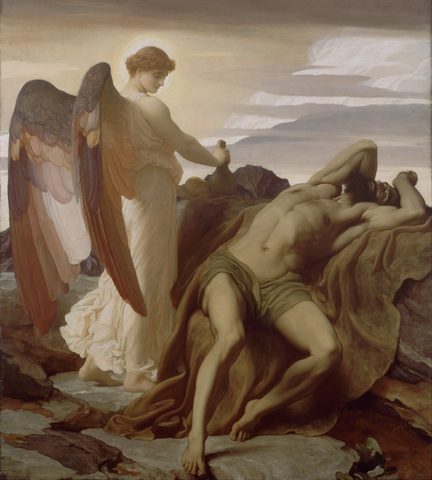
Elijah in the Wilderness
Frederic Leighton, 1878
A prophet in the desert, fed by almost nothing, waiting on a god who takes his time. Hunger as glory. The wilderness wins the color. Elijah wins the stare.
About this work
The prophet Elijah lies stretched out asleep on a rock in the wilderness in this painting by Frederic Leighton, made in 1877–78 and now in the Walker Art Gallery in Liverpool. His body is thrown back across a cloak, and behind him a tall angel with great pale wings bends toward him, bringing food and drink. In the Bible, Elijah fled into the desert and lay down to die, and an angel woke him and fed him so that he could continue his journey.
Leighton was a British Victorian painter, draughtsman and sculptor who painted historical, biblical and classical subjects in an academic style. He became Sir Frederic in 1878 and was later raised to the peerage as Baron Leighton. The muscular figure and the soft, warm desert tones show his love of the human body and of classical art.
The scan is 3202 × 3555 pixels, suited to medium prints. It makes a meaningful gift for a lover of Victorian art or of biblical subjects.
Sources: Wikimedia Commons · Wikipedia: Frederic Leighton
FAQ
Where can I buy a framed print of Elijah in the Wilderness?
Here. Elijah in the Wilderness is available as a framed print in two sizes: Small (18 × 20 in) for $195 and Medium (22 × 24 in) for $295. Prices include the frame and US shipping; delivery takes 14–21 days, with 30-day returns.
What size works best for Elijah in the Wilderness?
The file is 3,202 × 3,555 px. Small (18 × 20 in) is the largest size that prints at 150 ppi or more (178 ppi), the sharpest choice for close viewing; Medium (22 × 24 in) prints at 146 ppi, fine from a few feet away but softer up close.
Is it legal to print Elijah in the Wilderness?
Yes. Elijah in the Wilderness is in the public domain: its copyright, if it ever had one, expired long ago. In the United States a faithful photograph of a public-domain painting does not create a new copyright (Bridgeman v. Corel, 1999), so the image can be printed and sold freely.

















