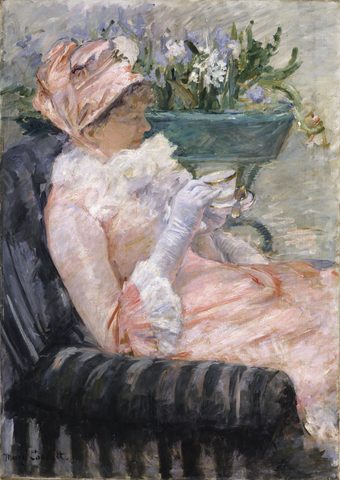
The Cup of Tea
Mary Cassatt, 1880
Tea raised. Gloves still on. Afternoon held.
About this work
The Cup of Tea is an oil on canvas of 92.4 by 65.4 centimetres painted by Mary Cassatt in Paris in about 1880 to 1881. It belongs to the Metropolitan Museum of Art in New York (22.16.17), from the collection of James Stillman, the gift of Dr. Ernest G. Stillman in 1922. Stillman, a retired American banker and a friend of the Cassatt family, bought the painting later. It shows her sister Lydia Cassatt, dressed in pink, sitting in a striped armchair and raising a cup at the ritual of afternoon tea, her gloves still on, beside a pot of flowers. Scholars have called it a quintessentially Impressionist painting for its vivid colour, loose brushwork and unusual viewpoint. It is unclear when it was first shown: Edgar Degas listed it among works for the Impressionist exhibition of 1879, but it is missing from the catalogue, and it was certainly included in the sixth Impressionist exhibition of 1881, where it drew both praise and criticism. Cassatt was born in Allegheny, Pennsylvania, now part of Pittsburgh, in 1844, and studied at the Pennsylvania Academy of the Fine Arts before settling in France. There she befriended Degas and exhibited with the Impressionists. She became known for images of women's social and private lives, above all of mothers and children.
Sources: The Metropolitan Museum of Art · Wikipedia: The Cup of Tea · Wikipedia: Mary Cassatt
FAQ
Where can I buy a framed print of The Cup of Tea?
Here. The Cup of Tea is available as a framed print in three sizes: Small (14 × 20 in) for $195, Medium (17 × 24 in) for $295 and Large (26 × 36 in) for $395. Prices include the frame and US shipping; delivery takes 14–21 days, with 30-day returns.
What size works best for The Cup of Tea?
The file is 4,142 × 5,844 px, so every size is sharp: even Large (26 × 36 in) prints at 159 ppi. Choose Large (26 × 36 in) for a large wall; Small (14 × 20 in) suits a narrower space.
Is it legal to print The Cup of Tea?
Yes. The Cup of Tea is in the public domain: its copyright, if it ever had one, expired long ago. In the United States a faithful photograph of a public-domain painting does not create a new copyright (Bridgeman v. Corel, 1999), so the image can be printed and sold freely.
















