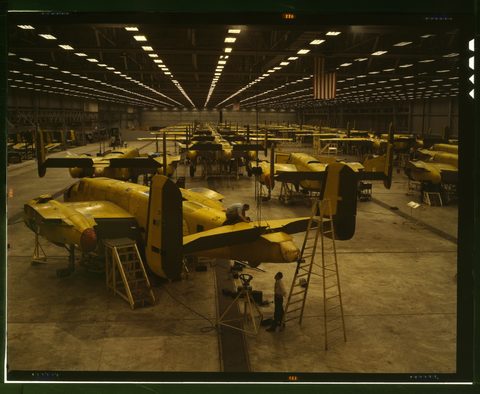
B-25 line
Alfred T. Palmer, 1942
Assembling North American B-25 Mitchell bombers at Kansas City, Kansas, in 1942, photographed by Alfred T. Palmer. Reproduced from the original 4×5 color transparency in the Library of Congress.
About this work
Workers assemble North American B-25 Mitchell bombers at the company's plant in Kansas City, Kansas, in October 1942. The photograph was made by Alfred T. Palmer for the Office of War Information and has been digitized by the Library of Congress from the original 4×5 inch colour transparency (fsac.1a35291), which is why its colours are so fresh. Palmer, born in 1906, is best known for the vivid Kodachrome pictures of American war production he took for the OWI in 1942 and 1943, made to show the nation's factories at full stretch. The B-25 was a twin-engined medium bomber named after Brigadier General Billy Mitchell, an early champion of American air power. It was built in large numbers at North American Aviation's plants in Inglewood, California, and at the Fairfax airfield plant in Kansas City, which opened in 1941 and turned out thousands of the type during the war. B-25s served in every theatre of the war. The best-known mission was the Doolittle Raid of April 1942, when sixteen of them took off from the aircraft carrier USS Hornet to bomb Tokyo.
Sources: Wikipedia: Alfred T. Palmer · Wikimedia Commons · Wikipedia: North American B-25 Mitchell
FAQ
Where can I buy a framed print of B-25 line?
Here. B-25 line is available as a framed print in three sizes: Small (20 × 16 in) for $195, Medium (24 × 20 in) for $295 and Large (36 × 30 in) for $395. Prices include the frame and US shipping; delivery takes 14–21 days, with 30-day returns.
What size works best for B-25 line?
The file is 7,758 × 6,362 px, so every size is sharp: even Large (36 × 30 in) prints at 212 ppi. Choose Large (36 × 30 in) for a large wall; Small (20 × 16 in) suits a narrower space.
Is it legal to print B-25 line?
Yes. Alfred T. Palmer made this photograph for the U.S. Office of War Information, a federal agency, and works of the U.S. federal government are in the public domain, so it can be printed and sold. The print is made from the Library of Congress scan.
















