Caen
British Army, 1944
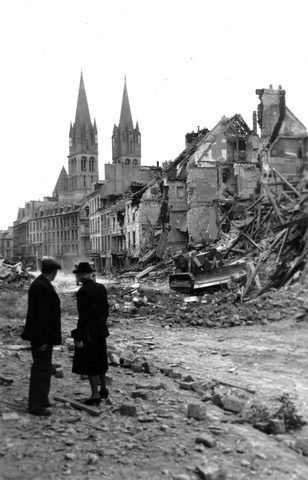
Two residents watch a Canadian bulldozer clear the ruins of houses on rue de Bayeux in Caen in July 1944, with the towers of the Abbaye aux Hommes behind. From the Imperial War Museums.
About this work
In this photograph, taken on July 10, 1944, two residents of Caen watch a Canadian bulldozer clear the ruins of destroyed houses on the rue de Bayeux. In the background the two towers of the Abbaye aux Hommes still stand. The photographer is not named. The image comes from the photo archive of the Conseil Régional de Basse-Normandie, credited to the National Archives of Canada, which describes it as public domain. The picture was taken the day after Operation Charnwood. That Anglo-Canadian offensive of July 8 and 9, 1944, took the part of Caen north of the river Orne during the Battle for Caen, which lasted from June to August 1944 and pitted the British Second Army against German Panzergruppe West. Much of the city was destroyed, mostly by Allied bombing, and many French civilians were killed. Little of pre-war Caen remained after the battle. The Abbaye aux Hommes, or Abbey of Saint-Étienne, was founded in 1063 by William the Conqueror and is one of the most important Romanesque buildings in Normandy.
Sources: Wikimedia Commons · Wikipedia: Battle for Caen · Wikipedia: Operation Charnwood · Wikipedia: Abbey of Saint-Étienne, Caen
FAQ
Where can I buy a framed print of Caen?
Here. Caen is available as a framed print in three sizes: Small (13 × 20 in) for $195, Medium (15 × 24 in) for $295 and Large (23 × 36 in) for $395. Prices include the frame and US shipping; delivery takes 14–21 days, with 30-day returns.
What size works best for Caen?
The file is 2,480 × 3,867 px. Medium (15 × 24 in) is the largest size that prints at 150 ppi or more (161 ppi), the sharpest choice for close viewing; Large (23 × 36 in) prints at 107 ppi, fine from a few feet away but softer up close.
Is it legal to print Caen?
Yes. Wikimedia Commons lists this 1944 photograph as public domain: it comes from the National Archives of Canada, and Canadian Crown copyright in photographs of that age has expired. The regional photo archive that published it describes it as free of rights, and the print is made from that public-domain copy.

















